

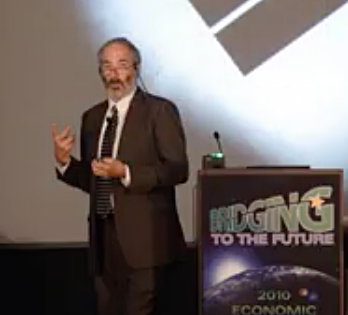
Bill Hampel
PLANO, Texas–There will be no economic recession in the near term, according to CUNA’s former chief economist, Bill Hampel.
Speaking to Catalyst Corporate’s 40th annual Economic Forum here, Hampel noted that the economy is well into its ninth year of recovery—a fact that has brought with it warnings that the recovery has nearly run its course, and that a recession may be just around the corner. Not so, Hampel said.
Hampel said triggers of a recession typically involve a hot economy reaching full employment and stirring inflationary pressures. In its efforts to fight the effects of inflation, the Federal Reserve usually raises interest rates to cool the economy, which can lead to a recession, he observed.
Hampel told the Forum that while the economy is presently hovering near full employment, inflationary pressures are only light to moderate. And with no signs of alarming inflation, the Fed does not have to hurriedly raise interest rates as a counter measure, Hampel said. Instead, the Fed has some space to raise interest rates cautiously to a higher point, so that it can lower them again, if necessary, to fight recessionary effects sometime in the future.
To predict recessions, Hampel explained economists look to the yield curve as a solid indicator.
“You can’t have a recession without a preceding inverted yield curve,” Hampel said. Usually three to six months after the Fed Funds rate tops the 10-Year Treasury Yield—creating the inverted yield curve—a recession occurs. Like clockwork, it happened in 1991, 2002 and in 2007, he said.
However, when looking at a freshly produced economic analysis, Hampel said the Fed Funds Rate remains well below the 10-Year Treasuries, “and if our forecast is correct, we still won’t have an inverted yield curve. And so, we are good for a couple years.”
In the meantime, Hampel is predicting that strong lending will continue for credit unions.
Although some economists think car sales will decline, Hampel is also bullish that there is some built up demand resulting from a long slow recovery that will lead to “strong car sales,” which in turn will continue to stoke loan growth.
Loan growth has averaged more than 9% over the past five years—and touching 10.6% in 2016. Hampel expects above 10% loan growth this year, though possibly slipping slightly to 9.5% in 2018. “Still strong,” he said.
Consumer confidence is quite high right now. “People aren’t worried about finding jobs,” he added.
Hampel noted that the household debt/payment ratio—the proportion of household income that is spoken for at the beginning of the month—is the lowest in 30 years. “