

By Ray Birch
ALEXANDRIA, Va.— The NCUA board on Thursday approved its final 2026–2027 budgets, trimming millions of dollars from earlier proposals while also confirming that federal credit unions will pay less in operating fees in 2026.
The agency reduced the 2026 operating budget by $3.6 million from the staff draft and lowered the recommended 2027 operating budget by $9 million, and separately said it will collect less from federal credit unions next year by applying previously unspent operating fees to the 2026 assessment.
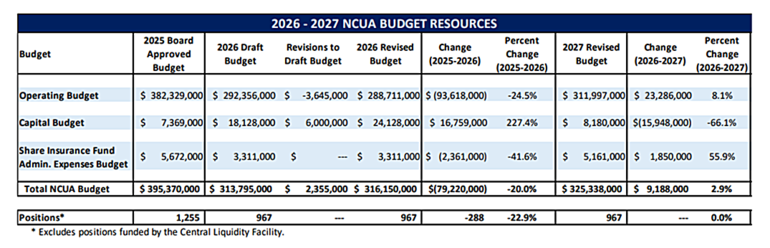
The final 2026–2027 budgets reflect several adjustments from the draft proposals. NCUA staff stated Thursday that taken together, those changes result in the combined 2026 budget declining 20% from 2025 levels, while the combined 2027 budget increases 2.9% from the final 2026 total.
Compared with the draft budgets, the final changes include:
- The 2026 operating budget decreases by $3.6 million
- The 2027 operating budget decreases by $9.0 million
- The 2026 capital budget increases by $6.0 million
- The 2027 capital budget decreases by $10.3 million
- The 2026 and 2027 Share Insurance Fund administrative budgets remain unchanged
A key takeaway for federal credit unions is that the NCUA will collect less from them next year.
For the 2026 operating fee, NCUA will apply previously collected but unspent operating fees paid by federal credit unions in prior years. By applying this unspent cash balance to the operating fee calculation, the agency will reduce by $1 million the total amount it collects from federal credit unions in 2026, staff explained Thursday.
Under the approved operating fee methodology, federal credit unions with assets of $2.16 million or less will not be assessed an operating fee in 2026. For FCUs with assets above $2.16 million, the NCUA uses a three-tiered assessment scale to calculate operating fees. For assets up to $2.54 billion, the operating fee rate will decline from $188.71 per $1 million of assets in 2025 to $142.20 per $1 million in 2026—a reduction of approximately 24.65%.
Federal credit unions with assets between $2.54 billion and $7.68 billion will be assessed $41.44 per $1 million of assets within that range. Assets above $7.68 billion will be assessed at $13.84 per $1 million. Both of these rates also represent reductions of approximately 24.65% from comparable 2025 levels, the agency said.
To illustrate the impact, a $10-billion credit union would pay slightly more than $200,000 less in operating fees than it would have absent the budget reduction, staff said. For a $100 million credit union, the difference is also meaningful. Under the revised 2026 budget, the operating fee would be approximately $14,000. Had the NCUA continued with last year’s projected budget, that credit union would have faced a bill of about $19,135. As a result, the credit union will save roughly $5,000 under the streamlined budget, the agency said.
Kyle Hauptman
Santa—Not Grinch
NCUA Chairman Kyle Hauptman said he enjoys giving back to credit unions, particularly when the opportunity comes during the holiday season.
“It’s always enjoyable when you get to be Santa and not the Grinch,” Hauptman said, joking that if he were not nearing the end of his NCUA term and looking for employment elsewhere in Washington, he would have worn a Santa hat to Thursday’s meeting.
Hauptman also touched on the NCUA’s newly launched Deregulation Project, emphasizing strongly that it is designed first and foremost to ease the regulatory burden on small credit unions.
Announced last week, the long-term initiative aims to systematically review and revise NCUA regulations to ensure they are squarely aligned with the agency’s core mission and statutory responsibilities. Four Notices of Proposed Rulemaking are currently open for public comment in the Federal Register, and the agency is encouraging stakeholders to weigh in.
Hauptman described the effort as a form of regulatory “spring-cleaning,” in which the agency is taking a holistic look at its rules, guidance, and directives to determine whether each one is still necessary.
“This is about smaller credit unions,” he said. “It’s about making the job of running a small credit union less burdensome and increasing the chance that a small credit union can not only survive, but thrive for decades to come.”
Hauptman said the project responds directly to longstanding concerns from small-credit-union executives who say they spend too much time complying with regulatory requirements and not enough time serving members.
“The credit union motto is ‘people helping people,’ not doing compliance work because of redundant or obsolete commands from their regulator,” Hauptman said. “I believe we’re right-sizing that burden. The only people who think compliance is easy are the ones who don’t have to do it.”
Looking ahead, Hauptman said NCUA will also undergo a reorganization in 2026, as the agency works to implement a revised mission and regulatory framework. While details of the new structure are still being finalized, he said the goal is a sharper focus on safety, soundness, and system resilience—while further reducing unnecessary compliance burdens.
“That mission has the additional benefit of lifting regulatory weight so credit unions can do what they do best: serve their members,” he said, adding that more details on the agency’s new mission and strategic plan will be released early next year.
Auto Lending Concerns
Hauptman also flagged auto lending as a growing risk area across the broader financial system. While credit unions continue to outperform the industry overall, he noted that nationwide auto loan delinquencies have now risen above levels seen during the financial crisis.
He attributed the trend to sharply higher vehicle prices and interest rates, which have pushed monthly payments higher—despite the absence of widespread job losses so far.
“Fifteen years ago, the scary thing was home equity and mortgages,” Hauptman said. “If I had to pick one today, it would be auto loans.”
Auto lending represents roughly a third of credit union assets, while mortgages account for about half, he noted—making the sector’s exposure to consumer credit trends particularly significant.
With Thursday’s meeting being the final of 2025, Hauptman recognized the agency is saying farewell to many staff members who participated in the Deferred Resignation Program or are moving into retirement.
“We appreciate their commitment to public service and recognize their contributions to the agency,” he said. "
The board Thursday also provided a quarterly update on the Share Insurance Fund.
The SIF in Q3 reported $100.4 million in net income during the third quarter of 2025. Net income increased by $18.4 million over the second quarter and increased by $28.2 million as compared to the third quarter of 2024. The increase in net income for Q3 was due to a lower provision for insurance losses and higher investment income, NCUA stated.
The funds total assets increased to 24 billion. The equity ratio was 1.28% and the projected equity ratio for December 31 is 1.30%