

WASHINGTON – Treasury has released a report on managing AI that cites opportunities and challenges the technology presents to the security and resiliency of the financial services sector.
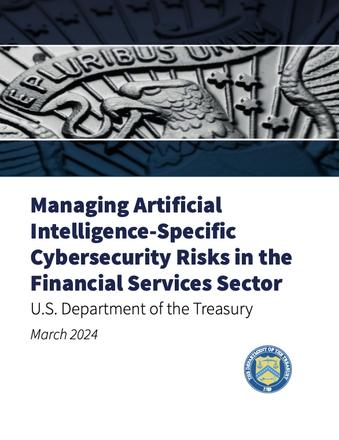
Titled Managing Artificial Intelligence-Specific Cybersecurity Risks in the Financial Services Sector, the report was written at the direction of Presidential Executive Order 14110 on the Safe, Secure, and Trustworthy Development and Use of Artificial Intelligence.
Treasury said its Office of Cybersecurity and Critical Infrastructure Protection (OCCIP) led the development of the report. OCCIP executes the Treasury Department’s Sector Risk Management Agency responsibilities for the financial services sector.
In the report, Treasury identifies significant opportunities and challenges that AI presents to the security and resiliency of the financial services sector.
The Next Steps
The report outlines a series of next steps to address immediate AI-related operational risk, cybersecurity, and fraud challenges:
- Addressing the Growing Capability Gap. “There is a widening gap between large and small financial institutions when it comes to in-house AI systems. Large institutions are developing their own AI systems, while smaller institutions may be unable to do so because they lack the internal data resources required to train large models,” the report states “Additionally, financial institutions that have already migrated to the cloud may have an advantage when it comes to leveraging AI systems in a safe and secure manner.”
- Narrowing the Fraud Data Divide. “As more firms deploy AI, a gap exists in the data available to financial institutions for training models. This gap is significant in the area of fraud prevention, where there is insufficient data sharing among firms,” the report states “As financial institutions work with their internal data to develop these models, large institutions hold a significant advantage because they have far more historical data. Smaller institutions generally lack sufficient internal data and expertise to build their own anti-fraud AI models.”
- Regulatory Coordination. “Financial institutions and regulators are collaborating on how best to resolve oversight concerns together in a rapidly changing AI environment. However, there are concerns about regulatory fragmentation, as different financial-sector regulators at the state and federal levels, and internationally, consider regulations for AI,” the report states.
- Expanding the NIST AI Risk Management Framework. “The National Institute of Standards and Technology (NIST) AI Risk Management Framework could be expanded and tailored to include more applicable content on AI governance and risk management related to the financial services sector,” the report states.
- Best Practices for Data Supply Chain Mapping and “Nutrition Labels.” “Rapid advancements in generative AI have exposed the importance of carefully monitoring data supply chains to ensure that models are using accurate and reliable data, and that privacy and safety are considered. In addition, financial institutions should know where their data is and how it is being used,” the report states. “The financial sector would benefit from the development of best practices for data supply chain mapping.
“Additionally, the sector would benefit from a standardized description, similar to the food ‘nutrition label,’ for vendor-provided AI systems and data providers. These ‘nutrition labels’ would clearly identify what data was used to train the model, where the data originated, and how any data submitted to the model is being used,” the report adds.
- Explainability for Black Box AI Solutions. “Explainability of advanced machine learning models, particularly generative AI, continues to be a challenge for many financial institutions,” the report states. “The sector would benefit from additional research and development on explainability solutions for black-box systems like generative AI, considering the data used to train the models and the outputs and robust testing and auditing of these models. In the absence of these solutions, the financial sector should adopt best practices for using generative AI systems that lack explainability.”
- Gaps in Human Capital. “The rapid pace of AI development has exposed a substantial AI workforce talent gap for those skilled in both creating and maintaining AI models and AI users. A set of best practices for less-skilled practitioners on how to use AI systems safely would help manage this talent gap. In addition, a technical competency gap exists in teams managing AI risks, such as in legal and compliance fields. Role-specific AI training for employees outside of information technology can help educate these critical teams,” the report states.
- A Need for a Common AI Lexicon. “There is a lack of consistency across the sector in defining what ‘artificial intelligence’ is. Financial institutions, regulators, and consumers would all benefit greatly from a common AI-specific lexicon,” the report states.
- Untangling Digital Identity Solutions. “Robust digital identity solutions can help financial institutions combat fraud and strengthen cybersecurity. However, these solutions differ in their technology, governance, and security, and offer varying levels of assurance. An emerging set of international, industry, and national digital identity technical standards is underway,” the report states.
- International Coordination. “The path forward for regulation of AI in financial services remains an open question internationally. Treasury will continue to engage with foreign counterparts on the risks and benefits of AI in financial services,” the report states.
Now With Free Shipping! The CUToday.info Daily News Email Keeps Getting Better!
The biggest, best and freshest news reporting in credit unions remains free, and now has an added bonus---free shipping to your email address! That’s right. Each morning CUToday.info delivers its daily Fresh Today news update offering the latest headlines and breaking news right to your email, with the easy-to-read headlines format allowing you to click on the stories that interest you most in order to learn more. So stop paying those bank-fee-like subscription prices from other so-called “news” publications!
If you haven’t yet signed up for the new email solution on which CUToday.info has partnered with ResponseGenius, you can do so here. Signing up requires less than one minute of your time—and it’s free!
Please note that after signing up you may need to go to your Spam/Junk folder and mark the morning headlines email as safe. CUToday.info does not provide its list of readers and emails to outside parties, and we will not be contacting you to sell you an extended warranty or sending you any links so you may cash in on an inheritance you didn’t know was coming.
And did we mention it’s free?