LARKSPUR, Calif.–Financial institutions can no longer count on higher interest rates alone to attract term deposits during times of economic slowdown, which will require changes in the pricing models of deposits and liquidity management, according to a new study.
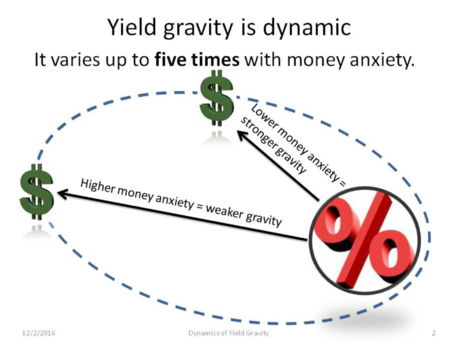
The study, “Dynamics of Yield Gravity” co-authored by Dr. Dan Geller and Professor Nahum Biger, suggests that the main factor impacting the ability of yield to attract balances (gravitational pull) is the level of money anxiety of consumers. When money anxiety is lower, the gravitational pull of yield is greater, which is why the “orbiting” deposits balances are closer to the magnetic field of yield, according to the authors. Conversely, when money anxiety is higher, the gravitational pull of yield is weaker and the “orbiting” deposit balances are farther away from the magnetic field of yield, the study says.
The Dynamics of Yield Gravity study has been validated by a double-blind peer review of two international organizations of economics and finance research; the International Conference on Business and Economic Development, and the International Conference on Economics, Finance and Management Outlooks, the authors stated.
Dr. Dan Geller is a behavioral economist who pioneered the research and application of behavioral economics to the banking services. He runs the firm, Analyticom. Professor Nahum Biger is an emeritus professor of management and financial economics. He received his Ph.D. from York University in Toronto and published more than 70 articles in academic journals.
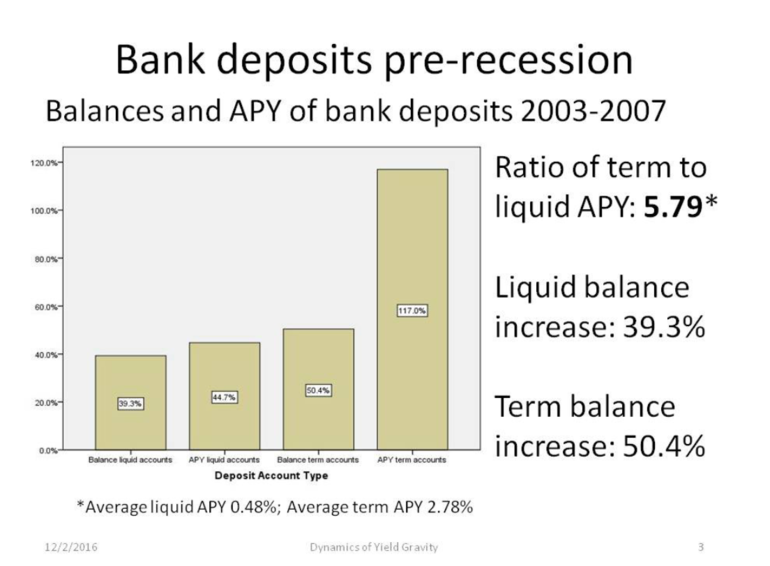
“We can clearly see the changes in the gravitational pull of yield by comparing the behavior of yield and balances of deposits during two time periods – five years prior the beginning of the Great Recession vs. five years during and in the aftermath of the Great Recession,” Geller and Biger said. “During the pre-recession period (2003-2007), balances of liquid accounts (checking, savings and money market) increased by 39.3% while average APY of liquid accounts increased by 44.7%. Similarly, balances of term accounts increased by 50.04% and average APY of term accounts increased by 117.0%. Most importantly, as we will see later, the ratio between the average APY of term accounts (0.48%) and the average APY of liquid accounts (2.78%) was 5.79.”
Comparing that behavior of APY and balances of liquid and term accounts to the five-year period that includes the recession and its aftermath (2008-2012), the study said, shows how balances of liquid accounts increased by 78.9%, hence twice as much as the increase in the pre-recession period (2X), and balances of term accounts decreased by 22.0%, hence three times different than the pre-recession period (3X).
“And here is a critical fact – the ratio between the average APY of term (0.23%) and the average APY of liquid account (1.26%) remained nearly identical to the pre-recession time period at 5.48,” the authors said. “This means that despite the fact that the ratio between APY of liquid accounts and the APY of term account remained nearly the same, balances of liquid and term accounts were five times different in the post-recession period compared to the pre-recession period. So, what caused this phenomenon? What made the gravitational pull of term APY so much weaker compare to liquid APY even though the ratio between the two remained the same? The answer may surprise you – its money anxiety.”
Money anxiety is defined by the authors as a “common and normative response to economic and financial uncertainty.”
The authors said that in order to be able to objectively measure money anxiety, which is a latent variable and can’t be directly observed or measured, they used a special statistical model called Structural Equation Modeling (SEM) that is capable of measuring the impact money anxiety has on the financial behavior of people.
So how does the dynamics of yield gravity impact a financial institution? According to the study, there are two areas every FI should be watching and steps that should be taken:
-
Implications on interest expense
Problem: Financial institutions tend to misprice deposits because they do not incorporate behavioral economics factor when forecasting and pricing their deposits. Solution: Deposit pricing models should include behavioral economics factors to ensure that interest rates are optimal for the economic environment. Otherwise, unnecessary interest expense can put the financial institutions at risk of low net interest margins. -
Implications on term liquidity
Problem: Diminishing yield gravity during economic slowdown will prevent financial institutions from complying with Basal III Net Stable Funding Ratio (NSFR) requirement of one-year liquidity. Solution: Financial institutions can’t rely on yield alone to attract term liquidity during economic slowdown (high money anxiety). Product features and other non-yield incentives should be used instead.