SYDNEY, Australia–Young men are leading the way when it comes to using digital payment technology—and also spending more, according to a new survey.
The survey, commissioned by personal finance comparison website finder.com and conducted by global research provider Pureprofile, offers insights into trends and developments in digital and mobile wallets.
Among the survey’s findings:
- More than two in five (43%) of Americans have used a “digital wallet” to send or receive money this year, such as Venmo, Facebook Messenger, Google Wallet, Apple Passbook, Lemon Wallet, Square Wallet, Chirpify.
- That’s an estimated 106.6 million American adults, according to finder.com
- Interestingly, said finder.com, more than half (57%) of Americans (60.7 million adults) use their digital wallet more than any other means for transferring money, such as online banking, checks or ATMs.
- 31% use their digital wallets at least once a month.
- 7% use their digital wallets every day.
Gender breakdown
- Men are more likely to use a digital wallet than women, with more than half of men (51%) having used one in the past year, compared to 39% of women.
- Men are also more frequently using their digital wallets, with 41% saying they use it once a month or more, while 27% of women use theirs at least once a month.
- In fact, men are three-times more likely to use their digital wallets every day than women (12% versus 4%, respectively, finder.com said.).
- Men are more likely to spend up compared to women when using their digital wallets, and more likely to use their digital wallets more than other means of transferring money.
Generations
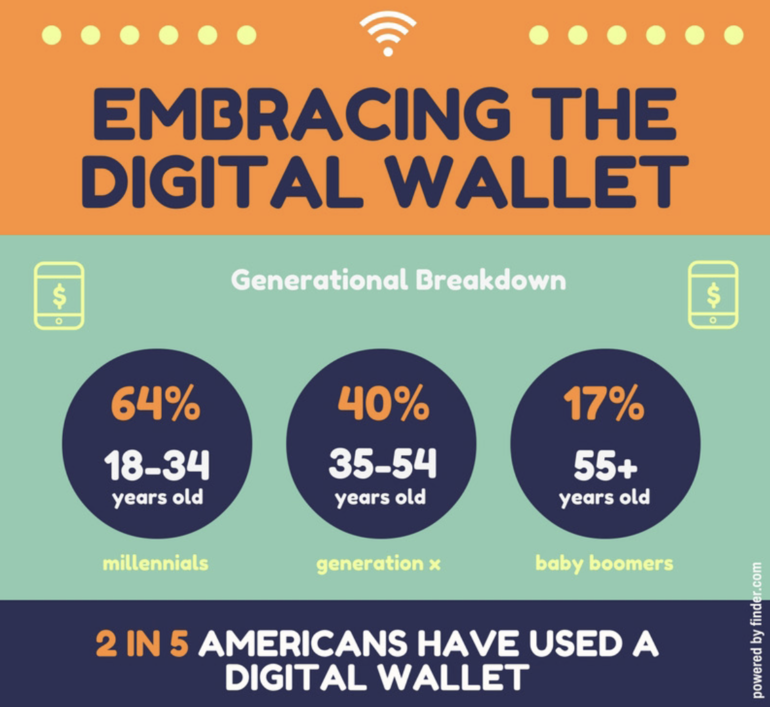
- Millennials (aged 18-34) are the biggest users of digital wallets, with 64% using one in the past year – 50% of whom use them on a regular basis (at least once a month).
- 40% of Generation X (35-54) have used a digital wallet in the past year, while 17% of Baby Boomers (55+) have done so.
- Millennials are also more likely to spend more than other generations when using their digital wallets, as well as use it more than other ways to transfer money.
Income, education, employment
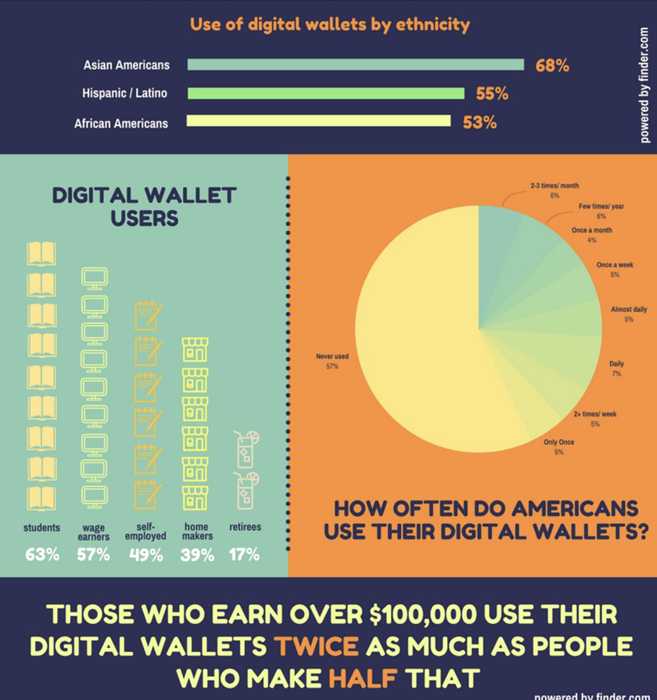
- The more you earn, the more likely you are to use a digital wallet and spend more money, finder.com reported. Sixty percent of those who earn more than $100,000 have used a digital wallet in the past year – that’s double the proportion of those who earn half as much, the company said.
- Those who have a tertiary education are more likely to use a digital wallet than those who only completed high school.
- Students are the biggest users of digital wallets, with 63% of students taking on the trend, followed by people who work for wages (57%), self-employed (49%) and homemakers (39%).
- Retirees are the least likely to use a digital wallet, with only 17% that have used one, followed by those unable to work (21%) and those out of work (28%).
Ethnicity
- Asian Americans are the biggest users of digital wallets compared to other ethnicities, with 68% saying they have used them in the past year
- They are followed by Hispanic or Latino (55%) and African-Americans (53%), according to the company.
Marital status
- The biggest digital wallet users according to marital status are single people who have never married (53%), followed by married/domestic partnership (42%), and those who have separated (35%).
Dependents
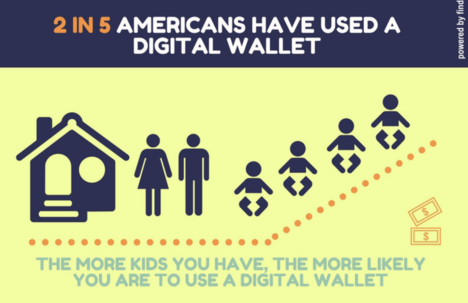
- The more kids you have, the more likely you are to use a digital wallet. This is not surprising as digital wallets can be more cost effective to transfer money than other means.
“Most of us carry our phones with us everywhere we go and new mobile apps are making it easier than ever for it to be the only thing you leave the house with,” said Michelle Hutchinson, a Money Expert with finder.com. “So we’re not surprised by the popularity of digital wallets, as our study shows over two in five Americans are using digital wallets.
“Traditionally, U.S. banks have charged high fees for transferring money from your bank account to other people but payment apps allow you to sidestep those fees by removing the bank as the middleman,” continued Hutchinson. “For instance, major banks may charge up to $10 in next-day transfer fees, compared to one digital provider, Venmo, with one business day transfers not incurring any transaction fees. While banks have been late to join the movement, media reports suggest they are no longer sitting on the sidelines. Many U.S. banks including Bank of America, Chase, Citi and Wells Fargo are planning to launch a payment app called Zelle.”