

CHICAGO– The ongoing growth in e-commerce is likely behind a surge in shipping fraud, which is now the fastest growing type of digital fraud worldwide, according to TransUnion’s 2022 Global Digital Fraud Trends Report, which also includes details on several types of fraud that could affect credit unions and their members.
Shipping fraud saw a 780.5% year-over-year (YoY) global increase, and when compared to a two-year timeframe from 2019 to 2021, TransUnion said the data show shipping fraud grew more than 1,500%.
According to TransUnion, shipping fraud – defined as when a buyer spoofs a shipping address or when a seller receives payment for goods or services, but never ships to the buyer – has quickly emerged as one of the top fraud types across a variety of industries. The issue is most prominent in the logistics industry where consumers purchase goods online and are then reliant on third-party carriers for transportation and delivery of items, TransUnion said.
“As consumers shifted from brick-and-mortar retailers to e-commerce platforms over the course of the pandemic, fraudsters gravitated toward areas where consumers were increasingly spending both time and money,” said Shai Cohen, senior vice president and global head of fraud solutions at TransUnion. “Online shopping has become the ‘new normal’ on a global scale and as a result, the propensity for shipping fraud has also increased.”
Other Growth Areas
Meanwhile, TransUnion said, as consumer adoption of digital channels has continued to accelerate, the global rate for all types of suspected digital fraud attempts increased 9.4% YoY from 2020 to 2021 and 52.2% from 2019 to 2021.
In addition to shipping fraud, other types of fraud that experienced large increases when comparing 2020 to 2021 include business identity theft (+113.8%) and identity mining / phishing attempts (+104.8%) which both showed high rates of annual growth.
According to TransUnion’s recent survey of 12,500 adults worldwide, 62% of consumers reported identity theft as their greatest concern when it comes to digital fraud.
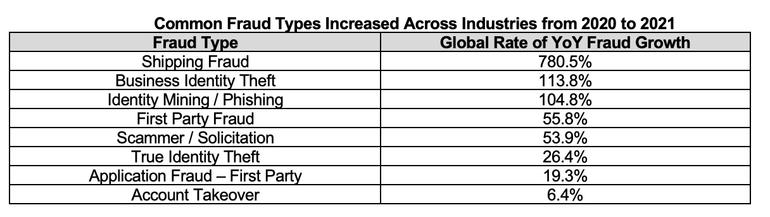
“Nearly half of all consumers worldwide surveyed by TransUnion said they are conducting the majority of their transactions online, covering everything from managing personal finances and shopping to conducting business matters, which has led to an elevated consumer expectation in terms of both experience and security,” said Cohen. “To effectively mitigate digital fraud risks, businesses should ensure there are strong authentication processes in place as well as streamlined technology and multi-layered identity solutions. These solutions will help build trust with customers and thwart these fraud tactics.”
The Top Industries Targeted
TransUnion noted that while shipping fraud spans a plethora of industries, certain business sectors tend to be more prone to digital fraud attempts. In the United States, the gaming industry saw the largest percentage of annual fraud growth in 2021 with an increase of 60.3% YoY.
Other industries that have seen increases include:
- Travel and leisure (58.4%)
- Telecommunications (29.5%)
- Financial services, led by credit card fraud (27.2% YoY)
- Insurance (11.1%)
Digital fraud in financial services remains a prime target for fraudulent activity worldwide and grew 32.6% YoY, making it an increasing area of concern for businesses and consumers alike. The number one fraud type in financial services is true identity fraud – where the victim is a real person and a fraudster uses a stolen identity to commit fraudulent transactions. As such, many financial institutions have taken steps to put greater security measures and authentication solutions in place, especially since digital banking is regarded as the industry standard.
‘Target on their Backs’
“Fraud continues to impact a variety of different business sectors and fraudsters are always looking for the next opportunity. However there are some industries that continue to have a target on their backs – such as financial services or travel and leisure – that should preemptively employ fraud detection solutions and strategies to better serve customers and protect their bottom line,” said Sean Donnelly, senior vice president and go-to-market global fraud solutions at TransUnion.
TransUnion said its conclusions about fraud against businesses is based on intelligence from billions of transactions and more than 40,000 websites and apps contained in its flagship identity proofing, risk-based authentication and fraud analytics solution suite TransUnion TruValidate.
For more info, go here.
Don’t Forget to Check the Spam Folder!
Don’t forget to check your Spam/Junk email folder if you didn’t receive your free, popular and daily CUToday.info news headlines on Monday.
And if you haven’t yet signed up for the new email solution on which CUToday.info has partnered with ResponseGenius, you can do so here. Signing up requires less than one minute of your time.
CUToday.info has received very positive response from readers following the move to an improved provider of the daily headlines, but many also noted they did need to go to their Spam/Junk folder and mark it as safe.
The new email solution has not only improved every reader’s delivery experience, but it also features a fresh, new format that is easy to read, especially on mobile devices.
Please note and/or make your IT department or email administrator aware the emails will be coming from the domains CUTodayinfo.com and CUTodayinfoReply.com.