

RICHMOND, Va.–A new report offers insights into the latest trends related to first-time homebuyers and offers some predictions on what’s ahead. But an important caveat: the report was released before the full effect of the coronavirus began to be felt across the world and economies.
Genworth Mortgage Insurance has released the 12th edition of the First-Time Homebuyer Market Report, authored by its Chief Economist Tian Liu for the fourth quarter of 2019. The report aggregates all publicly available government data and proprietary mortgage industry data into one digestible report.
The Findings
Among the findings:
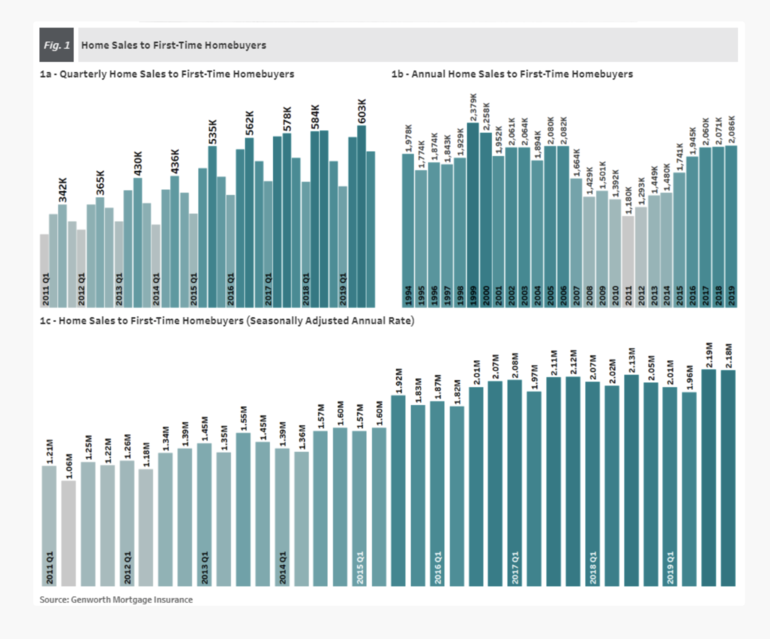
- First-time homebuyer market activity strong in Q4: 517,000 single-family homes were purchased––up 6% from a year ago. First-time homebuyers reached 2.18 million seasonally-adjusted annual rate in Q4, their fastest pace since 2006
- First-time homebuyer market in the middle of a boom: A stronger second half pushed the first-time homebuyer market to a strong full year result of 2.09 million. For the third consecutive year, the number of first-time homebuyers exceeded 2 million, unprecedented in the past 26 years
- The most important customer segment for the housing industry: In 2019, 38% of all homebuyers and 56% of purchase borrowers are first-time homebuyers
- First-time homebuyer demographics maturing: The aging of the Millennial population implies that the increase in first-time homebuyers over the age of 30 will likely lead to an overall increase in the number of first-time homebuyers in the 25-44 age group in the order of 580,000 first-time homebuyers over five years
- First-time homebuyer growth turning headwind into tailwind for the second-time homebuyer market: The pool of potential second-time homebuyers increased for the first-time since 2008 to 8.3 million in 2019 and will grow by over three million in five years
- Strong first-time homebuyer trends across states: States with fast job growth reported first-time homebuyer growth rates of 44% between 2014 and 2019, compared to the 37% growth rate for states with slow job growth
- Improving housing affordability providing a better environment for first-time homebuyers: In addition to lower mortgage rates, housing affordability also improved as homebuilders expanded building activity by 16% in the $200,000 to $400,000 price range, leading to the fastest growth in new homes sold since 2016
- Low down payment mortgages essential for first-time homebuyers: Financed 1.66 million (80%) first-time homebuyers in 2019, up 1% from 2018; the second biggest year for the low-down payment mortgage market in history
- Private Mortgage Insurance (PMI) most-sold product: 720,000 first-time homebuyers used conventional mortgages with PMI to finance their first home purchase in 2019, up five percent from a year ago
‘Long-Overdue Rebound’
“The housing market is in the middle of a multi-year boom in the first-time homebuyer market,” said Liu. “The market has exceeded two-million first-time homebuyers each year for the past three years, which is unprecedented in the past 26 years. In part, this represents a long overdue rebound from the trough earlier in the decade.
“The first-time homebuyer market offers important insights into the housing market. With 38% of home sales and 56% of purchase loans in 2019, it is a market too big to ignore,” continued Liu. “I see the trend toward more affordable homes by homebuilders and a historically large PMI market as two results of the boom in the first-time homebuyer market.”
“Another feature of the housing market from the past five years is a lack of homeowner mobility, which has resulted in a flat repeat-buyer market in the middle of generally favorable economic conditions. The trend in the first-time homebuyer market offers an explanation and a prediction. A prolonged depression in the first-time homebuyer market between 2007 and 2015 led to a sharp decrease in the pool of potential second-time homebuyers, resulting in lower homeowner mobility. But the strong growth in the last few years predicts that the repeat-buyer market and mobility should recover over the next five years.”
The full report can be found here.