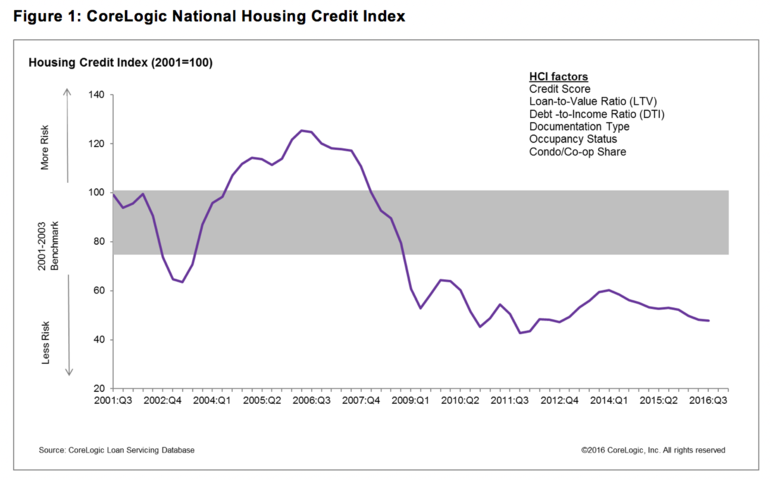
IRVINE, Calif., December 20, 2016—A new quarterly report featuring the CoreLogic Housing Credit Index (HCI) that measures variations in home mortgage credit risk attributes over time—including borrower credit score, debt-to-income ratio (DTI) and loan-to-value ratio (LTV), has been released by CoreLogic.
A rising HCI indicates that new single-family loans have more credit risk than during the prior period, and a declining HCI means that new originations have less credit risk, the company said.
The current HCI shows mortgage loans originated in Q3 2016 continued to exhibit low credit risk versus the previous quarter and Q3 2015. In terms of credit risk, Q3 2016 loans are among the highest-quality home loans originated since the year 2001.
“Mortgage originations over the past 15 years have exhibited a huge swing in credit tolerance, as shown in our Housing Credit Index. The index incorporates six risk attributes, including the three C’s of underwriting—credit, collateral, and capacity. Using 2001 originations as a base year, the HCI shows the significant loosening of credit running up to 2006. This was followed by a dramatic tightening of credit in response to the real estate crash and a decline in high-credit-risk applicants beginning with the Great Recession,” said Dr. Frank Nothaft, chief economist of CoreLogic, in a statement. “While low downpayment and high payment-to-income products are available today, borrowers generally need good credit scores to qualify. This may be a factor that has led to the drop-off in applications from those with lower credit scores during the last few years.”
Nothaft added that one of the consequences of this prolonged trend is that many potential
homebuyers appear to believe that they cannot get a mortgage. “When we compare applications to closed loans, what we find is that lenders are originating the bulk of the applications that they are receiving, but the applications that are coming in tend to be from relatively high-quality, low-risk applicants.”
Among the HCI Highlights as of Q3 2016:
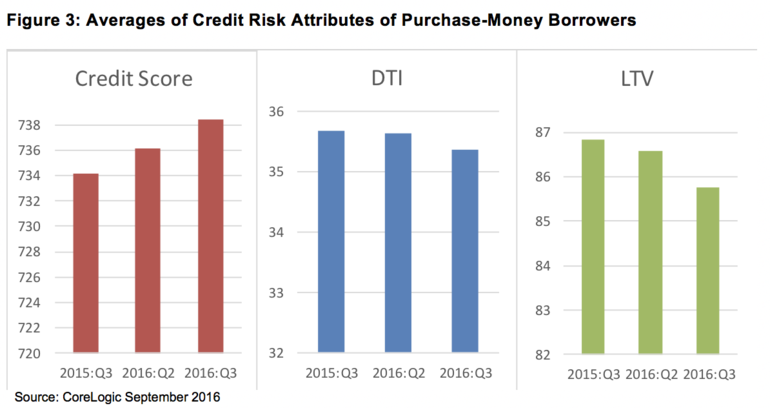
- Credit Score: The average credit score for homebuyers increased 5 points year over year between Q3 2015 and Q3 2016, rising from 734 to 739. In Q3 2016, the share of homebuyers with credit scores under 640 had dropped by more than three-quarters compared with 2001.
- Debt-to-Income: The average DTI for homebuyers fell slightly between Q3 2015 and Q3 2016, falling from 35.7% to 35.4%. In Q3 2016, the share of homebuyers with DTIs greater than or equal to 43% was about the same compared with 2001.
- Loan-to-Value: The LTV for homebuyers decreased about one percentage point between Q3 2015 and Q3 2016, declining from 86.8% to 85.6%. In Q3 2016, the share of homebuyers with an LTV greater than or equal to 95% had increased by more than one-fourth compared with 2001.