

DUBLIN–A new report by Ireland’s credit union regulator has found the country’s CUs have become “more resilient” and better able to weather the current financial challenges, although concerns remain.
The report, issued by the Central Bank of Ireland, follows by nine years a similar publication, the Report of the Commission on Credit Unions, that was first published in 2012 to examine what was then a struggling credit union sector in Ireland. At that time the Commission put forth a number of recommendations for Ireland’s financial cooperatives. The newest report from the Commission is in follow up and examines how CUs are faring in the current economic climate and as a result of the changes instituted.

The most recent report found credit unions continue to mature, consolidate and strengthen and while certain challenges remain–in particular rising cost income ratios, higher savings and lower levels of lending–the “strengthened financial position of credit unions since 2012 has made the sector more resilient to deal with the current challenges.”
The Central Bank report warns, however, the economic outlook is uncertain with COVID-19 and Brexit impacts potentially yet to be fully realized.
“Good governance will be key to overcoming the challenges and credit unions will need to continue to monitor adverse trends while assessing the suitability and sustainability of its business model and strategic objectives,” according to the regulator.
Crash Leads to Analysis
Nearly a decade ago, the Commission was established after the financial crash to “review the future of the credit union movement and make recommendations in relation to the most effective regulatory structure for credit unions, taking into account their not-for-profit mandate, their volunteer ethos and community focus, while paying due regard to the need to fully protect depositors' savings and financial stability.”
As the Central Bank noted, the Report resulted in an overhaul of the legislative and regulatory framework governing credit unions. A tiered approach to regulation of credit unions was recommended where different rules were to be applied depending on the nature, scale and complexity of the credit union and their respective operations and business models. Ultimately the Credit Union and Co-operation with Overseas Regulators Act 2012 provided the Central Bank of Ireland with powers to make regulations on regulatory requirements for credit unions.
The Report also made a number of recommendations including a recommendation that Ireland’s many small credit unions explore consolidation. At the time of the Report, there were 404 credit unions in Ireland with total assets of c. €13 billion. The Report called for the establishing the Credit Union Restructuring Board with the aim of achieving a lower number of larger credit unions through voluntary amalgamations and transfers of engagements, noted the Central Bank.
Declining Numbers
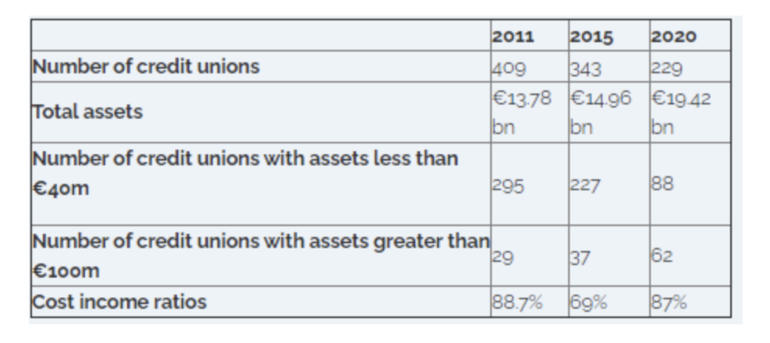
As of Sept. 30, 2020, there were 229 credit unions; down from 243 on Sept. 30, 2015 and 343 on Sept. 30, 2011. Not surprisingly, the number of larger credit
Ireland’s credit unions as of September 2020 grew total assets to €19.42 billion with good reserves, liquidity and loan provisioning, the report found.
But lending remains a struggle.
“Lending decreased in 2020 slightly down from €5.11 billion in 2019 to €5.09 billion and there was a marginal increase in arrears,” the new report states. “The return on assets also decreased during 2020 from 0.7% Sept. 30, 2019 to 0.4% at 30 September 2020 with 28 credit unions reporting negative ROA at 30 September 2020.
“The adverse cost to income ratio has also continued to trend in the wrong direction,” the report continues. “Income decreased from €626 million at 30 September 2015 to €573 million at 30 September 2020 is a further cause for concern in particular if loan book values and quality decline as a result of the pandemic restrictions in place.”
Short to Medium Term Outlook
The Central Bank forecast the financial strength of the sector overall will assist in protecting the sector from the challenges it will face but the growing gap between savings and lending will be a source of concern to credit unions boards and management.
“The challenge now will be to reduce costs while at the same time increasing income through growing lending and closely monitoring its arrears position,” the report stated. “…The nature and pace of recovery of the economy will dictate how credit unions will respond. A K-shaped recovery may impact certain credit unions more than others and may result in further consolidation of the credit unions while larger credit unions will rely on increased diversification of its product offerings and targeting membership growth.”
The Central Bank of Ireland warned that although the sector has shown resilience in 2020 due to strong reserves and liquidity positions, a continuation of the trends identified in the report “could see individual credit unions facing sustainability challenges over the medium term.”
“Good governance will be key to ensuring credit unions remain resilient in the face of the economic outlook with the Central Bank identifying some concerns in respect of governance, credit, operational risk and business model risk in many credit unions in its PRISM Supervisory Commentary 2020,” the report notes.