

WASHINGTON—The U.S. Postal Service is continuing to explore opportunities in providing financial services, especially in underserved communities, with proposals that build on services it already offers, partnerships with banks and credit unions, or a full-fledged “post bank.”
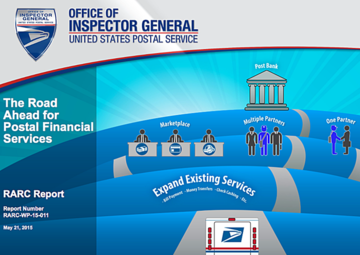
On the heels of a January white paper from the U.S. Postal Service Office of Inspector General, a new RARC Report from the USPSOIG called “The Road Ahead for Postal Financial Services” delves even further into the idea that the Postal Service could provide products that “could benefit the 68 million underserved Americans who either do not have a bank account or rely on expensive services like payday lending and check cashing.”
The products also could help the Postal Service “generate new revenue to continue providing universal service,” the new report states. “Because it has a presence in every neighborhood, including many places where there are no longer any bank branches, the Postal Service is well suited to provide such services. In addition, its well-trained workforce is already experienced at handling complex transactions and watching out for related fraud and other risks.”
The new report was developed in conjunction with the Mercator Advisory Group, which was retained to perform the analysis and forecast.
The Postal Service notes that it is already the largest single provider of paper money orders in the United States, having sold $21 billion worth of money orders in fiscal year 2014, bringing in $165 million in revenue. It also offers prepaid cards, international money transfers, and limited check cashing.
“Because many current users of postal financial services are repeat customers, they likely form a ready base of consumers who would benefit from additional postal financial services,” the OIG report states. “An expanded product suite could attract many new customers too, as survey results show that most current users of alternative financial services would go to their local post office to get more affordable financial products. Small town America in particular could be a major beneficiary of expanded services, given that post offices in rural ZIP Codes sell 27% more money orders per capita than urban locations. Affordable products from the Postal Service could also help the millions of underserved seniors and military service members who currently rely on expensive alternative financial services.”
The new paper from the Postal Service examines five potential approaches it could take for expanding services:
- Expanding the products it already offers under its existing legal authority. Among those products could be electronic money transfers, bill payment services, expanded check cashing, and international money transfers to additional countries where the market is “huge and quickly growing.”
- Right now, the Postal Service offers international money transfers “Although regulatory approval would have to be received before going forward, this approach could generate $1.1 billion in annual revenue after five years, while covering costs and contributing profits,” the report states. “This estimate is based on Mercator Advisory Group’s standard industry assumption that many financial products take up to five years to reach full rollout.”
- The Postal Service said that projection is just a “fraction” of the potential revenue it could earn.
- Approaches 2 and 3 examine ways the Postal Service could partner with one or more banks, credit unions, or other organizations to provide products like reloadable prepaid cards and small loans. “Establishing partnerships could help the Postal Service handle operational and regulatory complexities, bring important expertise, and possibly provide necessary capital. Having one exclusive partner could streamline operations, but could also mean that problems with that sole partner could jeopardize the whole program. Having multiple partners could allow the Postal Service to find the best possible provider for each product, but would require more time and resources to manage.”
- Approach 4 examines how the Postal Service could create a marketplace where multiple providers offer each product for sale to the public so long as the products adhere to certain standards. “This marketplace strategy would create a platform to spur competition among providers for citizens everywhere,” the report states. “This could drive down costs, give citizens a wide menu of options, and enhance value for all — the Postal Service, providers, and consumers. However, such a marketplace could be challenging to manage if it attracts a large number of providers.”
- Approach 5 involves the Postal Service establishing its own full-fledged post bank. “This could have the biggest benefits for the underserved, but the process for establishing a post bank would likely be lengthy and difficult. Moreover, this approach would introduce heavy regulatory requirements for the Postal Service. This reflects the inherent tension between the goal of financial inclusion and the ease of implementation. While approaches 2 through 5 could each generate billions in revenue, reliable financial estimates would require additional information that is unavailable.”
The January report from the Postal Service was met by pushback from many parties, including credit unions, which questioned whether the USPS needs to be in the financial services business.
“This report raises a lot more questions than answers,” said John McKechnie, a partner in the Washington advocacy firm Total Spectrum. “It’s not clear that the Post Office is well-suited to deliver financial services in addition to the mail. If Congress is looking for ways to expand financial services options for underserved Americans, credit unions would be a ready, and more sensible option to consider.”
The full report can be found here.