

ALEXANDRIA, Va.–With NCUA noting the first half of 2022 experienced the sharpest increase in interest rates in decades, the agency has issued a new Letter to Credit Unions addressing interest rate risk.
“A sharp rise in interest rates may amplify market risk exposure to earnings and capital,” NCUA said in the letter. “This occurs because a credit union’s assets and liabilities do not reprice equally or concurrently. This timing (or duration) mismatch, combined with a sharp rise in interest rates, may result in sharply lower net economic values (NEV) as measured using the NCUA’s NEV Supervisory Test (NEV Test) or the Estimated NEV Tool (ENT).”
This letter revises the risk management expectations for credit unions over $50 million in assets described in Letter to Federally Insured Credit Unions 16-CU-08, Revised Interest Rate Risk (IRR) Supervision, effective Jan. 1, 2017, and provides additional information and updates to the NCUA’s supervisory framework of interest rate risk (IRR), according to the agency.
An Overview
In summary, NCUA said the changes include:
- Revising the risk classifications by eliminating the extreme risk classification and modifying the high risk classification
- Clarifying when a Document of Resolution (DOR) to address IRR is warranted, including removing any presumed need for a DOR based on an IRR supervisory risk classification and related need for a credit union to develop a de-risking plan
- Providing examiners more flexibility in assigning IRR supervisory risk ratings
- Revising examination procedures to incorporate updated review steps when assessing how a credit union’s management of IRR is adapting to changes in the economic and interest rate environment.
“Exam staff must remember that IRR is a major area of risk and, under certain market conditions, may expose credit unions to other related issues, such as liquidity risk, asset quality deterioration, unexpected losses to earnings, capital erosion, and strategic risk,” NCUA said. “The credit union system has experienced significant growth in complexity over the past two years with total assets growing by approximately 25%. As the system has grown, concentrations in longer maturity assets have significantly increased sensitivity to changes in interest rates.”
Key Procedure Changes
In the letter, NCUA outlined key procedural changes for IRR supervisory framework and noted it had revised risk classifications (see chart, below).
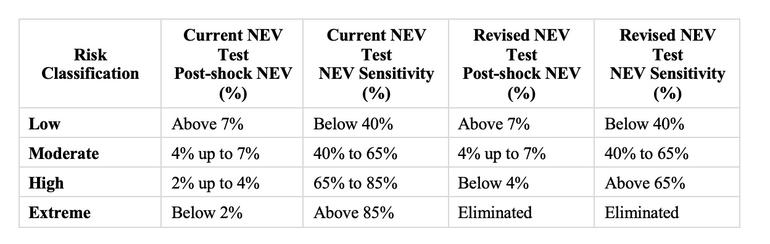
“In summary, the NEV Test measures IRR exposure relative to capital. It also establishes a uniform and transparent measure of market risk that allows exam staff to scale the IRR scope and review procedures to match the credit union’s level of risk,” NCUA said. “Both thresholds apply, so either measure triggers the risk classification.
“As observed in 2022, credit unions are experiencing a significant increase in NEV Test risk classifications due to the combination of rapid changes in interest rates and lower starting point net worth ratios, which are tied to exceptional share growth experienced during 2020 and 2021,” the Letter continues. “With an upward surge in interest rates in a short period of time, sharply lower asset values amplify the shocked NEV results given the starting point is much lower.”
NCUA said it is updating the NEV Test risk classifications by removing the extreme classification, which was associated with a potential undue risk to the Share Insurance Fund. The high risk classification will now include any post-shock NEV below 4% or any post-shock NEV sensitivity higher than 65%.
Other Points
The Letter also:
- Clarifies when a DOR to address IRR is warrants
- Provides examiners with more flexibility in assigning IRR supervisory risk ratings
- Revises exam procedures to incorporate updated review steps when assessing how a CU’s management of IRR is adapting to changes in the economic and interest rate environment
- Addresses consideration of the source of high IRR
- Assess risk management and controls, and more.
The full letter can be found here.
The Very Best in CU Reporting. For You. For Free. Or Your Money Back.
Don’t forget to check your Spam/Junk email folder if you haven’t been receiving your free, popular and daily CUToday.info news headlines.
And if you haven’t yet signed up for the new email solution on which CUToday.info has partnered with ResponseGenius, you can do so here. Signing up requires less than one minute of your time.
CUToday.info has received very positive response from readers following the move to an improved provider of the daily headlines, but many also noted they did need to go to their Spam/Junk folder and mark it as safe.
The new email solution has not only improved every reader’s delivery experience, but it also features a fresh, new format that is easy to read, especially on mobile devices.
Please note and/or make your IT department or email administrator aware the emails will be coming from the domains CUTodayinfo.com and CUTodayinfoReply.com.