WASHINGTON–Issuers' costs of authorizing, clearing, and settling (ACS) debit card transactions, excluding issuer fraud losses, varied greatly during 2015, according to a new report published by the Federal Reserve Board, which also found a substantial increase in costs related to fraud.
The median issuer had an average ACS cost of 12.3 cents and the issuer at the 75th percentile had an average ACS cost of 30.5 cents, according to the Fed report. Issuers with the highest debit card transaction volume generally had the lowest ACS costs per transaction. The overall average ACS cost per transaction in the industry was 4.2 cents per transaction, down from 4.6 cents per transaction in 2013, the Fed said.
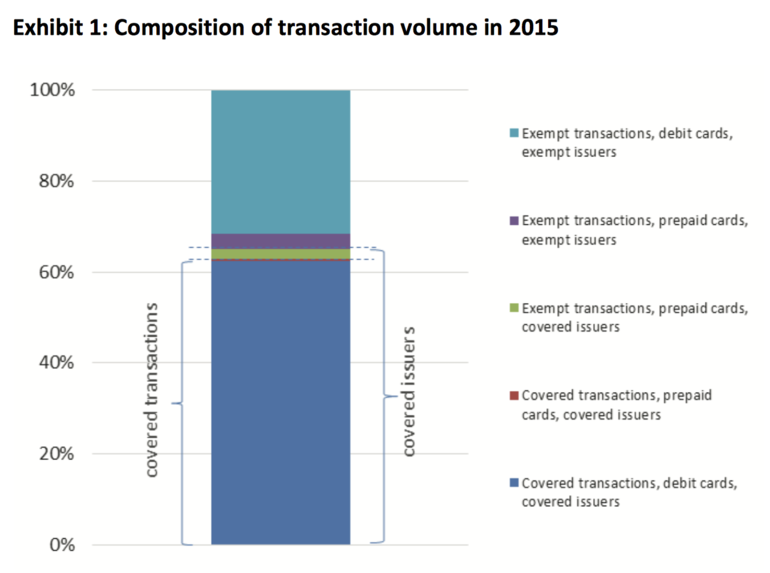
The report is the fourth in a series to be published every two years pursuant to section 920 of the Electronic Fund Transfer Act (EFTA). The Board's Regulation II (Debit Card Interchange Fees and Routing), which implements this provision of the EFTA, provides that a debit card issuer subject to the interchange fee standard (a covered issuer) may not receive an interchange fee that exceeds 21 cents plus five basis points (0.05%) multiplied by the value of the transaction, plus a one-cent fraud-prevention adjustment, if eligible. The regulation does not apply to debit card issuers with consolidated assets of less than $10 billion, certain government-administered debit cards, and certain prepaid cards. The interchange fee standard became effective on Oct. 1, 2011.
In the report the board estimated debit-card fraud losses to all parties (merchants, cardholders, and issuers) increased by 44% from 2013 to $2.41 billion in 2015, with an average loss of 10.3 basis points (0.103%) as a share of transaction value as compared to 8.0 basis points (0.08%) in 2013. The median covered issuer's average fraud loss as a share of transaction value was 6.6 basis points (0.066%), up from 5.1 in 2013, the Fed report states. The median covered issuer had average fraud prevention and data security costs of 1.9 cents per transaction.
Sixty-six percent of covered issuers had average ACS costs, including issuer fraud losses, below 21 cents plus five basis points (0.05%) of the value of a transaction (the base component of the interchange fee standard) in 2015, according to the Fed report.
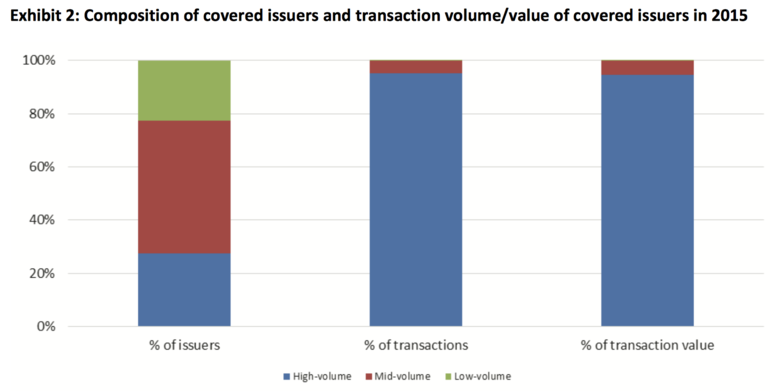
“This proportion is slightly higher than the 64% of covered issuers with average ACS costs below the maximum interchange fee in 2013,” the Fed said. “Covered issuers with average ACS costs below the maximum interchange fee in 2015 processed more than 99% of all reported covered transactions, the same proportion as in 2013.”
Among the findings in the report:
- Payment card networks processed 60.6 billion debit and general-use prepaid card transactions valued at $2.31 trillion in the United States during 2015. Dual-message networks, which typically process signature-authenticated transactions, accounted for 65.5% and 64.6% of the total by volume and value, respectively. Single-message networks, which typically process PIN- authenticated transactions, accounted for the rest.
- Total transaction volume grew 6.8% from 2014 to 2015, which was similar to the average annual growth over the previous three years.
- Dual-message networks experienced slightly slower transaction volume growth than single- message networks from 2014 to 2015, with growth rates of 6.7% and 7.1%, respectively. This is the first time since data collection began in 2009 that transaction growth for single- message networks has exceeded transaction growth for dual-message networks, the Fed said.
- Card-not-present transactions accounted for 14.5% of transaction volume in 2015, but card-not-present volume continued to grow more than twice as fast as card-present volume, with growth rates from 2014 to 2015 of 13.1 and 5.9%, respectively. As in previous years, the average transaction value of card-not-present transactions, $70.76 in 2015, was more than twice as high as that of card-present transactions.
- Issuers that are exempt from the interchange fee standard in Regulation II experienced slightly slower transaction volume growth than covered issuers from 2014 to 2015, with growth rates of 6.4 and 7.1%, respectively. This is the first time since Regulation II went into effect in 2011 that covered issuer transaction growth has exceeded exempt issuer transaction growth.
- The growth in the volume of prepaid card transactions from 2014 to 2015 was 7.9%, faster than the average annual growth of 5.3% over the previous two years.
Interchange Fees, Network Fees, And Incentives
According to the Fed:
- In 2015, interchange fees across all debit and general-use prepaid cards (exempt and covered) totaled $18.41 billion.
- The average interchange fee per covered transaction was $0.23 in 2015 and has not changed materially since Regulation II took effect in the fourth quarter of 2011. Average interchange fees for exempt transactions on dual-message networks have also not changed materially since the fourth quarter of 2011 and stood at $0.51 in 2015. However, among single-message networks, the average interchange fee per exempt transaction has been falling gradually since Regulation II took effect, from $0.32 in the fourth quarter of 2011 to $0.26 in 2015.
- The average network fee per transaction was $0.102 in 2015, little changed from 2013. Network fees totaled $6.16 billion in 2015. Acquirers paid 58% of these fees; issuers paid the rest. These percentages have not changed significantly in recent years, the Fed said.
- Payments and incentives offered by networks grew 8.1% since 2014, totaling $1.37 billion in 2015. “This growth is in contrast to the previous three years, when payments and incentives changed little from year to year,” the Fed said. “Issuers received 67% of payments and incentives in 2015; acquirers and merchants received the rest.”
Fraud
- Across all debit and general-use prepaid card transactions, fraud losses to all parties are estimated to have totaled $2.41 billion in 2015, which is a 44% increase over the estimate for 2013.
- The estimated increase in total fraud losses is driven by two factors: a 28% increase in average fraud losses as a share of transaction value and a 12% increase in the value of total transactions from 2013 to 2015, the Fed report found.
Issuer Costs
- Average per-transaction authorization, clearing, and settlement (ACS) costs, excluding issuer fraud losses, across issuers covered by the interchange fee standard in Regulation II fell to $0.042 in 2015. This is a decline of only $0.004 since 2013 but a cumulative decline of 45% since data collection began in 2009.
- The base interchange fee standard in Regulation II of 21 cents plus five basis points times the value of a transaction exceeded average per-transaction ACS costs, including issuer fraud losses, for 66.0% of covered issuers in 2015, up from 64.1% in 2013, and 99.2% of covered transactions in 2015, roughly unchanged from 99.3% in 2013, the Fed said.