

MADISON, Wis.—It was a rough year for credit union lending in 2020, as the industry also set some not-so-enviable records—including the lowest yield-on-asset ratio in credit union history—according to CUNA Mutual Group’s latest Trends Report, which is based on January 2021 data.
On the other side of the balance sheet, CU savings growth is now the fastest in modern history.
Overall, credit union loan growth slowed to a 5.3% in 2020, down from 6.5% in 2019 which was the slowest pace since 2012, CUNA Mutual stated.
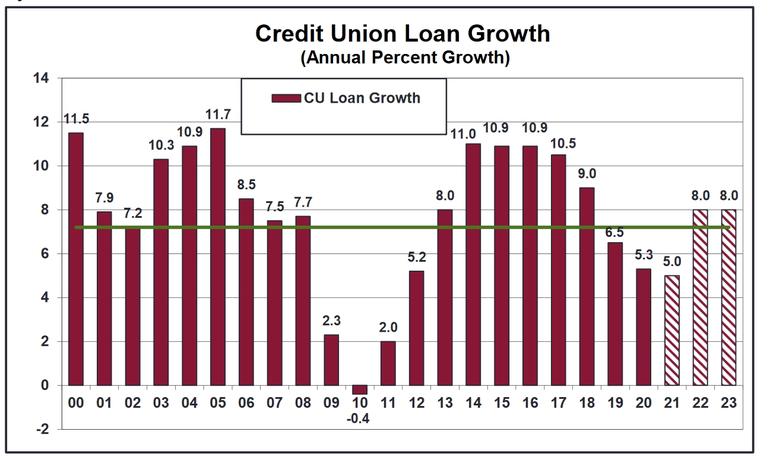
The report reveals four factors drove the relatively weak performance: borrowers paying off loans with funds obtained from cash-out mortgage refinances, rising job insecurity causing potential borrowers to be hesitant when taking on additional debt, members using stimulus checks to pay off credit card and home equity loans and strong past credit growth during the last six years.
The slow loan growth lowered credit unions’ loan-to-asset ratio to 62.6% in January 2021, from 70.6% one year ago and the lowest since March 2015. Fewer loans as a percent of assets during the fourth quarter of 2020, led to the record-low yield-on-asset ratio. Credit unions reported 3.27% yield on assets, down from 4.04% in the fourth quarter of 2019.Credit unions reported zero growth in loan balances in January, down from the 0.3% gain in January 2019.
“Looking forward, February is historically the weakest loan growth month of the year, with seasonal factors typically shaving off 0.6 percentage points from the underlying trend growth rate,” the report states.
Here’s a look at how credit unions performed by category in January:
Consumer Installment Credit
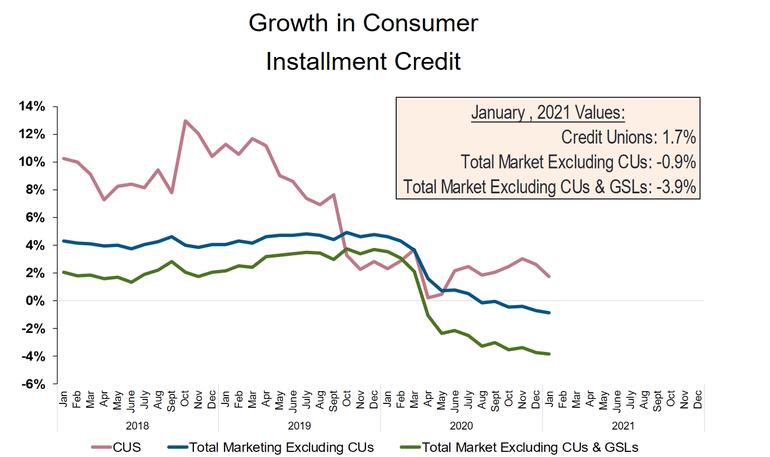
Credit union consumer installment credit balances (auto, credit card and other unsecured loans) declined 0.9% in January, worse than the 0.1% rise set in January 2020, due to the deleveraging mindset of many credit union members, CUNA Mutual reported.
Credit card loan balances fell 3% in January, significantly below the 1% drop in credit card balances reported on average over the last 10 years. Members are still using cash out refinance money to pay down high-rate credit card debt. During the last 12 months, credit union consumer installment credit grew 1.7%, greater than the total market excluding credit unions,-0.9%, and the total market excluding credit unions and government student loans -3.9%, the analysis found.
Vehicle Loans
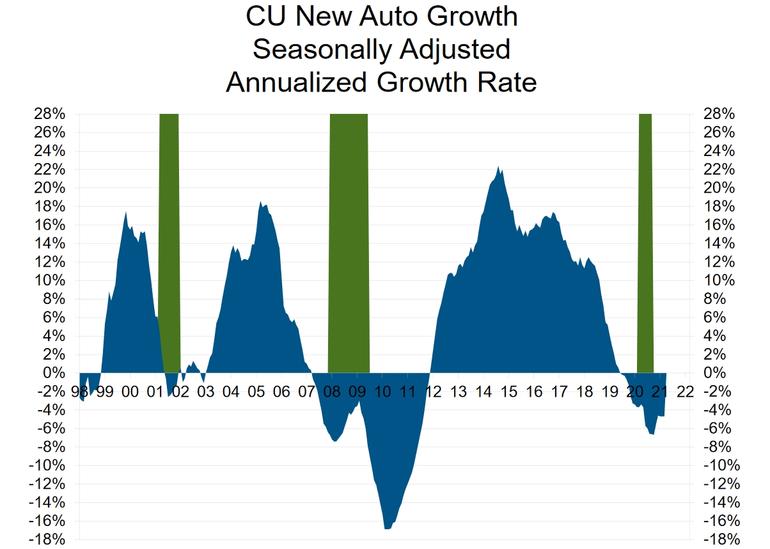
Credit union new-auto loan balances fell 0.6% in January, weaker than the 0.3% decline set in January 2020, and fell 6% during the last 12 months. On a seasonally-adjusted annualized basis, new-auto loan balances fell at a 4.7% pace in January, a significant deceleration from the last few years, the Trends Report stated.
The first quarter of the year is typically the weakest quarter for credit union new-auto loan growth due to various seasonal factors, CUNA Mutual said.
Vehicle sales were 16.6 million in January, which at a seasonally-adjusted annualized sales rate is 2% below the 16.8 million pace set one year earlier.
“Expect auto sales to rise 17% to 17.1 million units in 2021, which is well above the 16.5 million sales rate that economists believe is the inherent long run demand,” the Report forecasts. “Factors supporting auto sales in 2021 include: herd immunity reached in the third quarter, falling job/income uncertainty raising consumer confidence, record low auto loan interest rates, low debt burdens, rising job growth, record high stock prices and record-breaking rise in home prices.”

Real Estate Lending
Credit union fixed-rate first mortgage loan balances rose 0.5% in January, above the 1% decrease reported in January 2020, due to historically low mortgage interest rates, according to the Trends Report.
Credit union fixed-rate first mortgage loan balances rose 13.2% at a seasonally adjusted annual rate in January, a slight decline compared to the last year or so. The contract interest rate on a 30-year, fixed-rate conventional home mortgage rose to 2.74% in January, up from 2.68% in December and lower than the 3.62% reported in January 2020. The mortgage credit-risk premium (the difference between the 30-year mortgage interest rate and the 10-year Treasury interest rate) averaged 2.22% during 2020, above the 1.79% in 2019 and 1.63% in 2018, CUNA Mutual’s economists noted.
“Expect mortgage interest rates to rise 50 to 100 basis points for the remainder of the year, effectively stalling the mortgage refinance boom,” the report states. “Home prices rose a large 0.9% in January from December, according to the Core Logic Home Price Index, and 10% year-over-year, because housing supply is limited, and demand was
Surplus Funds
Credit union surplus funds rose $20 billion, or 3.2%, in January due to deposit accumulation exceeding loan originations. The surge in deposits helped reduce total credit union borrowings by $200 million. Capital grew by $1.2 billion in January and $15 billion over the last year, according to CUNA Mutual.
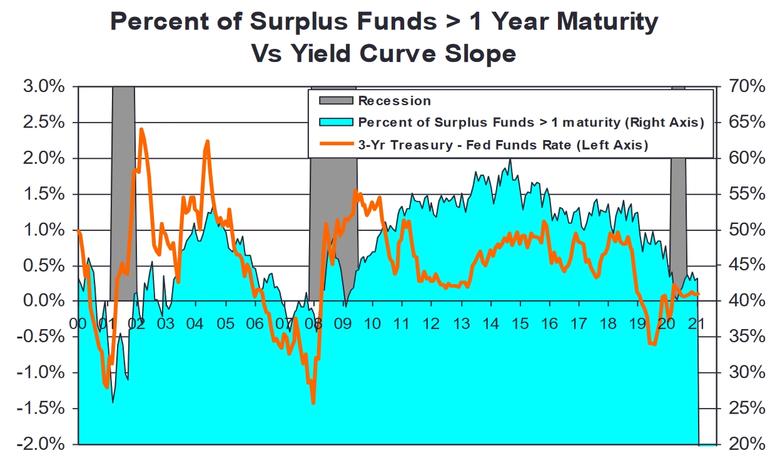
Credit union capital grew 8.3% over the last year, the fastest pace since the summer of 2014. The growth rate of capital is also known as return-on-equity, a key credit union performance ratio. Over the last 30 years, credit union return-on-equity ratios averaged 8.5%. Credit union surplus funds as a percentage of assets rose to 33.5% in January, up from 25.3% in January 2020 and the highest since the summer of 2014, the Trends Report states.
“Credit union liquidity positions will swell again in 2021 as deposit growth surges and loan growth remains subdued,” the report notes. “Credit unions are keeping the maturity of their surplus funds short term. Currently only 43.2% of investments are invested with a maturity greater than one year, down from 46% in January 2020, due to longer term interest rates being not much higher than short term rates.
CUNA Mutual noted the obverse of the rising surplus funds ratio is the falling loan-to-asset ratio, which reached 62.6% in January, down from 70.6% last January as asset growth outpaced loan growth.
“This will have downward pressure on credit union yield-on-asset ratios for the remainder of the year,” the Report forecasts.
Savings and Assets
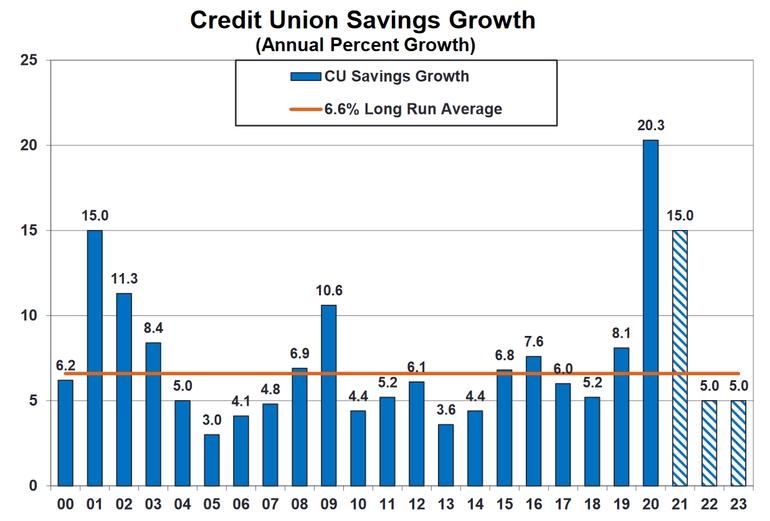
Credit union savings balances rose 0.9% in January due to $600 stimulus checks being deposited in millions of credit union members checking accounts. This growth was still less than the 1.2% increase reported in January 2020, due to that month ending on a payroll Friday, according to CUNA Mutual’s analysis.
“January savings balances have historically declined 0.2% due to recurring seasonal factors. We expect exceptionally strong savings growth at credit unions in 2021 due to additional $1,400 stimulus checks being sent out this spring,” the Report states. “So, with savings balances rising 20.3% in 2020, we expect credit union deposits to increase another 15% this year, which will have increased credit union savings by 38% during the last two years. This is the fastest growth in modern history. Expect weak loan growth in 2022 and 2023 as consumers release some pent up demand for spending.”
Capital and Other Key Measures
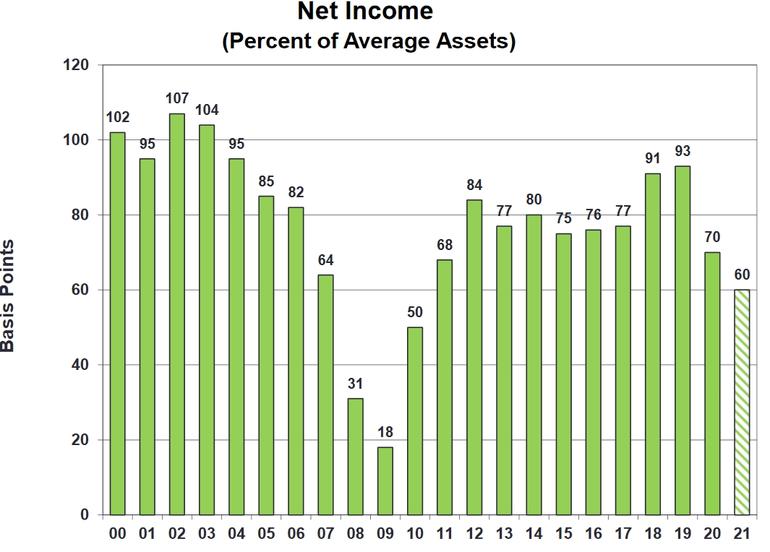
The credit union industry’s net income to average asset ratio, return on assets, fell to 0.7% in 2020, down from 0.93% in 2019. A 32-basis point decrease in net interest margins, combined with a 7-basis point increase in provision for loan losses more than offset a 17-basis point decrease in operating expense ratios, according to the Trends Report.
“Expect return on asset ratios to fall to 0.6% in 2021 as loan growth remains slow and falling interest rates reduce the yield on assets. We could see yield on assets ratios fall to 3.1% in 2021, the lowest in credit union history,” CUNA Mutual reported. “Return on equity (ROE) ratios fell to 8.5% in 2020 from 10.7% in 2019 due to the drop in return on assets exceeding the increase in the leverage ratio (asset-to-equity ratio). The ROE ratio is one of the more important credit union metrics because it determines the long-run sustainable asset growth rate. For example, credit unions reported ROE ratios of 8.5%. This indicates their assets can grow 8.5% while maintaining a constant capital-to-asset ratio. But since credit union assets grew 18.1% in 2020, credit union capital-to-asset ratios fell from 11.3% to 10.3%.”
Credit Union Membership
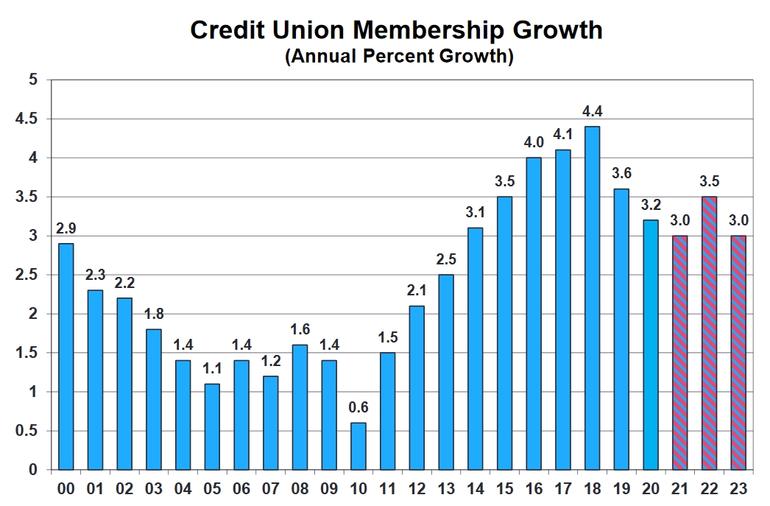
Credit unions added 378,000 memberships in January, slightly above the 371,000-gain recorded in January 2020. One factor driving membership growth is job creation. In January, the economy added 166,000 jobs, according to the Bureau of Labor Statistics, less than the 315,000 jobs added in January 2020, the Trends Report observes.
CUNA Mutual said CUs should expect monthly job growth to accelerate rapidly over the next few months as the economy reopens.
Total credit union memberships reached 127 million in January 2021, which, in percentage terms, rose 0.38% in January and 3.2% during the last 12 months. With the economy expected to gain over 4 million jobs in 2021 due to the COVID-19 crisis coming to an end, credit unions should expect membership growth to come in around 3%, the Report forecasts.