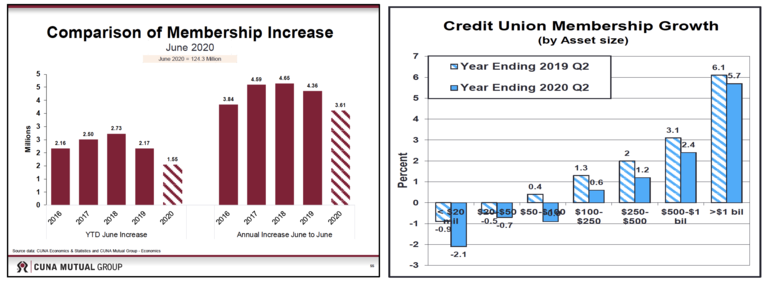
MADISON, Wis.–Newly released analysis of CU performance reveals an ongoing and growing trend—it’s becoming a tale of two credit union communities, including a “huge disparity” in loan growth between large and small credit unions.
CUNA Mutual Group’s latest Trends Report, which analyzes CU performance through July of this year, found credit unions with assets more than $1 billion reported loan growth of 8.9% in the year ending in June 2020, “significantly faster than every other asset size category.”
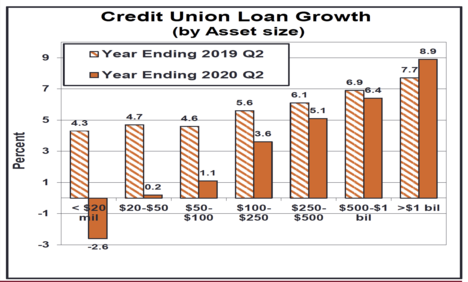
Credit unions with less than $20 million in assets reported negative loan growth.
And while overall credit union membership growth continues to slow vs. prior years, credit unions with assets less than $100 million reported negative membership growth, compared to 5.7% growth at CUs of more than $1 billion in assets.
Below is a look at credit union performance through July, according to the Trends Report, including why CUs are about to reach the “64-32 Rule.”
Total Credit Union Lending
Credit union loan balances rose 0.7% in July, higher than the 0.6% pace reported in July 2019, due to stronger growth in used-auto loans (1.3% vs 0.4%) and adjustable-rate mortgage loans (1.1% vs -1%). During the first seven months of 2020, credit union loan balances grew 3.1%, slightly faster than the 3% pace set in the similar period last year, according to the Trends Report.
But the report found the overall number hides a bigger problem. “There remains a huge disparity between loan growth at large and small credit unions. Credit unions with assets over $1 billion reported loan growth of 8.9% in the year ending in June 2020, significantly faster than every other asset size category,” according to the Trends Report analysis. “Credit unions with less than $20 million in assets reported negative loan growth of -2.6% due to 73% not offering first mortgage loans. These credit unions reported significant declines in credit card (-11%), other unsecured loans (-8.1%) and home equity lines of credit (-6.4%) as members refinanced their mortgage loans at other financial institutions and used some funds from a cash out mortgage refi’s to pay down higher-rate consumer credit.”

Credit Union Consumer Installment Credit (CUCIC)
According to the Trends Report, credit union consumer installment credit loan balances (auto, credit card and other unsecured loans) rose 0.5% in July, above the 0.4% pace set in July 2019. During the last 12 months, credit union consumer installment credit grew 0.5%, slightly above the total market excluding credit unions of 0.4%. Credit union credit card balances fell 13% at a seasonally adjusted annual rate in July as members used cash from mortgage refis to pay down existing credit card debt, the report added.
Vehicle Loans
Credit union used-auto loan balances rose 1.3% in July 2020, above the 0.4% pace set in July 2019. Currently, used-auto loan balances are rising at a remarkably low 3% seasonally-adjusted annualized growth rate, which is down from the double digit pace reported during 2013-2017. Used auto prices rose 5.4% in August, and 4% over the last 12 months, due to a limited inventory of used cars for sale. New auto loan balances are down 3.5% year-to-date, significantly slower than the 0.7% drop in the first 7 months of 2019, according to the Trends Report.

Real Estate Secured Lending – First Mortgages and Other Real Estate
CUNA Mutual’s analysis found credit unions originated a record $130.4 billion first mortgage loans in the first half of 2020, a 92% increase above the $67.9 billion in originations in the first half of 2019.
“Credit unions then proceeded to sell off 40% of those originations into the secondary market, a higher percentage than the 35% reported in the first half of 2019,” CUNA Mutual said in its analysis. “The stage is set for a strong second half of 2020 due to the significant drop in mortgage interest rates and strong demand for purchase mortgage loans. We expect both purchase mortgage and refinance mortgage activity to remain strong through 2021.”
“As the job market heals and consumer confidence improves, we expect home sales to continue on their upward trajectory over the next several years,” the forecast states.

Surplus Funds (Cash + Investments)
Credit union surplus funds as a percent of assets rose to 31.5% in July, up from 25.1% in July 2019, as surplus funds rose 51.7% over the last year while assets grew 17.3%. This is the fastest growth in credit union liquidity in over 30 years. The obverse of the surplus funds ratio is the loan-to-asset ratio, which reached 64.5% in June, below the 71.1% reported in July 2019.
“We expect credit unions to reach the “64-32 Rule”, or long-run average, in the fall of 2020,” CUNA Mutual said in its report. “The 64-32 Rule stands for 64% of credit unions assets in loans and 32% of assets in investments, for a total of 96% earning assets and 4% non-earning or fixed assets. At the 64-32 Rule, loan balances are twice that of investment balances and for every one percentage point drop in loans as a percent of assets, there is a corresponding one percentage point rise in investments as a percent of assets, hence the mirror image of the red line and blue area (see chart above).”
CUNA Mutual said its research shows that every five years credit unions reach the 64-32 Rule.
“Credit unions can expect downward pressure on asset yields over the next year as lower-rate investments become a greater mix of overall assets,” CUNA Mutual said. “Moreover, as the Federal Reserve keeps interest rates low over the next few years, auto, credit card, home equity and adjustable rate mortgage interest rates will fall as well, pushing down credit union yield-on-assets ratios further. This is referred to as the ‘rate effect.'"
Savings and Assets
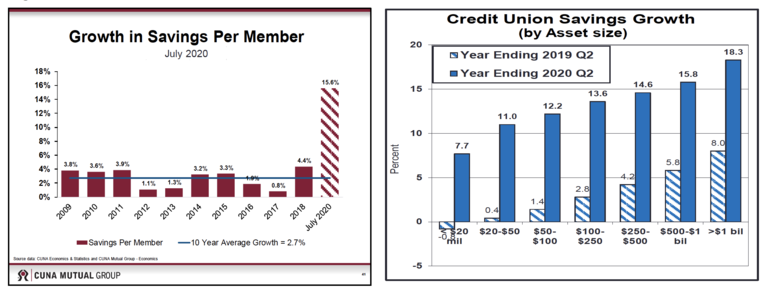
Credit union savings balances rose 1.6% in July, above the 0.3% decline in balances in July 2019, due to the month ending on a payroll Friday, the Trends Report stated, adding July is normally the weakest month of the year for savings growth due to seasonal factors, but 2020 is “not a normal year.”
During the last 12 months, savings balances rose a remarkable 18.9%, the fastest pace in over 30 years, as members saved stimulus checks, saved money on gasoline purchases and stayed at home, the Trends Report added.
“Savings growth per member reached 15.6%, almost six times greater than the long-run average of 2.7%,” the report noted.
Capital and Other Key Measures
The industry’s weighted average capital-to-asset ratio fell to 10.3% in July from 11.2% for the same time period last year, according to NCUA call report data, due to assets growing faster than capital (17.3% vs. 8.3%).
“The credit union movement’s 8.3% capital growth rate over the last year, which is also known as the movement’s return-on-equity, has been trending above its long-run average of 7% lately,” the Trends Report stated. “The credit union return on asset ratio fell to 0.57% in the first six months of 2020 at an annualized basis, down from 0.96% in the first six months of 2019. The 39 basis point decrease in earnings during the last year was driven by a 28 basis point drop in net interest margins, a 15 basis point increase in provision for loan losses and a seven basis point drop in fee/other income as a percent of average assets. Mitigating some of the drop in earnings was a 11 basis point drop in operating expenses as a percent of average assets. Billion dollar credit unions reported a larger drop in earnings compared to smaller credit unions.

Number of Credit Unions
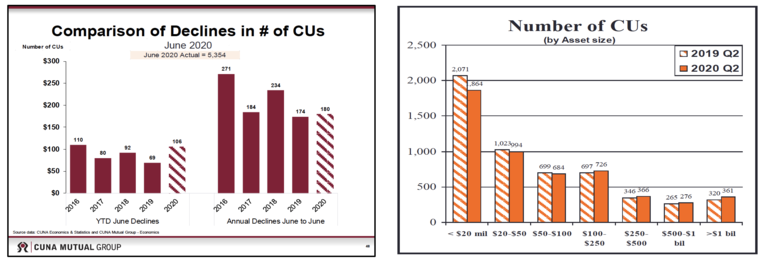
As of July 2020, CUNA estimates 5,365 credit unions are in operation, down four from June. Year-to-date, the number of credit unions fell by 95. which is more than the 73 reported in the first seven months of 2019. NCUA’s Insurance Report of Activity showed 32 mergers in the second quarter with an average asset size of $66.2 million, 12 fewer than reported in the second quarter of 2018, with an average asset size of $23.7 million.
“These smaller credit unions are finding it difficult to increase their member value proposition as fast as larger credit unions and are therefore losing members,” CUNA Mutual reported. “Recently released mid-year NCUA call report data shows 361 credit unions with assets in excess of $1 billion and 276 credit unions with assets between $500 million and $1 billion. The greater than $1 billion asset category represents 6.8% of all credit unions, but more than 69.8% of the credit union system’s assets and 71.9% of the loans. The median asset size of a U.S. credit union rose to $40.3 million in mid-year, up 15.8% from the $34.8 million reported at mid-year 2019.”
Credit Union Membership
Credit union memberships grew 327,000 in July, or 0.26%, below the 435,000 new members added in July 2019. Year-to- date credit unions added 1.9 million new members, slower than the 2.6 million members added in 2019, CUNA Mutual reported.
Total credit union memberships reached 124.6 million in July, 2.9% higher than July 2019.
“This is slower than the 3.8% pace reported in the year ending July 2019. Credit union with assets less than $100 million reported negative membership growth, while credit unions with assets greater than $1 billion reported membership growth of 5.7%,” according to CUNA Mutual. “The slowdown in membership growth is due to the slowdown in loan growth and the deceleration in job creation.
Approximately 11.4 million jobs have been lost since July 2019, down from the 1.9 million job gain reported in the 12 months ending in July 2019, according to the Bureau of Labor Statistics. We forecast credit union memberships to grow 2.9% in 2020 and 2.5% in 2020 due to annual job gains slowing each year, and less demand for consumers.”