WASHINGTON–Today’s young adults are taking longer to experience common milestones, such as careers, marriage and setting up households, than did prior generations, according to a new Census Bureau report.
The implications for credit unions include delayed needs for the types of financial products associated with those milestones.
The Census Bureau report, The Changing Economics and Demographics of Young Adulthood: 1975-2016, noted that in prior generations, young adults were “expected to have finished school, found a job, and set up their own household during their 20s—most often with their spouse and with a child soon to follow. Today’s young adults take longer to experience these milestones. What was once ubiquitous during their 20s is now not commonplace until their 30s.”
Some demographers, the report states, believe the delays represent a new period of the life course between childhood and adulthood, a period of “emerging adulthood” when young people experience traditional events at different times and in a different order than their parents look different from prior generations in almost every regard.
The report defines the young adult population as 18 to 34 years old, and focuses on two periods, 1975 and today (using data covering 2012 to 2016 to reflect the contemporary period).
Among the highlights of the report:
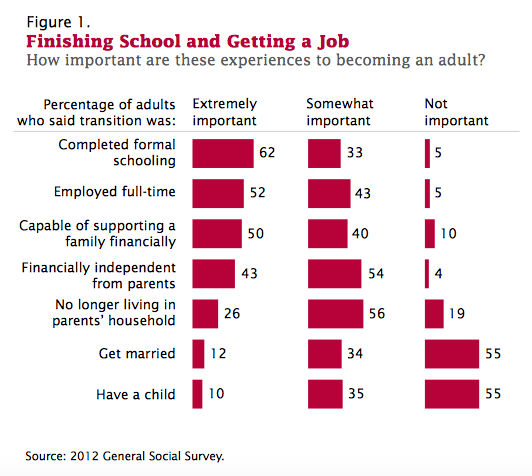
- Most of today’s Americans believe that educational and economic accomplishments are extremely important milestones of adulthood. In contrast, marriage and parenthood rank low: over half of Americans believe that marrying and having children are not very important in order to become an adult.
- Young people are delaying marriage, but most still eventually tie the knot. In the 1970s, eight in 10 people married by the time they turned 30. Today, not until the age of 45 have eight in 10 people married
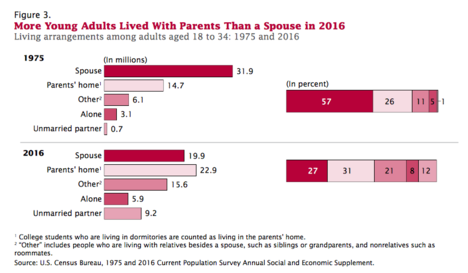
- In 2005, the majority of young adults lived independently in their own household, which was the predominant living arrangement in 35 states. A decade later, by 2015, the number of states where the majority of young people lived independently fell to just six.
- More young men are falling to the bottom of the income ladder. In 1975, only 25% of men aged 25 to 34 had incomes of less than $30,000 per year. By 2016, that share rose to 41% of young men. (Incomes for both years are in 2015 dollars.)
- Between 1975 and 2016, the share of young women who were homemakers fell from 43% to 14% of all women aged 25 to 34.
- Of young people living in their parents’ home, one-in-four are idle; that is they neither go to school nor work. This figure represents about 2.2 million 25- to 34-year-olds
- The emphasis on education today underlies the rising student debt that many young people carry. In 2013, 41% of young families had student debt, up from 17% in 1975. The amount owed on student loans nearly tripled, rising from a median of $6,000 to $17,300 across the same time period.
- Economic security ranks second in the transition to adulthood. About half of adults believe that having a full-time job and being able to financially support a family are extremely important to becoming an adult.
- Despite the prominence given to economic security, only a quarter of Americans think that moving out of the parents’ home is a very important part of adulthood. Given the attention paid to the “Boomerang Generation” that has “failed to launch,” it is surprising that Americans do not rate living independently more highly.