

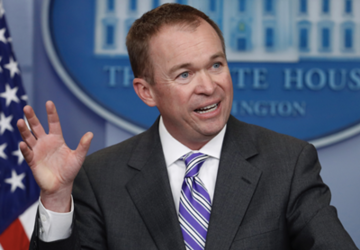
Mick Mulvaney
WASHINGTON — The Consumer Financial Protection Bureau has released its semi-annual report highlighting its work. It the first report issued by Acting Director Mick Mulvaney and includes his four recommendations for statutory changes to the Bureau.
“The Bureau is far too powerful, with precious little oversight of its activities,” said Mulvaney in a statement. “The power wielded by the director of the Bureau could all too easily be used to harm consumers, destroy businesses, or arbitrarily remake American financial markets. I’m requesting that Congress make four changes to the law to establish meaningful accountability for the Bureau. I look forward to discussing these changes with Congressional members.”
In the report’s introduction letter, Mulvaney recommends four changes to the Dodd-Frank Wall Street Reform and Consumer Protection Act.
- Fund the Bureau through Congressional appropriations
- Require legislative approval of major rules
- Ensure the director answers to the President in the exercise of executive authority
- Create an independent Inspector General for the Bureau
The report primarily covers the Bureau’s significant work from April 1, 2017 to Sept. 30, 2017, the period before the President appointed Mick Mulvaney as Acting Director. As part of its regulatory work, in February 2017, the Bureau said it established a task force to help identify and reduce unwarranted regulatory burdens consistent with its objectives under the Dodd-Frank Act. During this period, the Bureau further noted it issued guidance on topics such as maintaining compliance management systems, combatting elder abuse, responding to natural disasters, and ensuring accuracy in credit reporting.
The Bureau’s said it enforcement work included actions taken against illegal practices in mortgage servicing, student loan servicing, credit reporting, and debt collection.
According to the report, from Oct. 1, 2016 to Sept. 30, 2017 the CFPB handled approximately 317,200 consumer complaints. The most-complained-about products or services were debt collection at 27% of complaints, credit reporting at 27%, and mortgages at 13%. Approximately 80% of all consumer complaints were submitted through the Bureau’s website. Companies have responded to approximately 93% of complaints sent to them for response during the period, the CFPB said.
"File this under ‘man bites dog,'" said John J. McKechnie, senior partner with Total Spectrum in Washington. "It isn’t too often that you see a federal agency head ask for less authority, and yet here is Director Mulvaney doing just that. CFPB has been such a politically charged entity since its creation—I guess nothing should surprise.”