ST. LOUIS–A new analysis offers insights into national housing market trends in terms of buyer demand, and has identified the top markets where demand is strongest and weakest.
Clever Real Estate said it created a Housing Demand Metric that tracks buyer demand as a result of the coronavirus shutdowns in 50 U.S. metros. The Housing Demand Metric includes three variables associated with buyer demand: Median days on market, percentage of active listings on market for less than two weeks, and the contract ratio (pending sales/active listings).
According to Clever, its national analyses showed that the lowest point of buyer demand was during the week of April 6. The company said it then used that date as a “low point” for comparison, with the more recent trends based on data from June 15.
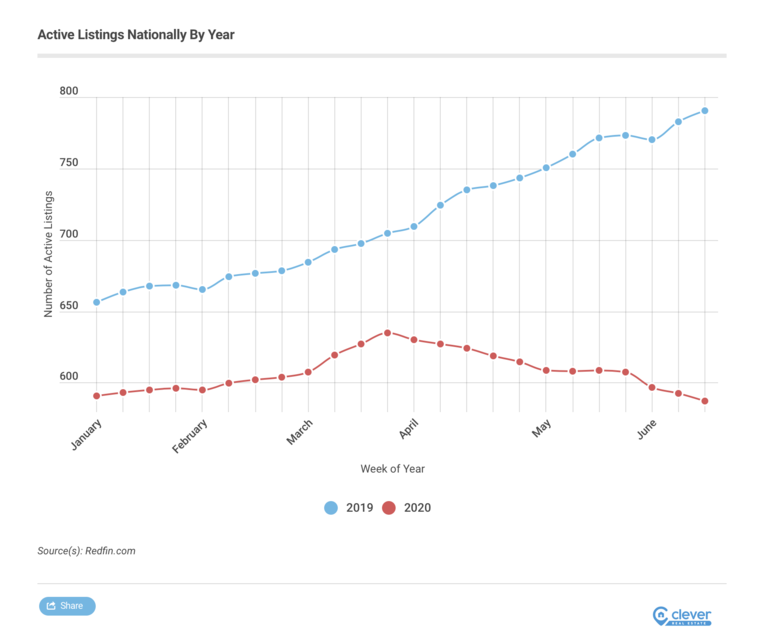
“There were fewer homes on the market at the beginning of 2020 than the beginning of 2019 — which is perhaps not surprising given the inflated market over the last few years,” Clever Real Estate said. “The overall trend, however, seemed similar to last year; active listings steadily rose through late March.”
‘Cautious’ Sellers
Clever noted real estate tends to be seasonal, with the market heating up throughout the spring and summer and cooling off in late fall. “The number of active listings, however, took a downward turn around April when COVID-19 cases became widespread across the US and has yet to recover,” it said. “The relatively low number of active listings across the nation supports previous research that sellers are being cautious about putting their homes on the market during the pandemic lockdowns.”
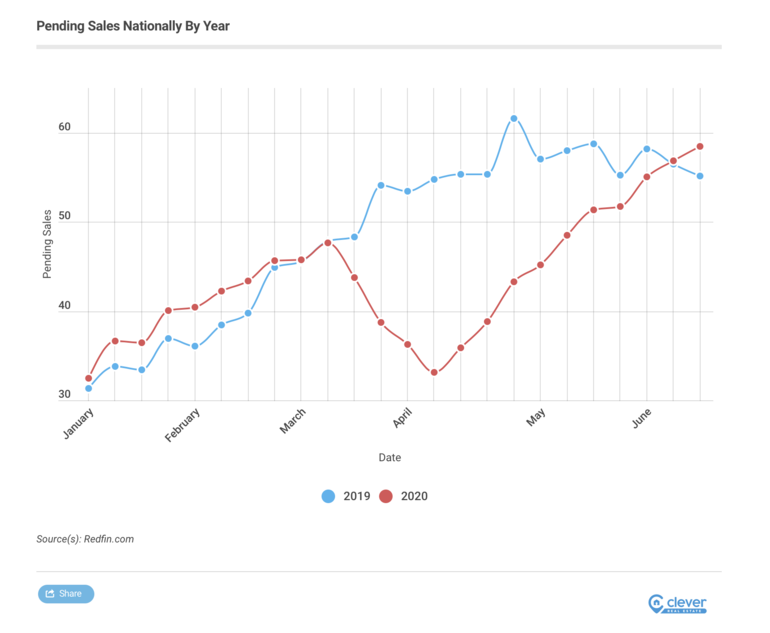
According to Clever, although inventory might be low, buyers “are still biting: The weekly pending sales in 2020 took a huge hit in early April but have since recovered to meet back up with 2019 sales.”
The company said that based on analyses of previous, similar lockdown procedures across the world, many predicted what real-estate expert Mike DelPrete called a “checkmark” recovery wherein the housing market would experience a quick dip, 3-4 weeks at the bottom, and a steady — albeit slow — recovery period.
“Put together, buyer demand can be gauged by calculating the contract ratio, or the ratio of pending sales to active listings,” Clever stated. “If there are significantly more listings than sales in a given market — leading to a lower contract ratio — we can presume low buyer demand relative to supply (i.e., seller inventory). A higher contract ratio (closer to 1:1, or 100% sold inventory) indicates higher demand.”
Top, Bottom Markets
According to Clever, markets with the largest increase in demand include Albany, N.Y.; Houston; Harrisburg, Penn.; Dallas/Ft. Worth; New Orleans; Detroit; Washington, D.C.; Cleveland; Nashville and Philadelphia.
Metros with the biggest drops in demand include Tulsa; Salt Lake City; Tucson, Ariz.; Virginia Beach, Va.; Cincinnati; Jacksonville, Fla.; Kansas City, Mo.; Knoxville, Tenn.; Little Rock, Ark.; and Boise.
The full report can be found here.