

MADISON, Wis.–Lending volume at credit unions will grow just 3% this year, yield-on-asset ratios could also fall to 3%, the lowest in credit union history, and ROA will likely decline to 0.5% in 2020, according to new projections from CUNA Mutual Group.
The company’s Trends Report for January reveals installment credit was flat, used-auto loan balances showed “significant deterioration,” and membership growth has really cooled.
Overall, CUNA Mutual’s economists are projecting the economy will contract 5% on a seasonally adjusted annual basis this year, including a massive 20% contraction in the second quarter.
Like other forecasts, CUNA Mutual is calling for an economic rebound once the coronavirus pandemic is largely under control.
Here’s what the Trends Report shows for CU performance by category:

Credit Union Consumer Installment Credit (CUCIC)
Credit union consumer installment credit balances (auto, credit card and other unsecured loans) were unchanged in January, worse than the 0.5% rise set in January 2019, due to the deleveraging mindset of many credit union members, CUNA Mutual reported.
Credit card loan balances grew at a 3% seasonally-adjusted annual rate in January due to members using cash out refinance money to pay down high rate credit card debt.
“The current economic crisis is expected to push credit union loan growth down to only 3% this year, the lowest level since coming out of the Great Recession in 2011, despite historically low interest rates,” CUNA Mutual said. “We expect a significant slowdown in consumer and business loan growth, particularly auto loans.”
Vehicle Loans
Credit union new-auto loan balances fell 0.3% in January, slower than the 0.1% decline set in January 2019, and fell 1.1% during the last 12 months, according to the Trends Report.
On a seasonally-adjusted annualized basis, used-auto loan balances fell at a 1.2% pace in January, a significant deceleration from the last few years.
According to CUNA Mutual, five factors drove this decline:
- Credit unions raised their new-auto loan interest rates two percentage points over the last year
- Rapid loan originations two-to-three years ago precipitate larger loan balance amortization today
- New-auto sales declined 2% over the last year
- Members used “cash out” funds from mortgage refinances to pay off auto loans
- Rapid growth of indirect auto lending has leveled off
“The first quarter of the year is typically the weakest quarter for credit union new-auto loan growth due to various seasonal factors,” CUNA Mutual’s economists said. “The current economic crisis will ensure that this summer will be the weakest in new-auto lending for credit unions in history…Expect auto sales to fall below 10 million in 2020, down from the 17 million sales pace set in 2019.”

Real Estate Secured Lending – First Mortgages and Other Real Estate
Credit union first mortgage originations jumped to $180 billion in 2019, a 28% increase from the $141.8 billion in originations in 2018, the Trends Report states.
“Just in the fourth quarter, mortgage loan originations jumped 77% to $59.5 billion due to the drop in long-term market interest rates,” the Trends Report states. “Credit unions proceeded to sell off 35.6% of those originations into the secondary market, a higher percentage than the 33.1% reported in 2018 due to credit unions not wanting to hold as much of these very low rate fixed-rate mortgages. Very low interest rates are likely to stimulate mortgage lending in 2020, particularly refinances, which will help buttress some credit unions.”
CUNA Mutual is further forecasting lower long-term rates are also likely to induce credit unions to sell more mortgages and other long-term loans to the secondary market.
Surplus Funds (Cash + Investments)
Credit union surplus funds rose $5.6 billion, or 4.1%, in January due to deposit accumulation exceeding loan originations, the Trends Report states.
The surge in deposits helped reduce borrowings by $2.4 billion, while capital grew by $1.2 billion in January and $16.6 over the last year.
Credit union capital grew 10.2% over the last year, the fastest pace since the summer of 2014.
Credit union surplus funds as a percentage of assets rose to 24.9% in January, up from 23.2% in January 2019, CUNA Mutual stated, adding, “Credit union liquidity positions will swell significantly in 2020 as deposit growth surges and loan growth stagnates. The obverse of the rising surplus funds ratio is the falling loan-to-asset ratio, which reached 70.8% in January, down from 72.1% last January as asset growth outpaced loan growth.”
Borrowings as a percent of assets fell to 3.1% in January, down from 4.3% in January 2019. With loan growth expected to fall below savings growth in 2020, expect credit unions to see a significant drop in borrowings.

Savings and Assets
Credit union savings balances rose 1.2% in January, more than the 0.1% decline reported in January 2019, due to the month ending on a payroll Friday, the Trend Report states. January savings balances have historically declined 0.2% due to recurring seasonal factors.
“We expect exceptionally strong savings growth at credit unions in 2020 as consumer demand dries up, discretionary spending declines and the volatile stock market makes investments less attractive,” CUNA Mutual said.
Capital and Other Key Measures
The credit union industry’s net income to average asset ratio, return on assets, rose to 0.93% in 2019, up from 0.91% in 2018, according to the Trends Report.
“A four basis point increase in net interest margins, combined with a one basis point increase in fees and other income and a three basis point reduction in provision for loan losses was more than enough to offset a six basis point increase in operating expense ratios,” CUNA Mutual stated. “Expect return on asset ratios to fall to 0.5% in 2020 as loan growth slows and falling interest rates reduce yield on assets. We could see yield on assets ratios fall to 3% in 2020, the lowest in credit union history.
Return on equity (ROE) ratios fell for large credit unions but rose for most small credit unions in 2019 due to higher return-on-asset ratios in 2018 versus 2017. The ROE ratio is one of the more important credit union metrics because it determines the long-run sustainable asset growth rate.”
Number of Credit Unions
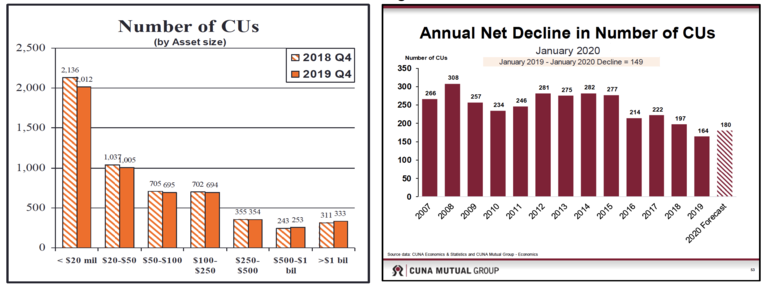
As of January 2020, the Trends Report points to CUNA estimates that 5,427 credit unions were in operation, down 149 from January 2019. Year-end 2019 NCUA call report data show 331 credit unions with assets in excess of $1 billion, representing 68% of the credit union system assets and 70% of the loans, while making up only 6.2% of all credit unions. This is up from 311 billion-dollar credit unions in 2018 holding 65% of assets and 67% of loans, the Trends Report added.
Meanwhile, the median asset size of a U.S. credit union rose to $35.7 million in 2019, a 6.8% increase from the $33.4 million set in 2018.
The Trends Report cited NCUA’s Insurance Report of Activity as showing 143 mergers were approved in the fourth quarter of 2019 – 11 due to “poor financial condition,” one due to declining field of membership, nine for an inability to find officials and 121 for “expanded services.” The merging credit unions had an average asset size of $59 million.
The continuing credit unions had an average asset size of $1.3 billion. We are forecasting that the number of credit unions will decline by 180 in 2020; this is approximately 3.4% of all credit unions.

CU Membership
Credit unions added 176,000 memberships in January, significantly below the 279,000 gain recorded in January 2019 due to weaker credit demand, CUNA Mutual reported.
The report added total credit union memberships reached 122.7 million in January 2020, which, in percentage terms, rose 0.14% in January and 3.2% during the last 12 months.
“With the economy expected to lose millions of jobs in 2020 due to the COVID-19 crisis, credit unions should expect membership growth to come in around 1.5%,” CUNA Mutual stated.