

CHARLOTTE, N.C.–The nation’s banks have collected $114 billion more in fees than they paid in interest over the past decade, according to a new analysis.
MagnifyMoney, a unit of Lending Tree, said it sought to identify how bank fees and interest have impacted consumers’ — and banks’ — bottom lines over the past decade in conducting the research, and found that between 2011 and 2020, deposit account bank fees outweighed interest by about 1.2 times.
Among the key findings, according to MagnfyMoney:
- Americans have paid far more in bank fees in the past decade than they’ve collected in interest. Between 2011 and 2020, consumers paid $345.1 billion in bank fees while collecting $231 billion in interest. That represents a deficit of $114.1 billion, or $198.40 per account.
- Bank account holders paid less in fees in 2020 than any other year dating to 2011. Americans last year paid $32.2 billion in bank fees, or an average of $53.79 per account.
- The amount of interest per account paid out by banks plummeted in 2020. Banks paid out $26.6 billion, or $44.48 per account, in interest last year, down $73.85 from a record-breaking $118.33 per account the year prior.
- Banks more than doubled what they collected per account in 2020. For each dollar paid out in interest to deposit accounts in 2020, banks collected $1.21 — a jump from 55 cents in 2019, but a far cry from what institutions were netting earlier in the decade.
Paying Less in 2020
MagnifyMoney said its examination of the 10 years’ wroth of data found Americans paid the lowest total — $32.2 billion — in bank fees in 2020 than in any year since 2011. Consumers have paid $345.1 billion in bank fees over this period, or a yearly average of $34.5 billion.
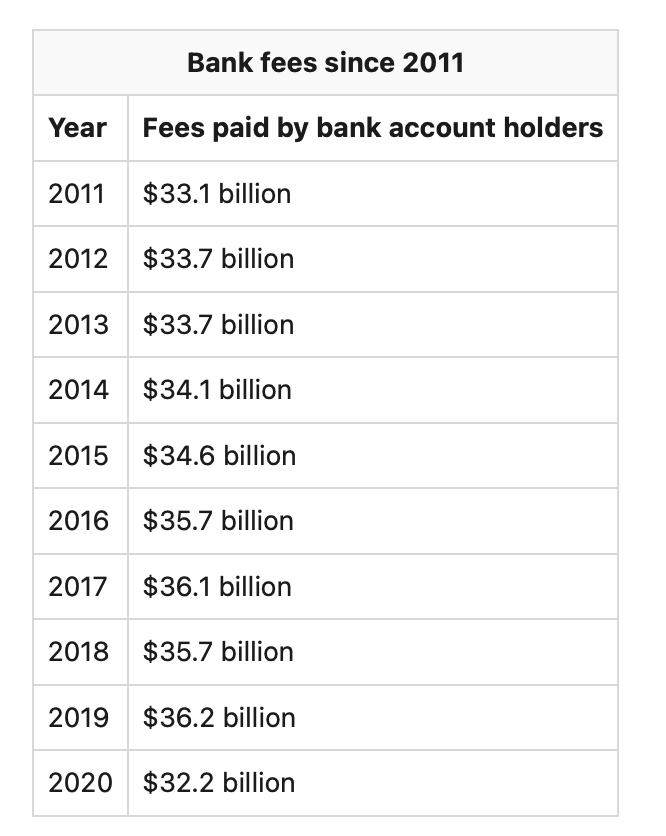
The company noted that when the pandemic started in early 2020, many banks provided temporary fee waivers to assist impacted customers, which led to the lower overall fees paid, as did the stimulus checks paid.
How did this drop in fees affect consumers on average? According to MagnifyMoney, average bank fees in 2020 were $53.79 per account, which is significantly lower than $64.84 per account in 2019.
The company said its research shows bank fees per account peaked in 2017 at an average of $66.66. On average since 2011, banks have charged $60.75 yearly in fees per deposit account.
Far Less Interest Paid
Meanwhile, in 2019, banks paid out $66.1 billion in interest, but “that amount plummeted” to $26.6 billion in 2020, or about 2.5 times less, according to MagnifyMoney. Since 2011, banks have collected $231 billion in interest — or an average of $23.1 billion yearly.
What’s notable, MagnifyMoney said, is that banks paid out more interest in 2018 and 2019 than they collected in fees. Banks paid out $45 billion in 2018 and $66.1 billion in 2019, far above any year in the past decade — and the only two years that total interest exceeded bank fees in this period.
Compared to the interest payouts from 2011 to 2017, though, the 2020 amount was still high.
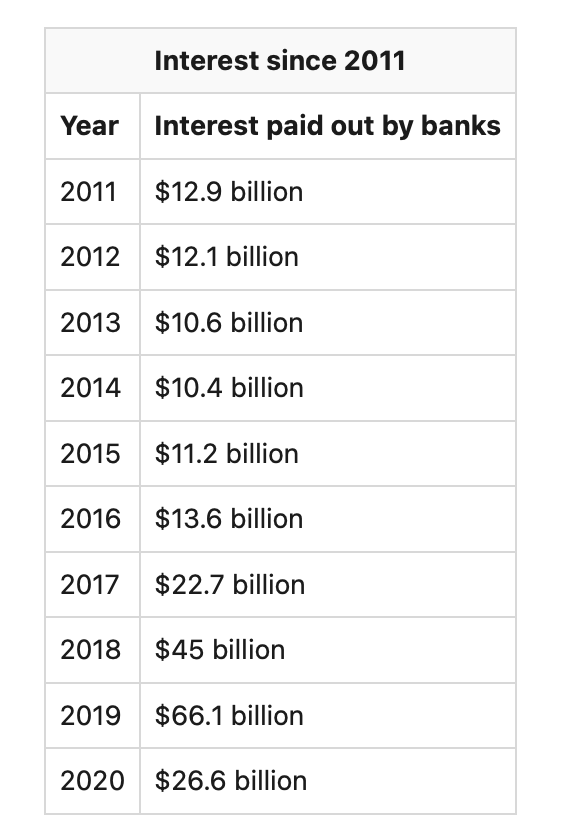
The pandemic relief measures that impacted the amount of bank fees collected also affected the amount of interest paid out on checking and savings account, the research found.
“This drop in fees and interest may have been years in the making, though. In 2017 and 2018, the Fed raised its benchmark interest rate seven times. This led to an increase in deposit rates at many banks,” the analysis notes. “The Fed started to reverse its rate hikes in August 2019, causing deposit rates to start falling in the second half of 2019. Deposit rates then plummeted in March 2020 after the Fed slashed its benchmark interest rate to help the economy try to overcome the pandemic’s effects.”
Per-Account Level Data
So, what has also this meant on a per-account level? According to MagnifyMoney, the interest paid out to consumers dropped in 2020 to $44.48 from a record-breaking $118.33 the year before — a fall of $73.85.
In the past 10 years, average bank fees per deposit account have ebbed and flowed, as has the amount of interest paid out to consumers, MagnifyMoney said, adding the average interest paid out by U.S. banks grew by:
- 68% from 2016 to 2017
- 98% from 2017 to 2018
- 43% from 2018 to 2019
From 2019 to 2020, though, it fell 62%. Since 2011, banks have paid out $40.67 yearly per deposit account, the research found.
“Despite all the turmoil that came banks’ way in 2020, they more than doubled what they collected per account compared to 2019,” the company stated. “For each dollar paid out in interest to deposit accounts in 2020, banks collected $1.21, a large jump from 55 cents in 2019. However, this win for banks in 2020 still left them falling behind the much more lucrative years earlier in the past decade.”
Since 2011, MagnifyMoney said its research found banks have, on average, made out better than they did last year. Banks have charged a yearly average of $60.75 in fees per deposit account since 2011 and paid out $40.67 per deposit account — or $1.49 in fees for each dollar in interest (better than 2020’s $1.21).
The full report can be found here.