

SPOKANE, Wash.–The average credit union leader should be fearing a natural disaster, or perhaps a surprise examination. Instead, like most people, their primary fear is snakes. And that’s their brain’s fault, as it contributes to stereotypes and bias, one expert said.
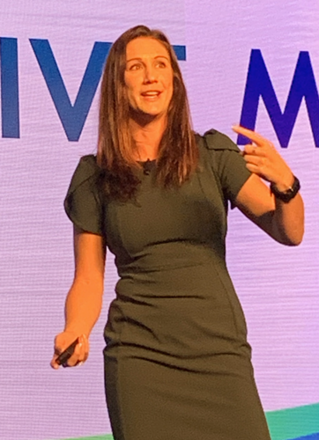
Rebecca Heiss addresses how people think during MAXX meeting.
The human brain of today was not built for today’s world. It was built for a world of tens of thousands of years ago when people lived in close-knit tribes of perhaps 150 people. Today, humans struggle to deal with a planet of eight-billion people and scenarios once imaginable, with people responding subconsciously in ways driven by their “prehistoric brains,” according to Dr. Rebecca Heiss.
Heiss, an expert in brain science and an author, illustrated for an audience at the Northwest Credit Union Association’s MAXX Conference here why they “think” the way they often do, and how they can “BREAK” that thinking.
Three Mismatches
Speaking to the issue of “Diversity, Equity, Inclusion and the Biology of Business,” Heiss said people today are “stuck with a Stone Age brain” that often leads to three “mismatches.”
What is the number-on fear among Americans? It’s not public speaking, as many people believe. Instead, it’s snakes, said Heiss.
“You’re literally nine times more likely to die by a lightning strike,” she said. “It’s an irrational fear, until you realize your ancestral brain is hardwired to be afraid of snakes. It’s the reason people are addicted to sugar. The ancestral brain couldn’t get enough sugar to lay down fats to survive winter.”
The second mismatch is all about processing information. Today, the average person is hit with approximately 400 billion bits of information per second. But the Stone Age brain can process just 50 billion per second, she said. That leads to stress on the brain, and brain stress leads to fatigue, low morale, anxiety, irritability and substance abuse, among other problems, Heiss added.
The third issue, according to Heiss, is people are often hard wired and affected by their environments in ways that create subconscious bias.
“What does that brain on stress mean for the stories that are told?” she asked. “Sometimes, the stories we want to tell aren’t the ones we tell.”
As an example, she cited “good intention bias.”
“It’s easy to miss things you aren’t looking for. It’s even easy to miss things you are looking for,” stated Heiss. “We all have blind spots, and often these blind spots align with race and gender.”
How Stories Misalign With Race
Why does racism occur? Why do people fear other people not like them?
“It’s because of our ancestral, cave man brains,” said Heiss. “Who did we live with? With people who acted and looked like us. So, when someone different came along, it was a threat.”
Racism and sexism and other biases occur even when people know diverse teams are more creative, engaged and accurate.
“We know this consciously. It’s why we push diversity,” she said. “The problem is when a stranger walks through the doors who doesn’t look like you, your body goes through a stress response. Other portions of the brain shut down. It’s why diversity initiatives often fail. The problem is so often our instincts lead to stories and our stories have associations that accompany them.”
Heiss walked her audience through examples of subconscious bias, such as the way Disney long portrayed strong women (think Cruella DeVille or any of numerous witch characters), and the way people think of blondes.
Another Stereotype
The blond stereotype is of someone who is ditzy and dumb, and is often represented by Barbie. But people never picture Ken, who is often also blonde, Heiss said.
“I don’t think people are biased against blondes, I think they’re biased against women,” Heiss stated. “People get defensive and say, ‘I’m not privileged and I’m not biased.’ That’s OK because being biased is human.”
In terms of bias, Heiss asked credit unions to think about their own marketing efforts and who is being targeted.
“It is worthwhile to ask who are you not hiring,” she said. “How might their voice contribute to reaching some of the populations you’re not reaching? We should care because there is money in it.”
Take a BREAK
How can people control how they are telling stories with subconscious biases? Heiss urged her audience to take a BREAK.
Breathe. “Breath is the only thing that connects the conscious and subconscious mind. A single breath can prime your brain to operate consciously. To do that more, practice meditation. You can grow brain cells in your frontal lobe after eight weeks of meditation.”
Redraw Lines. “Your brain is not naturally a harmonic space. It will create enemies, typically around age, race and gender. Sporting teams and companies have figured out messaging around common enemies. I am a fan of creating abstract enemies. How powerful can it be in your organization to create a common enemy? Who is your common enemy? What barriers can you break through?”
Equity and Equality. “We shouldn’t be fighting for equality. Let’s be honest, we’re note all equal. We all have different perspectives,” said Heiss. “We should be fighting for justice. Get comfortable with the uncomfortable. Every time you put yourself in a position of discomfort you are training your brain. When you don’t die (from uncomfortable situations), your brain records it as a success.”
Asking. “This is about asking for new definitions of leadership,” she said. “The top 100 leadership books all have something in common––97 of the top 100 were written by white men. There’s nothing wrong with white men. But if that is the only definition we see, we have blinders on. So, make sure to read outside your comfort zone.”
Know Thyself. “Break out of some of your subconscious stories.”