

SPOKANE, Wash.–NCUA Board Member J. Mark McWatters offered a CU audience here an update on CECL and banking the hemp business, as well as a prediction on what the board will tackle at its meeting later this week. McWatters also noted his remarks may be his last before a CU audience as a board member—or they may not.
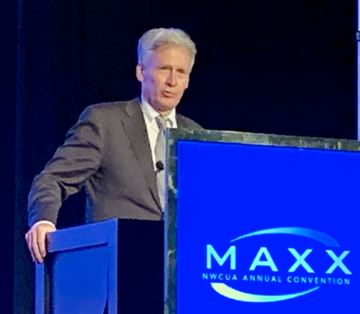
Mark McWatters addresses MAXX meeting.
Here’s a look at some of the issues touched on by McWatters in remarks to the Northwest CU Association’s MAXX Conference:
CECL
McWatters said CECL has been a “bit of a nemesis to credit unions,” saying aspects of the new accounting standard have been misunderstood by both CUs and the accounting community.
McWatters said in his earlier meetings with representatives of the Financial Accounting Standards Board he argued here was no need for CECL, CUs should be exempt, or at the very least there should be a delay. As CUToday.info reported, FASB has pushed back compliance until 2023.
Two Problems
There are two problems with CECL, according to McWatters, who is a CPA.
“The way this is structured, and to comply with CECL, the idea is a small shopping center credit union would have to go and hire an expert to have a crystal ball for what future losses might be. There isn’t a problem. Credit unions didn’t fail (during the economic downturn) because they didn’t properly reserve.”
McWatters said FASB has made some changes, but he stressed, “The key is to make sure the local CPA community gets it, that they understand what a credit union, particularly a small credit union, has to do to comply with CECL.”
The second issue, said McWatters, is on the effective date of compliance there was to be a one-day charge to regulatory capital. “You look at your reserves under the incurred loss method, and then do the CECL method, and subtract the two. It’s not a good thing. So my thought was let’s amortize this day one hit over 10 years. The banking regulators sort of jumped on that and they came up with three years. That’s not my number but it’s the number NCUA has adopted. Three years is better than taking a day one hit.”
FOM Litigation
At NCUA’s board meeting this week, in response to litigation filed by the banking industry, board members will look to clarify some issues around FOM expansion, particularly rules related to core areas in metropolitan areas. “We need to do a better job of documenting that and I appreciate the comments of the D.C. court,” said McWaters.
In its ruling, the U.S. Court of Appeals remanded the portion of the rule—without vacating it entirely—that addressed core-based statistical areas “for further consideration of the discriminatory impact it might have on poor and minority urban residents.” The provision permits credit unions to serve core-based statistical areas without serving the urban core that defines the area, an issue in the case that was the subject of questioning by the judges when the case was heard.
Banking Hemp Industry
McWatters said NCUA is just waiting on NCUA to promulgate rules on hemp before it issues rules around serving the industry. FDA has said such rules are coming by year-end.
Term on Board
McWatters’ term on the NCUA board expired in August, but he said he plans to remain on the board until a replacement is named.
“I want to say to you folks and people in the credit union community, I was a newbie to credit unions five years ago,” he said. “My NCUA time will equal about 14% of my legal career. I will tell you this has been an absolute delight and pleasure. I thank every one of you who have welcomed me and helped me understand what’s important to credit unions and what’ s not important to credit unions.