

SPOKANE, Wash.–Innovation is critical and can be championed by any CU regardless of asset size, according to one person who shared his organization’s strategy for breaking down into three areas where to focus when it comes to innovation.
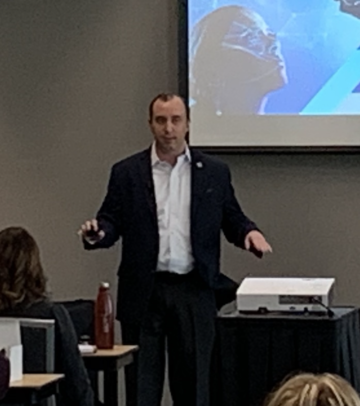
Brian Hamilton speaks during MAXX meeting.
Brian Hamilton, VP of innovation and insights with CU Direct, told credit unions gathered at the Northwest CU Association’s MAXX Conference they should take a “deep breath” when it comes to fears over certain innovations, but also to keep pressing forward.
Saying his biggest concern is credit unions—of which he is a strong proponent—won’t remain relevant, Hamilton noted regardless of a CU’s asset size, it’s a significant challenge to “spin up” a fintech on its own. But it can innovate, regardless of asset size.
Hamilton said he is a fan of Bill Gates’ observation, “We always overestimate the change that will occur in the next two years and underestimate the change that will occur in the next 10. Don’t let yourself be lulled into inaction.”
As an example, he pointed to self-driving automobiles, over which credit unions have expressed some concern given that auto loans make up more than a third of CU loan portfolios.
“Take a deep breath. This is going to happen, it’s just not going to happen in the next two years,” said Hamilton, who works out of CU Direct’s Innovation Lab in Irvine, Calif. “It’s going to happen over the next decade. And there will be an equal number of opportunities as there are threats.”
What Is Innovation?
But what is innovation? It’s an “interesting question,” according to Hamilton. In CU Direct’s case, it defines innovation as a “new solution that solves a problem.”
Innovation is not ideation, clarified Hamilton. “Ideation is an important step in the process, but it doesn’t stop there.”
As an aside Hamilton cautioned against allowing the ideation process to become bogged down. “The other thing we see happening is we bring constraints to the table in the ideation session and we instantly start nixing things. There’s a regulation, or operationally we can’t support it, or it’s not profitable. Stop doing that.”
Three Time Horizons
At CU Direct, Hamilton said the approach is to look at universe of innovations, such as blockchain and AI and robotic process automation, and sift through it according to projected time horizons so it knows where to dedicate its time.
“We look at three horizons, including those things that will be relevant in the next 18 months, and you should spend 60% to 70% of your time there,” said Hamilton.
Horizon II is for those things that are a little further out, such as blockchain, which is emerging but probably won’t be a competitive differentiator until more than 18 months from now. “But time to start looking at that now,” said Hamilton.
Horizon III is further out, such as blockchain in a ubiquitous state. “We only spend 10% of our time on that,” said Hamilton.
Free Knowledge
Monitoring innovation sounds great, Hamilton acknowledged, but many credit unions are going to say they lack resources and people. But there are ways to source knowledge for free, he said, citing as an example CU Direct’s closed Intranet on which more than 400 people now post various pieces of information.
But why does innovation even matter?
“Obviously, you have to be relevant,” said Hamilton. “There are practical things we see coming in the market that are going to make a difference.”
Much of what has come to the market has come from Amazon, leading to the so-called “Amazon effect.”
“It’s a term used in a lot of different ways, but one way to use it is in marketing,” said Hamilton. “Basic marketing 101 is about segmentation. The more sophisticated you are, the more targeted you can be in segmentation and the better you are. It’s now a segment of one. This is what AI and machine learning and Amazon and Apple are doing. You are no longer in a bucket with thousands and millions of other consumers. They can follow just you. That is relevant to you because that’s the new consumer expectation.”
The CU Advantage
The advantage credit unions have over the Amazons of the world, said Hamilton, continues to be “community.”
“Our members love that about us; never let that go,” he said. “But it’s not your only sustainable segment advantage.”
Other Observations
Other points made by Hamilton:
- Banks and credit unions are now at parity with customer or member satisfaction.
- In the debate over branch expansion or branch closures, Hamilton said the empirical data show it’s possible to close branches and prosper. But it’s about more than empirical data. “Do you have to close your branches? No, if that’s your member preference. But invest in digital transformation to optimize your back office operations.”
- Digital transformation is not about checking off boxes. “Going paperless does not mean you’re more efficient. It just means you have dual monitors. You took the paper off the desk and put it somewhere else. They’re still staring and comparing, and you doubled your IT expense,” said Hamilton. “It’s about transforming the back office to lead to better member experience, more efficiencies and higher ROI.”
- Hamilton encouraged every credit union leader to go to their loan processing area and watch what’s going on in the back end.
- “The important thing to understand about fintech is fintech now has 40% of the personal loan market share. They are taking market share from us. The point isn’t they are taking the personal loans. The point is how they did it and now they are coming after auto and mortgage and more.”
A Challenge
“I am going to challenge you to work with your providers, like Members Development, CMG Ventures, CU Direct, Filene,” said Hamilton. “We compete with these entities in some ways, but we also collaborate, because it’s for the greater good.”