

SPOKANE, Wash.–There have only been three really significant changes in the history of mankind—and the fourth is underway, according to one person, who told an audience of CU execs they are going to see some extraordinary things in their lifetimes.

Byron Reese addresses the meeting.
Byron Reese, an entrepreneur, technologist (websites he has created have seen more than a billion views) and a futurist shared with the Northwest Credit Union Association’s MAXX Conference a number of interesting observations around change and technology and what likely lies ahead.
First, the big changes. The first three pivot points in human history, according to Reese, have been:
- 100,000 years ago, when humans developed speech, which developed at same time as another technology, fire.
- 10,000 years ago, when agriculture developed. “Agriculture gave us cities, and cities gave us the division of labor. It also gave us more food.”
- 5,000 years ago, when writing developed at the same time as the wheel. “The reason these two are joined is with writing and the wheel we have everything we need for nation-states. We see all these nation-states emerge at the same time.”
Things Getting Better
Now, things are about to change for the fourth time, Reese said. The change? Two technologies: artificial intelligence and robotics, which outsource thinking and activities, respectively.
“I believe very deeply in something called progress. Things get better because of civilization,” said Reese. “We have learned to get along better. The other reason is technology. And what is technology? It’s things that multiply abilities.”
Citing Moore’s Law about the doubling of computing power every two years, Reese said humans are terribly bad at understanding what all the doubling means.
“I think it means something much more profound. If technology doubles and it doubles and it doubles, then the purely technical problems are going to be solved,” suggested Reese. “Technical problems have technical solutions. Now, don’t get me wrong, there are a lot of problems that are not technical and have to do with people.”
Problems Solved
Reese said people are going to see an extraordinary change over the next quarter-century.
“You’re going to live to see the end of disease. If you can hold on just 25 more years, you face a very real possibility you will not die,” posited Reese. “ Aging is a technical problem. You’re going to live to see the end of hunger. We already throw away enough food in this country to feed all the hungry people in the world. It now takes just 3% of us in the U.S. to feed the rest of us. You are going to live to see the end of poverty. You’re going to live to see an era of cheap or free energy. It’s the most abundant thing in the world.”
Could all of that be true? asked Reese. “Or, could it sound true if delivered fast enough?”
A Proof Point
As a “proof point” for his arguments, Reese showed a 1996 newspaper ad from Radio Shack. Ten years after the ad ran, each of the electronics items in the ad had been replaced by the iPhone. “And now the world is moving even faster.”
So what are the implications for credit unions?
Reese said technologies reduce the price of two things to zero: communication and performing calculations on data.
“That’s really the big news. What they do together is increase the velocity at which things can happen,” he said. “Credit unions and AI go together like beer and pizza. Technologies are going to change your businesses very quickly. Probably the most profound thing they will do is change how you assess risk. I think it’s going to open up opportunities for historically thin file borrowers to access credit.”
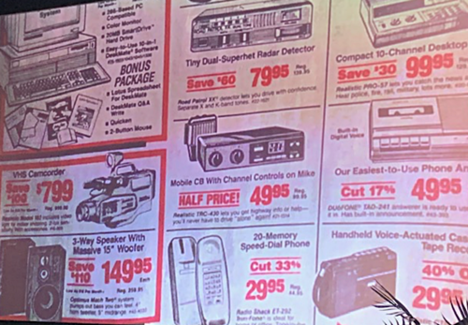
How fast can times change? Every electronics item in this 1997 Radio Shack ad was replaced by the iPhone just a decade later.
Where to Look
To really get a glimpse at the future for financial services and lending, Reese pointed to China where there are 500-million unbanked people. “They are a nation of thin file borrowers. They have to do nontraditional things to assess risk,” he said.
A number of fintech lenders have emerged in the U.S. that also look to nontraditional data to determine creditworthiness, such as cellphone payments or even social media history. But there is an emerging problem, said Reese.
“These methods of using nontraditional data sources tend to discriminate against people who are traditionally discriminated against,” he said. “We have replaced redlining with weblining.”
Innovating in a New World
How can a credit union innovate in such a new world? Reese offered this advice:
Innovating in Products
- Learn to Listen with Your Eyes. “Asking people what product they would buy is a horrible predictor. A great predictor is leaving products out and seeing which ones are stolen. If people are willing to break social norms to get the product, that’s a product to get behind. Watch what your members do and their actual behavior.”
- Solve the Problem You’re Not Expected to Solve. One company solved the problem of lost TV remotes by including a button that can be touched on the TV that signals the remote to play a song.
- Study the Data You’re Expected to Ignore. Fax technology was developed in the U.S., but it didn’t develop here. A Japanese company realized if overnight delivery companies were prospering, people would pay to get a document right away. “If you take the time to find data other people are ignoring and can infer something from it, you will have a huge lead.”
Innovating a Company
Why do some companies succeed when others do not? People like to think business is fundamentally simple with simple rules, observed Reese before adding, “This is not true. Almost all of the rules have an opposite form that is also true. I think it boils down to understanding what your core superpower is.
Innovating as an Industry
To keep the sanity, remember the X’s, he said.
- 10x rule. “If someone can do something 10x better, there is no way to stop them.”
- There is no such thing as “Big X.” “None of the original companies on the Dow are there now.. Big Whale Oil didn’t stop Big Kerosene.”
The Consequences
Reese acknowledged there is much nervousness around AI and robotics eliminating jobs. But he’s not a believer.
“If there is a job out there you can imagine a machine doing, and you make a human being do that job, you are saying we need you to not do anything creative. These are the worst jobs in the world,” he said. “People tell me all the time there is this hierarchy of jobs. The fact is what technology does is it creates jobs at the top and destroys jobs at the bottom. Do you think the people at the bottom can do these new jobs? The answer to that is no. The real question is can everybody in this country do a job a little bit harder than the job they have? We lose half of all jobs every 50 years, but we don’t have systemic unemployment. In the U.S., unemployment is almost always between 5% and 10%. The dominant image of the future is going to be the Help Wanted sign.”
Lesson from Grateful Dead
Finally, Reese urged credit unions to learn a lesson from the Grateful Dead.
“The Grateful Dead encouraged people to record their music. They realized they weren’t in business of selling CDs, they were in the relationship business. I think that’s your super-weapon in the end.”