ALEXANDRIA, Va.-The National Credit Union Share Insurance Fund shows a significant increase in reserves to reflect “probable and estimable” losses by specific credit unions, which is widely believed to refer to losses by CUs that made loans for taxi medallions that have plummeted in value.
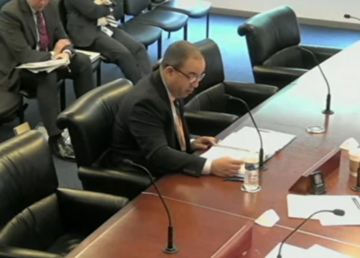
NCUA CFO Rendell Jones speaks to NCUA board meeting.
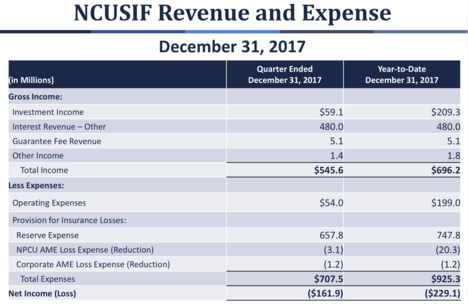
During its meeting here the NCUA board was updated on the state of the NCUSIF by CFO Rendel Jones. For the quarter ended Dec. 31, 2017, the NCUSIF reported a $161.9-million loss and $229.1 million for the year.
But the most noticeable line item in the NCUSIF’s balance sheet is the big increase in reserves. The agency is reporting year-end reserve balance of $925.5 million, up from a beginning balance of $286 million. NCUA also spent $17.8 million in expenses related to liquidations in Q4, which represents the bulk of the $18.4 million the agency spent on liquidations for all of 2017.
Jones told the board that the general reserve is “the measure of what we believe to be the contingent liability looking at the system as a whole. The specific reserve is really a measure of when we have more specific information about a credit union and what we estimate to be the economic loss for that credit union. This is GAAP accounting.”
In response, NCUA Chairman J. Mark McWatters, who is also a CPA, asked, “Something must have happened to make this more probable?”
“That is correct,” answered Jones. “One could deduce that something has become probable and estimable.”
As CUToday.info has extensively reported, what many analysts have deduced is the losses are related to loans and loan participations made by credit unions for taxi medallions, which have sunk in value as services such as Uber and Lyft have proliferated. But what credit unions will still need to deduce is exactly which credit unions represent which potential losses, as NCUA is not required to identify those CUs. It’s an issue McWatters addressed.
“I notice the specific reserve is a number, but I don’t know which credit unions that affects?,” McWatters said. “Are we hiding something here?”
Replied Jones, “We are not hiding anything. In many cases, the credit unions that meet the standard for probable and estimable are still operating and the disclosure of that information could harm that. We are also permitted to withhold (their names) under FOIA and the Sunshine Act.”
McWatters said that scenario means every credit union exec needs to ask themselves a “soul-searching question: if this was your credit union, would you want this information disclosed when you are under a supervisory action?”
Other notes from the year-end financials for the NCUSIF:
- For year-end 2017, the NCUSIF held assets of $16.1 billion, nearly all of which was in Treasuries and other investments
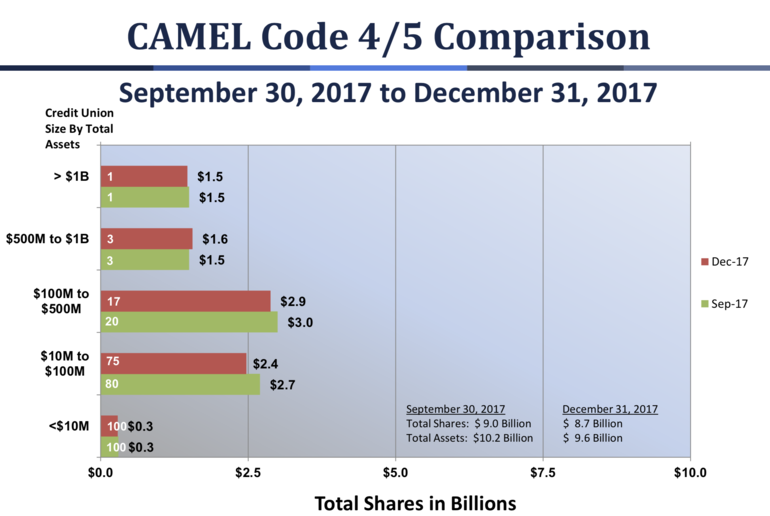
- $9.6 billion in assets was represented by credit unions that are CAMEL Code 4 and 5, a decrease from the $9.6 billion at the end of Q3
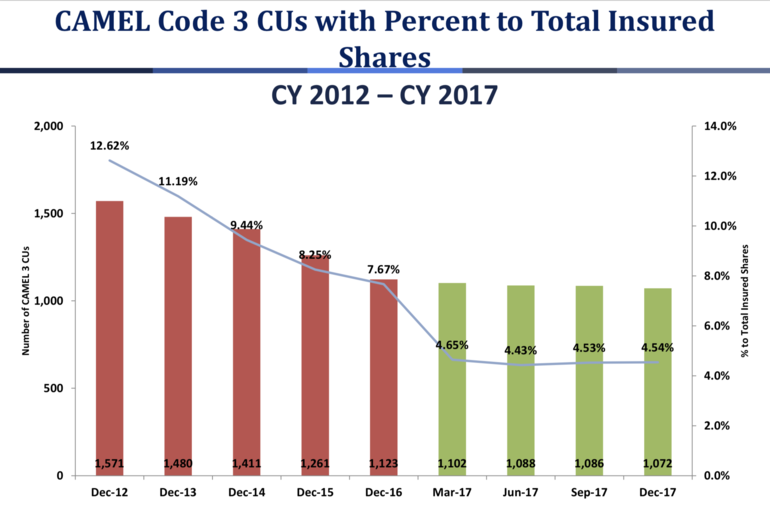
- Jones said total assets of $55.9 billion of assets were represented by CAMEL Code 3 CUs at year-end 2017, up from $55.1 billion as of Sept. 30
- There were 10 failures in 2017 at a cost to the insurance fund of $24.4 million. That compares to 14 failures representing $8.6 million in 2016
The full copy of the year-end NCUSIF report can be found in CUToday.info’s The Gov here.