

WASHINGTON–The newest NCUA board member, Mark McWatters, introduced himself to CUNA’s GAC here with a message that very quickly found a receptive audience.
McWatters said that his experience as both a CPA and attorney had grounded him in the need for transparent and fully accountable regulation, reiterated his previous statements that the risk-based capital proposal is unnecessary, emphasized again his desire to see the NCUA budget process opened up to questions and “TV cameras,” and called on NCUA calling on the NCUA Board to establish three formal advisory committees.
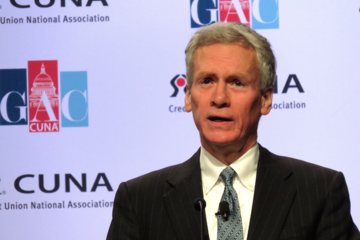
NCUA's Mark McWatters speaking at GAC.
The full text of McWatters’ comments can be found here.
McWatters challenged NCUA to have the “confidence, courage and conviction to chart a regulatory path for the credit union community that is based upon a transparent and fully accountable appreciation of the unique structure and attributes of the cooperative, not-for-profit business model.”
He further told the GAC that he believes in “true regulatory relief” and called on NCUA to “strive for thorough and thoughtful engagement.”
“True regulatory relief and protecting the safety and soundness of the Share Insurance Fund, in my view, are not mutually exclusive goals,” McWatters said.
Saying there is a need for an “objective and forward-looking balance between the free marketplace and protecting the Share Insurance Fund,” McWatters expressed concern that a “disequilibrium seems to be in place” when measuring regulation against the actual risk presented by the credit union community to the Share Insurance Fund.
In discussing the importance of regulatory relief for credit unions, McWatters encouraged NCUA to undertake true regulatory relief, including incorporating supplemental (secondary) capital into the final risk-based capital rule and modernizing the antiquated member business lending regulations that place unnecessary limits on the ability of credit unions to extend job-creating small business loans to Main Street enterprises. He also said NCUA needs to conduct a “top-to-bottom review” of its field of membership regulations that needlessly restrict the ability of credit unions to serve consumers.
The newest NCUA board member praised CUs for meeting the financial services needs of the middle class and the underserved, saying that “in a financial services world dominated by interconnected, systemically important, too-big-to-fail financial institutions, it is truly refreshing and remarkable that the locally owned and managed, cooperative, not-for-profit business model exists and thrives today.”
McWatters called NCUA and the credit union community to work together in and new direction through a “collaborative and collegial process with the goal of building trust and inclusiveness.”
“Matters of regulatory relief, the economic power of the marketplace and support for Middle American consumers, small business persons and the economically disenfranchised have always been embedded as an integral part of my DNA and will continue to serve as the foundation of all actions I take as a member of the NCUA Board,” McWatters said.
“The continuing success of the credit union system is directly attributable to the tireless, diligent efforts of you and your colleagues,” McWatters said. “I pledge that I will endeavor to formulate a regulatory protocol that respects these contributions and accomplishments while maintaining the sustainability and viability of the credit union financial services model and securing the safety and soundness of the Share Insurance Fund.”
Finally, McWatters called on the NCUA Board to “establish not less than three formal advisory committees” with the mandate to advise the NCUA Board about:
- NCUA’s budget and budgetary process,
- NCUA’s examination programs and appeals process, and
- Areas where NCUA may expedite regulatory relief for the credit union community without compromising the safety and soundness of the Share Insurance Fund.