

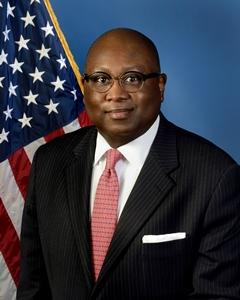
Rodney Hood
WASHINGTON—The Senate Banking Committee is holding a hearing next week with NCUA Chairman Rodney Hood slated to testify.
The hearing will focus on regulators' efforts to provide financial institutions with relief and resources amid the coronavirus pandemic.
A livestream of the virtual hearing will be available on the committee's website.
In addition to Hood, representatives from the Federal Reserve, Office of the Comptroller of the Currency, and FDIC will also be testifying.
The hearing is set to begin at 10 a.m. ET Tuesday.
SCOTUS Hears TCPA Case
Separately, the Supreme Court heard arguments in a case involving the Telephone Consumer Protection Act (TCPA)—fittingly, by telephone.
This week the court for the first time in its history has been hearing cases via teleconference due to the coronavirus pandemic. The TCPA has gotten significant attention from credit unions, specifically related to whether calls to inform members of activity on a card or other issues are a violation. The CU trade groups have repeatedly pressed the FCC to clarify the rules.
The case, Barr v. American Association of Political Consultants Inc., involves language in the 1991 law that puts limits on the number of robocalls that can be made. In 2015, Congress added an amendment allowing robocalls for government debt collection.
It is the government debt exception that has been under review in the courts and it was ruled unconstitutional in the Fourth Circuit. But the restrictions on other robocalls were left in place, creating the core of the arguments in the case before the Supreme Court, which is the constitutionality of content-based discrimination of robocalls.
Should the highest court ultimately decide the government debt exception is unconstitutional, it will mean that more robocalls fall under the banner of free speech, likely preventing prohibitions on such calls.
During arguments, Roman Martinez, Attorney for the American Association of Political Consultants, argued that while some restrictions on robocalls are constitutional and would not survive strict scrutiny, the current legislation inappropriately bans certain types of calls based on their content.
Martinez further suggested, “Because of the fact that everyone has cell phones, the government has an especially strong interest now, from a revenue perspective, of making those revenue calls.”
But in his arguments, Deputy Solicitor General Malcolm Stewart said the content of the call is not the only factor in determining the TCPA’s application.
“It is true that often a court...would look in part to the content of the call,” said Stewart. "But you wouldn't look exclusively to the content of the call."