

WASHINGTON–During testimony before the Senate, NCUA Chairman Todd Harper offered an update on the state of credit unions, repeated a call for two expanded authorities, heard NCUA both praised and criticized, and offered a one-word answer when a senator wanted assurances certain language would not appear again in the agency’s strategic plan.
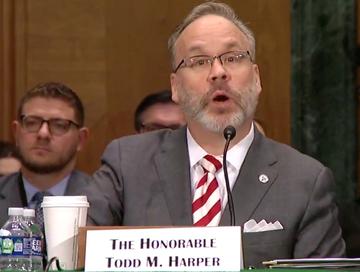
Harper appeared before a Senate Banking Committee hearing titled, “Oversight of Financial Regulators: A Strong Banking and Credit Union System for Main Street.” Also appearing as witnesses wereMichael S. Barr, vice chair for supervision with the Federal Reserve System; Martin J. Gruenberg, acting chair of the FDIC, andMichael J. Hsu, acting comptroller with the Office of the Comptroller of the Currency.
Harper and other regulators will appear before the House on Wednesday for a similarly titled hearing.
Harper told the committee in his oral statement that while the economic fallout of the COVID-19 pandemic and rising interest rates have influenced credit union performance over the last year, the credit union industry remains on a solid footing.
Harper shared an update on credit union data points—4,853 federally insured credit unions, nearly 133 million members, $2.1 trillion in assets, aggregate net worth of 10.42%––and said the National Credit Union Share Insurance Fund continues to perform well, with no premiums or distributions expected at this time.
‘Notable Actions’ Taken
“During the last year, the NCUA has taken several notable actions to strengthen capital, enhance cybersecurity, and support small and minority credit unions,” Harper said. “To fortify the credit union system’s ability to better withstand future crises, the NCUA implemented its risk-based capital rule, along with a simplified compliance option at the start of 2022.”
Harper also noted NCUA will begin deployment of its new, scalable Information Security Examination program to allow it to better evaluate credit union cyber risks, and it has further increased available resources in the field to assist small and minority credit unions.
“And, we will soon modify our examination procedures for minority credit unions to better recognize their unique strategies,” Harper said. “Additionally, the NCUA is paying closer attention to consumer financial protection, which buttresses and complements our safety-and-soundness efforts.”
Additional Points Made
Other points made by Harper during his oral testimony:
- NCUA examiners are reviewing compliance with pandemic-assistance programs, fair lending rules, servicemember protections, fair credit reporting laws, and overdraft programs.
- There has been an increase in resources for fair lending supervision.
- As 2023 approaches, the agency is emphasizing that all credit unions remain vigilant in managing safety and soundness and consumer financial protection to prepare for rising interest rates, inflationary pressures, liquidity concerns, and cybersecurity threats.
- NCUA has undertaken several rulemakings, or implemented new rules during the last year, including rules addressing member expulsion procedures, subordinated debt, emergency capital investments, and cybersecurity notifications.
Call for Legislative Changes
Harper repeated a request he has made previously, as have other members of the NCUA board, calling for “two legislative changes that would help the agency better fulfill its statutory mission.”
“Most timely, the NCUA requests a permanent adjustment to agent-member requirements for the Central Liquidity Facility. Notably, the extension of this enhancement comes at no cost to the taxpayer, as scored by the Congressional Budget Office,” Harper said. “Currently, corporate credit unions may serve as an agent for a subset of their members. But without legislative action, by year’s end, three out of every four credit unions—including most minority credit unions—will soon lose access to an important liquidity backstop. And, the credit union system’s capacity to address liquidity events will shrink by almost $10 billion.”
Vendor Oversight Authority
Second, Harper asked Congress to provide the agency with the ability to oversee third-party vendors, a request opposed by the credit union trade groups.
“This statutory change would provide the NCUA parity with other agencies that supervise and regulate federally insured depository institutions,” he said. “This examination authority is critical given the system’s increased reliance on third-party vendors and credit union service organizations. The Government Accountability Office, Financial Stability Oversight Council, and the NCUA’s Office of Inspector General have all recommended that Congress restore the NCUA’s vendor authority.”
What Worries NCUA?
Asked by Sen. Sherrod Brown (D-OH) on what he sees as his biggest concerns, Harper responded, “I see four risks that are coming down the line. First is interest rate risk for the institution itself. Second is liquidity risk. The third is cyber security risk, and something that we're watching on the horizon would be credit risk that happens particularly as unemployment rises. There is a correlation in the numbers that shows that as unemployment rates go up we often see an increase in charge-offs and defaults that's something that we're going to be watching very closely moving forward.”
Language on Farming Communities & FOM
Sen. Mike Rounds (R-ND) pressed Harper on language that had appeared in NCUA’s Strategic Plan 2022-2026 regarding FOM and the type of loans impacted by climate change, in which the agency stated, “Changing weather patterns will disproportionately affect farming communities. Over time, climate change will likely affect the value of collateral, including homes and vehicles. To remain resilient credit unions may need to consider adjustments to their fields of membership as well as the types of loan products they offer. Efforts to combat climate change will likely give rise to new regulations, potentially increasing costs for credit unions as they adapt and respond.”
Rounds called the language “very problematic” and said that “thankfully,” due to opposition on his part and on the part of others, it was not included in the final plan.
“Chair Harper, will you commit to avoiding similar problematic language in future strategic plans and commit to not punishing credit unions for supporting their local farmers ranchers and agri-businesses?”
“Yes,” answered Harper.
The Very Best in CU Reporting. Every Morning. At a Price Every CFO Will Love
Don’t forget to check your Spam/Junk email folder if you haven’t been receiving your free, popular and daily CUToday.info news headlines.
And if you haven’t yet signed up for the new email solution on which CUToday.info has partnered with ResponseGenius, you can do so here. Signing up requires less than one minute of your time.
CUToday.info has received very positive response from readers following the move to an improved provider of the daily headlines, but many also noted they did need to go to their Spam/Junk folder and mark it as safe.
The new email solution has not only improved every reader’s delivery experience, but it also features a fresh, new format that is easy to read, especially on mobile devices.
Please note and/or make your IT department or email administrator aware the emails will be coming from the domains CUTodayinfo.com and CUTodayinfoReply.com.