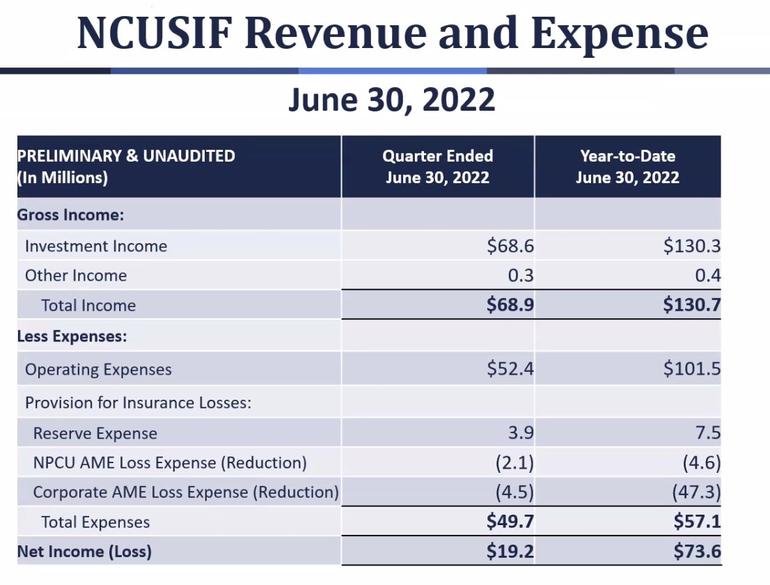
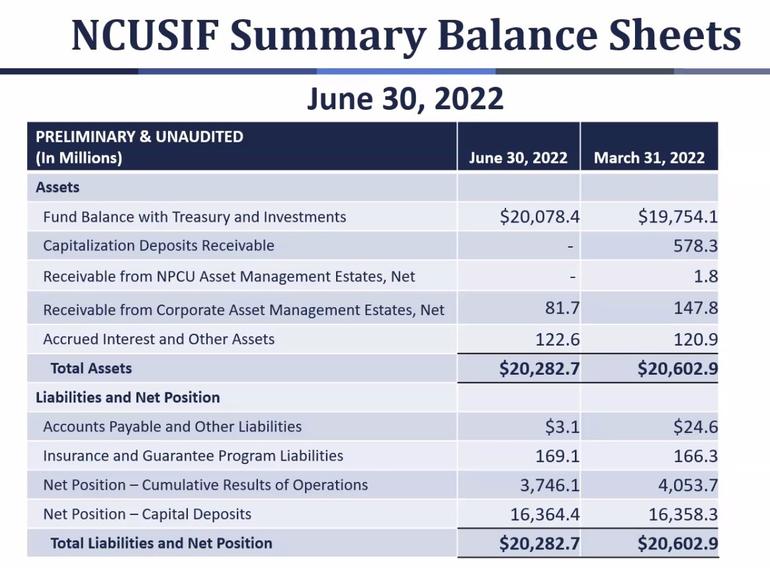
ALEXANDRIA, Va.–The National Credit Union Share Insurance Fund had a generally strong second quarter in 2022, with few CU failures and $73.6 million in net income.
It’s unlikely there will be any premium charged to credit unions, but also not likely credit unions will see any distribution from the fund, stated the agency’s CFO, Eugene Scheid, during Thursday’s open board meeting.
Some concerns were expressed, however. NCUA Chairman Todd Harper said many of the CUs now “getting caught in a liquidity vice of rapidly rising interest rates have $1 billion or more in assets,” and that those CUs present a “flashing caution sign.”
Overall, the NCUSIF closed Q2 with $20.3 billion in total assets, which was down by $300 million due to an unrealized loss on Treasury investments during Q2, according to Scheid.
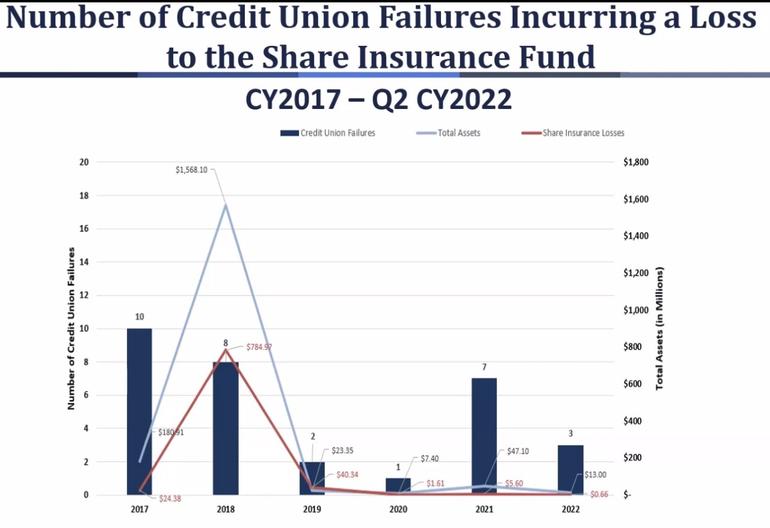
There were three credit union failures during the first half of the year, two of which involved assisted mergers. Fraud was a contributing factor in two of the failures, with the cost to the fund being $700,000, according to Scheid.
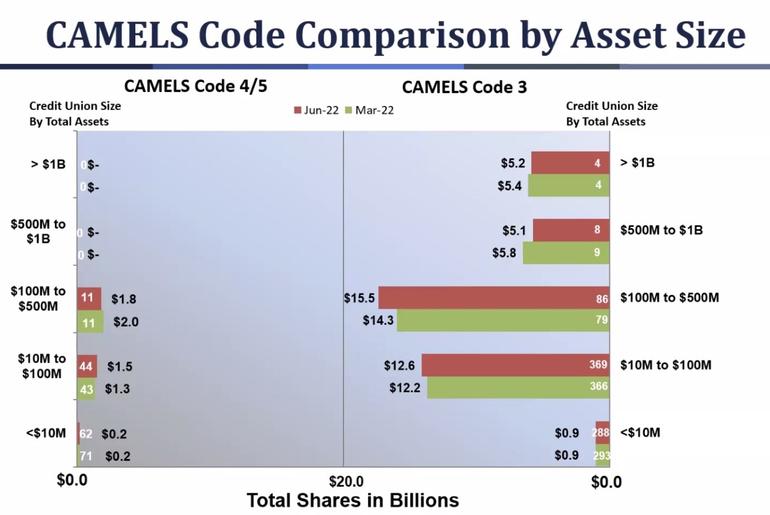
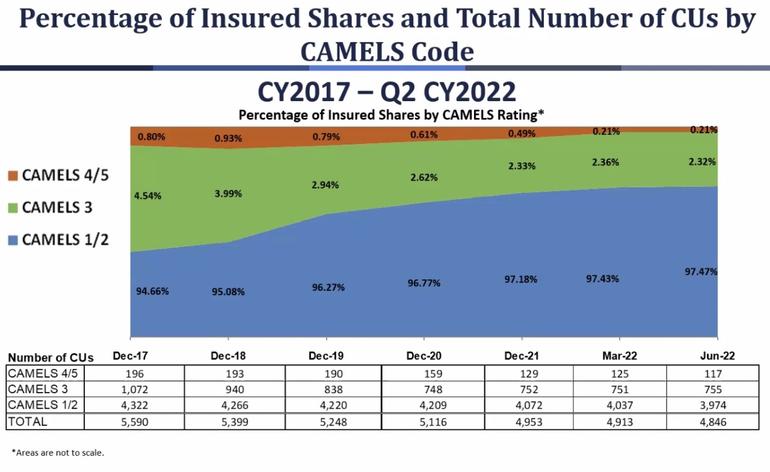
The percentage of insured shares and total number of CUs by CAMELS Code can be seen in the chart below.
Harper: Good News, But Also Caution Around Liquidity Pressures
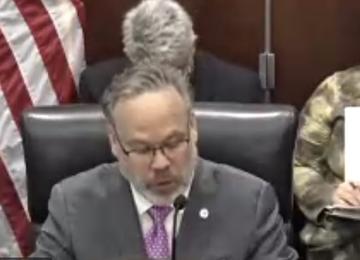
Todd Harper
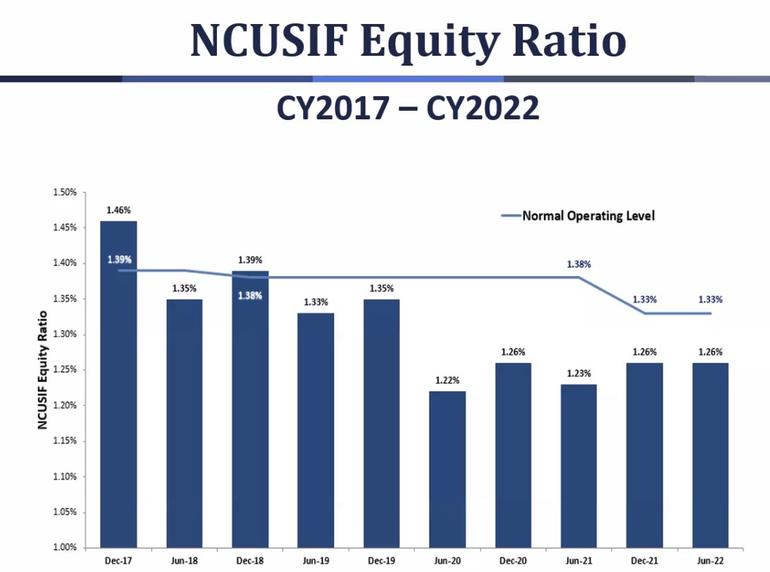
“Today’s briefing is filled with good news,” said NCUA Chairman Todd Harper. “The Share Insurance Fund continued to perform well in the second quarter, as it had in the first quarter. Although the equity ratio sits below an ideal level, it remains relatively stable at 1.26% as of June 30, which is a slight improvement over the 1.25% forecast provided last quarter.”
NCUA is forecasting a projected equity ratio of 1.30% at the end of 2022, which would be four basis points higher than year-end 2021.
Harper noted the Q2 data marks the first Share Insurance Fund presentation to reflect the CAMELS data, which now includes the “S” for Sensitivity to Market Risk.
While there was a small increase in CAMELS 3 credit unions this quarter, the data continues to show solid performance overall, according to Harper.
“The improved health of the Share Insurance Fund validates the NCUA board’s wisdom in delaying the imposition of preemptive premiums on the industry earlier in the pandemic when we teetered dangerously close to the 1.20% statutory minimum for developing a plan to recapitalize the Share Insurance Fund,” Harper said. “Nevertheless, while we project a 1.30% equity ratio by the end of the year, we are not out of the woods just yet.”
Harper said credit unions are feeling additional liquidity issues, and some credit unions are now “getting caught in a liquidity vice of rapidly rising interest rates and have $1 billion or more in assets.”
Billion-Dollar CUs & Risks
“Those billion-dollar-plus credit unions pose the risk of greater losses to the Share Insurance Fund,” said Harper. “That fact is a flashing caution sign that we should all heed, and it indicates that we should continue to proceed carefully when making any decision about the Share Insurance Fund.”
Asked by Harper how do inflation and rising interest rates are affecting both the Share Insurance Fund and its equity ratio, Scheid cited several factors, some of which are encouraging, others are cautionary, he said. The concerning signs include increased operating costs, he said, as well as interest rate risk that amplifies credit unions’ risks.
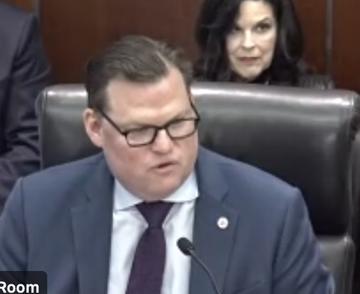
Kyle Hauptman
Hauptman: ‘Threat of Losing Access to Emergency Liquidity’
Like Harper, Hauptman said he saw a “lot of good news” in the update, noting losses to the SIF are a “fraction” of what they were over the past decade, with fraud contributing to two of the three failures in the second quarter.
As expected, the growth in insured shares continued to slow.
Citing the liquidity pressures credit unions are feeling, Hauptman said credit unions have a variety of tools to manage the challenges, including the recently passed derivative rule and updated supervisory guidance on interest rate risk.
“Unfortunately, many small credit unions – specifically the 3,600 under $250 million in assets – face the prospect of not having an emergency liquidity source,” said Hauptman. “I’m talking about membership in the Central Liquidity Facility through the corporate credit union agent sponsorship program.
“I mention this because – as most of you know – there is legislation in Congress that extends the ability of those small credit unions to access the Central Liquidity Facility via the corporate credit unions,” he continued. “But of course, there is no guarantee that the legislation passes. NCUA has been communicating the importance of this provision to our friends on Capitol Hill, and here has been our message: This provision – one that allowed small credit unions to more easily access emergency liquidity – was included in the CARES Act in 2020 as a way to resolve a problem that grew out of the last financial crisis.”
The Loss of U.S. Central
Hauptman noted that a decade ago, when the mortgage crisis first hit, U.S. Central – the corporates’ corporate – had the capital to pay for CLF membership for all credit unions for emergency liquidity access. The dissolution of U.S. Central left many smaller credit unions without access to the CLF, he reminded, noting there isn’t an equivalent entity like U.S. Central today.
“In anticipation of another financial crisis, the CARES Act allowed for a corporate to join the CLF for a subset of its members. Following the CARES Act passage, the result was an increase of over $12 billion in additional reserve liquidity as corporates joined the CLF for credit unions under $250 million,” said Hauptman. “The CLF is the only practical source of emergency liquidity for the over 3,600 credit unions under $250 million. Most of these credit unions are so limited in resources that a direct relationship with the CLF is impractical. The current agent program provides their corporates the authority to put up the capital and provide support on their behalf.
“But the program is about to end with the expiration of the CARES Act,” Hauptman said. “If corporates are not allowed to act as agents for a subset of their member credit unions, these credit unions will lose access to the CLF. We expect a reduction of $9.7 billion in reserve liquidity for the credit union system due to the corporates withdrawing their funds. That’s a $9.7 billion buffer between credit unions and the American taxpayer.”
The current interest rate risk environment makes a liquidity event in the short term a possibility, Hauptman added, echoing Harper’s comments.
“Without agent membership, 3,600 credit unions face the threat of losing access to emergency liquidity. NCUA will continue to communicate with Congress on this,” Hauptman cautioned. “So that’s NCUA’s message. I’ll add my two cents on top of it, which is that I completely understand the desire to put all of the emergency COVID provisions behind us. Life, including economic life, must go back to normal.”

Rodney Hood
Hood: Seeking Transparency
Hood said it is possible a “foreboding” economic environment is transitory, but he is not sure that is the likely outcome.”
“Furthermore, we can’t rule out the possibility of a recession that could have a serious impact on credit union operations,” said Hood. “So while we hope for the best, we prepare for the worst.”
That said, Hood added there is plenty to be positive about, including that CAMELS 1 and 2 CUs makes up 97.7% of total CU assets.
“Further, no credit union with more than $500 million in assets is rated a four or five,” said Hood. “So I will repeat, while we hope for the best, we prepare for the worst.”
Meanwhile, Hood noted an earlier board meeting on the status of the Share Insurance Fund discussed the outside accounting firm we hired to look at the true-up issue and how this impacts the equity ratio.
“For the record, at one of the last share insurance board updates, we discussed that the true-up memo by the outside accounting firm states that the timeliness and accuracy of the data is required in the Federal Credit Union Act, so this provision in the law, and I quote, ‘May provide some latitude from a strict interpretation, that the equity ratio must be calculated based on the financial statements amounts, particularly given the knowledge of the timing effect on the calculation of the equity ratio. Accordingly, it may be permissible to use the pro forma calculation of the contributed capital amount when calculating the actual equity ratio’,” Hood said.
Transparency Requested
“All three board members have asked for transparency at one point or another,” Hood continued. “The memo addresses a number of issues including how the NOL and equity ratio is calculated. In a previous board meeting, I noted that the letter pointed out the current practice understates the equity ratio by several basis points and that there were several options for correcting this understatement. I would ask that the full memo be released as soon as possible.”