ALEXANDRIA, Va.–The NCUA board has voted 2-0 to put out for 30-day comment a proposal that extends by one year the effective date of its final rule on risk-based capital. Compliance would be mandatory on Jan. 1, 2020 rather than Jan. 1, 2019 under the proposal.

The NCUA board discussing RBC proposal.
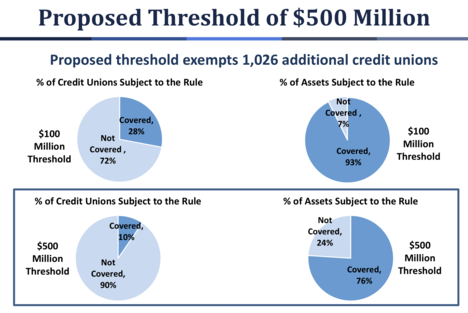
The proposal further adjusts the definition of “complex” credit unions for risk-based capital purposes to those with $500 million in assets from $100 million in assets. That change would exempt an additional 1,026 credit unions (90% of all CUs, although CUs representing 85% of assets would be covered by the risk-based capital rules, NCUA staff said during the meeting).
NCUA said the delay would allow both credit unions and the agency time to prepare for the changes. The agency added that during the extended delay period its current PCA requirements would remain in effect.
Three Years Later…
The 2-0 vote comes nearly three years after now Chairman J. Mark McWatters, who was a board member in 2015, voted against the risk-based capital proposal, in part due to differences he had with then Chairman Debbie Matz, who voted in favor of it, as did board member Rick Metsger.
While Metsger voted in favor of the proposal for the one-year delay, he also said he was “perplexed” over why credit unions continue to push for more delays in risk-based capital rules, especially when CUs have suffered due to losses to the insurance fund as the result of other credit unions that were undercapitalized based on their risk.
He noted discussions and proposals related to risk-based capital first began in January of 2014, and when the board voted to enact the rules in October of 2015 it gave credit unions until 2019 to comply.
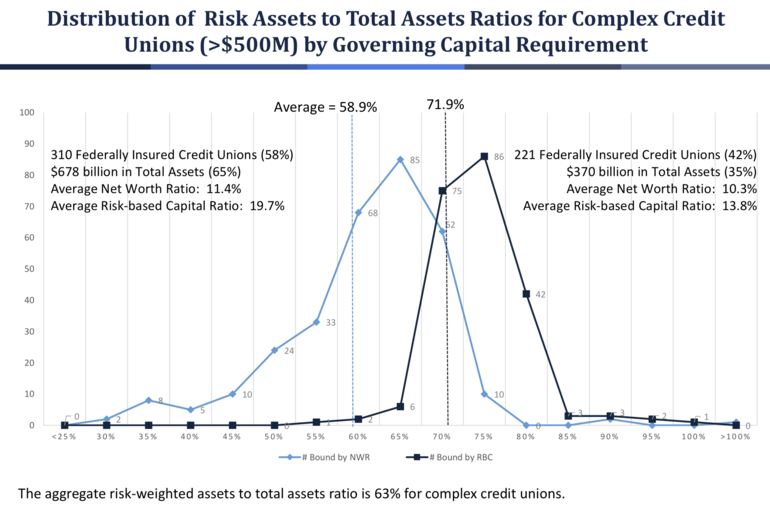
“We gave credit unions three years to either raise capital or adjust their portfolios if they needed it to adjust their risk,” said Metsger. “This is the longest delay in the agency’s history, to my understanding. Five years. I am perplexed as to why some in CUs believe credit unions need another two-year delay after five already, when the data show complex credit unions are ready. Capital at credit unions is up 25% since the rules were issued, and that doesn’t include the recent refund from the NCUSIF. Complex credit unions have 18% risk-based capital; that’s 800 basis points above the 10% requirement. That’s not just a cushion, it’s a full-size airbag. A credit union that has a RBC that is low isn’t just an outlier, it’s an extreme outlier. The members of such a CU should be asking their board and management why they can’t meet a standard that virtually all other credit unions are meeting.”
The Proposal’s Effects
Under the proposed rule, 98.7% of all complex credit unions would be considered well-capitalized, with the aggregate and average risk-based capital ratios for all complex unions 16.8% and 17.2%, respectively.
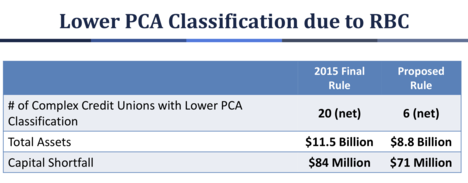
NCUA’s Director of the Office of Examination and Insurance Larry Fazio said under the proposal there would be seven credit unions with less than 10% in capital representing $10.2 billion in assets. An additional $208 million in capital would be needed by those CUs to meet the 10% proposed RBC requirement.
Under the proposal, NCUA has eliminated two factors in determining a “complex” credit union: Offering Internet banking, and holding investments with maturities greater than five years, where the investments are greater than 1% of total assets.
The proposal further revises four of the indicators used. The four changes are:
- The proposal states Commercial Loans in place of Members Business Loans
- Participations Loans are replaced by Participation Loans Sold
- First-Lien Mortgages are excluded from Interest Only Loans
- Real Estate Loans are narrowed to Sold Mortgages
Potential Losses
Fazio acknowledged that should those credit unions fail it would represent a large loss to the National Credit Union Share Insurance Fund.
“Total losses to the NCUSIF over the next 10 years would likely be significantly larger for credit unions with more than $500 million in assets than for those with assets between $100 million and $500 million if historical trends continue,” said Fazio in his presentation to the board.
Fazio further said that:
- Exempting credit unions with assets between $100 and $500 million represents approximately 16% of the total assets of credit unions bound by risk-based capital under the 2015 Final Rule and 21% of incremental capital required in the credit union system
- Under this proposal, 84% of the risk-based capital bound assets are covered along with 79% of the incremental capital required in the credit union system
Comments Welcome, But…
McWatters said NCUA welcomes comment over the next 30 days, but will only focus on comments specifically on the rule itself, on the effective date and the definition of complexity.
Added Metsger, “In making this change, we will protect shareholders in the NCUSIF. We have balanced the need to protect the NCUSIF with our goal of providing regulatory relief to non-complex credit unions.”
Metsger, who said the prior RBC rules from NCUA were opaque and not easily understood, stressed in comments prior to the vote that no banks are exempt from risk-based capital rules regardless of size, even though the NCUA rule exempts 90% of all CUs.
“I expect anyone who believes continued delay is needed to explain why credit unions need so much more time than banks do,” he said.
He also reminded that while there is a push to reduce oversight and capital demands, that twice in the last decade a “small number of credit unions have taken on excessive risk that the remaining credit unions have had to pay for.”