


L-R: Mark McWatters, Rick Metsger
ALEXANDRIA, Va.—The NCUA board Friday proposed a rule that would drop the overhead transfer rate (OTR) to 60% from 67.7%, and include new OTR calculation methodology the agency believes is simpler.
By a 2-0 vote, the board voted in favor of putting the rule out for a 60-day comment period, with the goal of presenting a final rule for approval and implementation during its November meeting later this year.
The board emphasized that federally insured state chartered credit unions are not subsidizing federal charters with the OTR, and that the proposed rule would reduce the portion of state chartered CU contributions to the operating fee to 29%, down from the current 33% level.
Acting Board Chairman Mark McWatters restated a position the agency has regularly shared, that the goal is to make the OTR calculation methodology more transparent.
“We are taking something that is largely misunderstood to where, with a little bit of study, is more clear and understandable,” said McWatters, adding that he realizes “we will not make everyone happy all of the time.”
Board Member Rick Metsger emphasized that keeping everyone happy with the OTR has been an ongoing struggle. Metsger read from board meeting remarks made by former NCUA Chairman Dennis Dollar that described a situation very similar to the one facing the agency today with the OTR.
But Metsger wanted credit unions to understand the overall impact of changes made to the OTR.
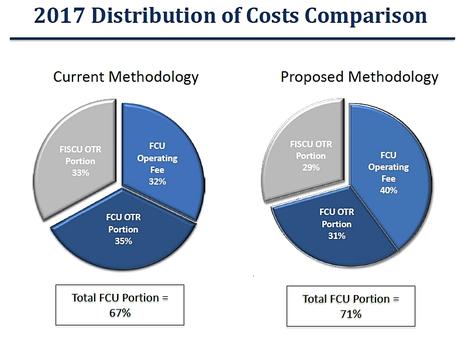
“Setting the OTR is a zero-sum game. If the OTR goes down, the operating fees go up, and vice versa. So someone will always be unhappy,” said Metsger. “The OTR rate does not impact the size of the NCUA budget, as some may believe. The budget is determined independently based on the needs of the agency.”
Metsger noted that NCUA’s goal with the OTR is to accurately reflect the cost of its role as an insurer.
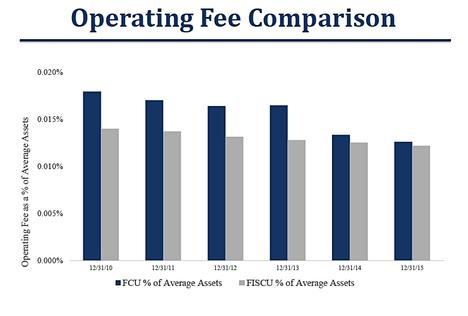
“It’s import to remember there is an inverse magnifier effect on federal operating fees when the OTR changes,” said Metsger. “So regardless of whether the OTR goes up or down, the operating fee will change by even more in the opposite direction because the operating fee is applied to a smaller base of institutions and shares. Consequently, if this proposal is adopted, next year—and I want to make this clear—the OTR will drop by 7.7%. But the operating fee charge only to federal credit unions will increase by 24%. That means the percentage increase of the operating fee would be roughly three times the reduction in the OTR rate. It’s also important to note that this 24% increase will come on top of this current year’s 25.5% increase in the operating fee—a consequence of this year’s reduction in the OTR from 73.1% to 67.7%. That’s a pretty big change in a two-year period.”
Three Steps
NCUA emphasized that a key change is revising the OTR calculation methodology down to three steps, from its current eight-step calculations. This methodology also eliminates the examination time survey.
CU trade associations shared their perspectives on the proposal.
"It is important to our members that the OTR methodology is transparent, fair and efficient," said NAFCU Director of Regulatory Affairs Alexander Monterrubio. "NAFCU supports the dual-chartering system, and we will always work to ensure that there is an appropriate balance between state and federal regulators. We encourage the agency to avoid tipping the scales in favor of state regulators. At the end of the day, we continue to urge the agency to materially reduce its overall operating expenses, which would in turn reduce the OTR's impact on the share insurance fund and the industry as a whole."
“CUNA has long requested NCUA open the OTR methodology to comment, so we appreciate NCUA’s decision. We urge credit unions make their voices heard during the comment period,” said Elizabeth Eurgubian, CUNA’s deputy chief advocacy officer. “Our ultimate goal is to see a process that ensures fairness to state and federal credit unions for the allocation of legitimate insurance-related costs, and we plan to submit a detailed comment letter outlining ways that can be achieved.”
NASCUS, which has wrestled with NCUA over the OTR, stated that the proposal is a positive step.
“NASCUS applauds NCUA's vastly simplified approach to calculating the overhead transfer rate and a second round of comments from all stakeholders. The proposed methodology is a significant step in the right direction and we appreciate that NCUA has acknowledged a number of the views we previously shared in our submitted comments. NASCUS will be reviewing the request for comments more closely and we look forward to working with NCUA in arriving at a methodology that meets our shared objectives of transparency, fairness, and simplicity,” the trade association stated.
Corporate Rule

L-R: Mark McWatters, Rick Metsger
The board, by a 2-0 vote, approved a notice of proposed rulemaking proposing amendments to agency regulations to create more transparency and simplicity in agency regulations governing corporate credit unions.
Regarding the corporate proposal, McWatters recognized the impact of the corporate crisis on natural person CUs.
“It’s 2017, not 2008, and time to slowly and prudently remove the shackles on corporate credit unions,” said McWatters. “That said, I know there are many within the credit union community who remember 2008 and 2009 and the checks they wrote to, in effect, cover the mischief some of the corporates engaged in. So I am very concerned about safety and soundness. But this is an approach that does not impact safety and soundness.”
In other business, the NCUA board also unanimously approved:
- A final rule updating agency regulations regarding treatment by the NCUA board, as liquidating agent or conservator of a federally insured credit union, of financial assets transferred by a credit union in connection with a securitization or loan participation
- A final rule revising agency procedures for disclosing records under the Freedom of Information Act
- A final rule adjusting civil monetary penalties for inflation, as required by Congress
The board also received a briefing on its Enterprise Solution Modernization program (ESMP). ESMP is a program to modernize and integrate the agency’s IT systems, to improve the ability of credit unions to remotely interact with NCUA and allow examiners to review CU data off-site.
NCUA said to expect ESMP to be rolled out in phases, an “iterative process,” as opposed releasing a suite of tools at one time. Staff said that data analytics tools could be released in early 2019, with new examination software following in the summer that same year.