ALEXANDRIA, Va.—By 3-0 vote, the NCUA board Thursday approved a proposal that would raise the current nonmember deposit limit from 20% to 50%.
Under the rule, FCUs would be able to accept nonmember and public unit shares up to 50% of paid-in and unimpaired capital and surplus.

L-R: Mark McWatters, Rodney Hood, Todd Harper
And while the proposal is out for a 60-day comment period, the fate of a final rule is anything but certain. As CUToday.info reported, the Trump Administration, through an Office of Management and Budget memo, is requiring all new rules from independent federal agencies to be approved by Congress.
Rule Eliminates Waiver
Under the Federal Credit Union Act, a federal credit union may have up to 20% of total shares, or $3 million, whichever is greater, from nonmembers under certain circumstances. A federal credit union can also request a waiver from this limit from an NCUA regional director, and that waiver request must include a specific, written plan for how the additional shares would be used. The proposed rule would eliminate the waiver request process. However, a federal credit union would be required to develop a specific use plan if its nonmember shares, combined with its borrowings, exceeds 70% of paid-in and unimpaired capital and surplus, the agency said.
NCUA board members and staff Thursday stressed the rule is aimed first at helping small credit unions grow.
“I share the staff’s belief that this rule will especially help low-income-designated credit unions and just small CUs in general,” said Chairman Rodney Hood. “These are the folks who are epitomizing the people helping people ethos. They are the ones really lending to low income communities, and I especially look forward to hearing their comments.”
Addressing the waiver removal, Hood said, “I believe this will get more credit unions to consider these (alternative funding) sources, but they will still need to complete a plan. So if this rule does make it to a final rule, we will give guidance on what that plan should entail.”
Board Member Mark McWatters asked NCUA staff why the proposed rule benefits small CUs as opposed to large ones.
“Is it because nonmember deposits are easier to deal with than borrowings; that the cost of capital associated with nonmember deposits is lower? What is exactly driving this?” asked McWatters.
Larry Fazio, director of Examination and Insurance, pointed to two main reasons.
“Smaller credit unions tend to have higher levels of net worth relative to their total assets, which is just reality,” said Fazio. “So they have more balance sheet capacity. Second, small institutions’ borrowing can be little more challenging, so maybe this will make it a little easier and also possibly become a lower cost source of funding.”
‘Capital Is King’
Board Member Todd Harper stressed “capital is king. What this is all about is making sure credit unions have capital—capital that can help them withstand a crisis if one occurs. It provides flexibility and regulatory relief, and enhances liquidity within the system.”
The proposal comes at a time the Trump Administration is cracking down on new rules created by independent federal agencies. As CUToday.info reported, new rules were announced by the Office of Management and Budget in a memo with the subject line “Guidance on Compliance with the Congressional Review Act.” According to the memo, effective May 11 2019, agencies must submit all new rules and regulatory guidance to the Office of Information and Regulatory Affairs (OIRA), which will then determine whether a proposed rule is “major” or “minor” according to standards laid out in the Congressional Review Act.
If the rule is major, it can’t go into effect until Congress has 60 legislative days to vote on whether or not to allow the rule, the OMB memo says. Should Congress vote against the rule, the agency involved is prohibited from devising a replacement rule ever, unless a new law enacted by Congress after the rule was rejected directs the agency to do so, the memo states.
NCUA Response
In a response to CUToday.info about whether today’s rule would be submitted to Congress, NCUA said, “The rule the board is considering today is only a proposed rule, not a final rule.”
As CUToday.info also reported, Washington insiders are concerned over the impact the memo could have on regulators’ independence. Former NCUA Chairman Dennis Dollar, who headed the agency from 2001-2004, is concerned the memo creates an “unhealthy” relationship between the president, or key members of Congress, and financial regulators, adding consumers who use banks and credit unions may ultimately suffer in the end.
“Personally, my experience as NCUA chairman showed me that the independence of federal financial regulatory agencies—from direct influence by both Congress and a presidential administration—is a matter of good public policy,” said Dollar in a previous report.
Harper, a Democrat, in last month’s board meeting, said, "I think we should also agree that it is the policy, not politics, that should guide our decisions. Congress established that NCUA is a bipartisan independent agency and gave the board members six-year terms in order to insulate the agency's decision-making process. That decision by Congress has served our nation and the credit union community well both in good times and in bad times. It will continue to do so in the future."
NASCUS said it will be examining the proposal for its impact on state chartered CUs.
“NASCUS acknowledges NCUA’s efforts to provide credit unions with access to capital and greater flexibility. We will closely examine the proposed rule to determine its impact on state chartered credit unions and to ensure it will not adversely affect the safety and soundness of the credit union system," said NASCUS President and CEO Lucy Ito.
"We have long held that capital reform is essential to the health of the credit union system and look forward to engaging with NCUA on the current proposed rule and any future proposals providing credit unions with access to additional forms of capital.”
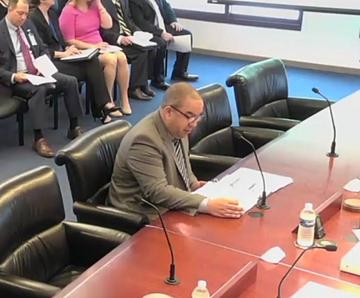
Rendell Jones
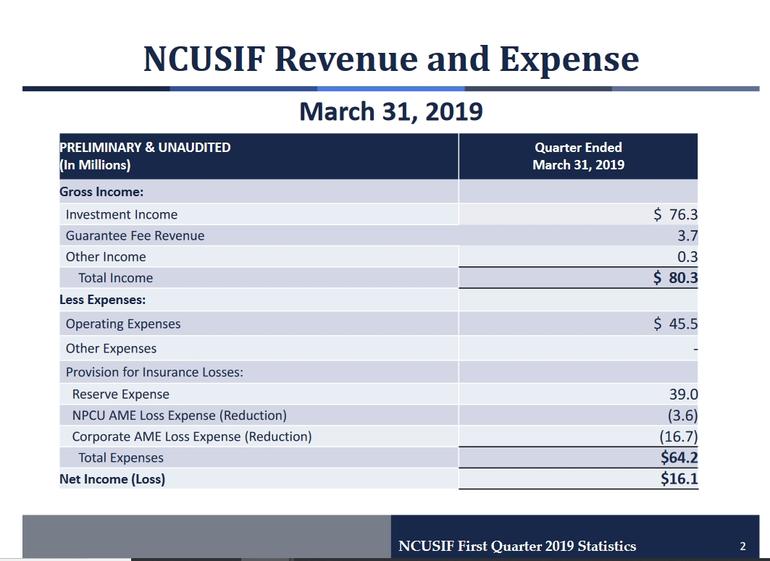
$16.1 Million NCUSIF Net Income
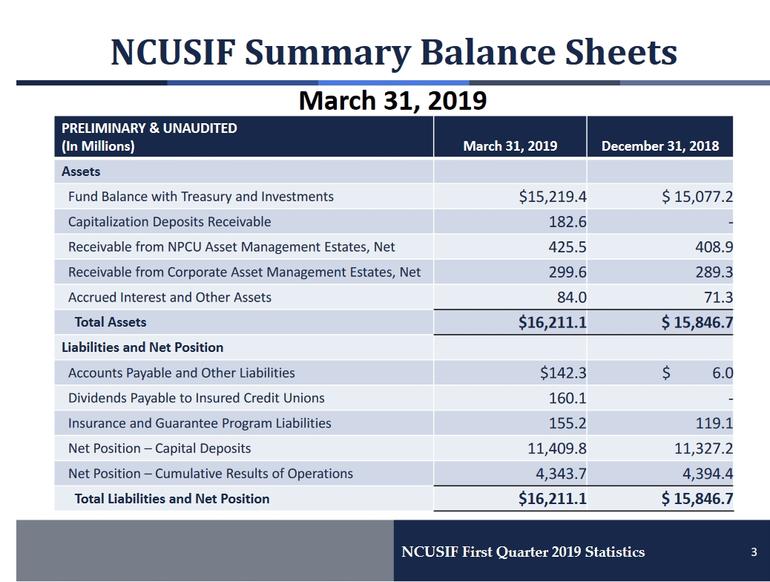
In other business, NCUA CFO Rendell Jones provided the NCUSIF Quarterly Report as of March 31. Jones said the NCUSIF reported a net income of $16.1 million and a net position of $15.8 billion for the first quarter of 2019. The fund’s total assets increased to $16.2 billion at the end of the quarter from $15.8 billion at the end of the fourth quarter of 2018 (see data below).
Jones noted the NCUA board approved a $160.1 million Share Insurance distribution in March. As CUToday.info reported, the distribution was made this week for more than 5,500 eligible federally insured credit unions. “It is the second largest Share Insurance distribution in the history of the fund. The agency has, in the past 11 months, made nearly $900 million in equity distributions,” he said.
For the first quarter of 2019:
- The number of CAMEL codes 4 and 5 credit unions increased to 202 from 193 at the end of the fourth quarter of 2018. Assets for these credit unions held steady from the fourth quarter of 2018 to the first quarter of 2019 at $11.8 billion.
- The number of CAMEL code 3 credit unions decreased to 905 from 940 at the end of the fourth quarter of 2018. Assets for these credit unions decreased 4.2% from the fourth quarter of 2018, to $50.5 billion from $52.7 billion.
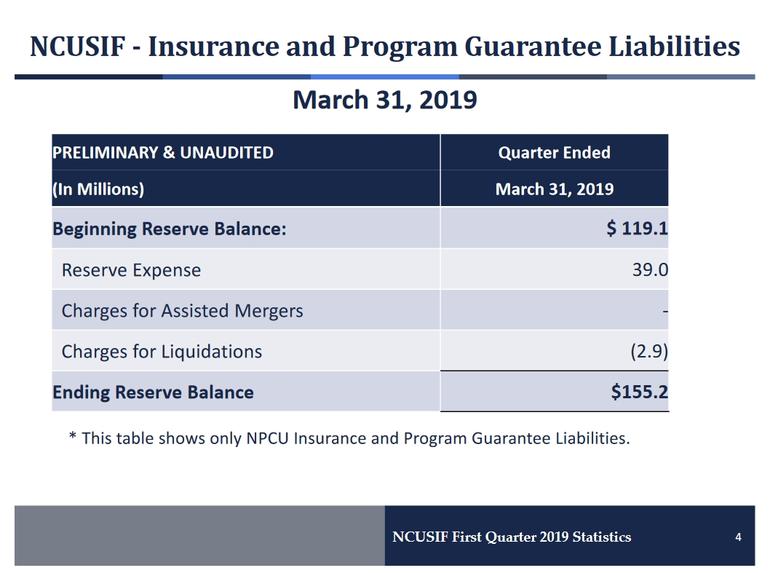
Share Insurance Fund reserves for possible losses increased by $36.1 million during the quarter. There was one involuntary liquidation in the first quarter of 2019 projected to cause a loss to the fund.
“We note the National Credit Union Share Insurance Fund’s net income of $16.1 million and the agency’s stewardship of credit unions’ funds. We encourage NCUA’s continual review of the normal operating level to balance the interests between covering emerging systemic risks and returning excess funds to credit unions,” said Ito.
Streamlining New CU Chartering
Martha Ninichuk, NCUA’s director of credit union resources and expansion, outlined how her office is improving the CU chartering process. She said the agency has a new online low-income designation area workbook that organizing groups and existing credit unions can use to research low-income areas they can target for possible member recruitment and outreach. She also explained a new chartering modernization effort is under way that will automate and streamline the process.
“The NCUA plans to open a new web portal with information to assist credit union organizers. The agency will offer pre-developed business models that organizing groups can use,” Ninichuk said.
McWatters commented on the current speed of the current chartering process within the agency.
“The new credit union chartering process has been amazingly sluggish in the last few years,” he said. “I am not sure why, but this needs to be streamlined and made easier. These are new credit unions, we are not sending people to Mars.”