

ALEXANDRIA, Va.—Will NCUA charge a Share Insurance Fund premium this year?
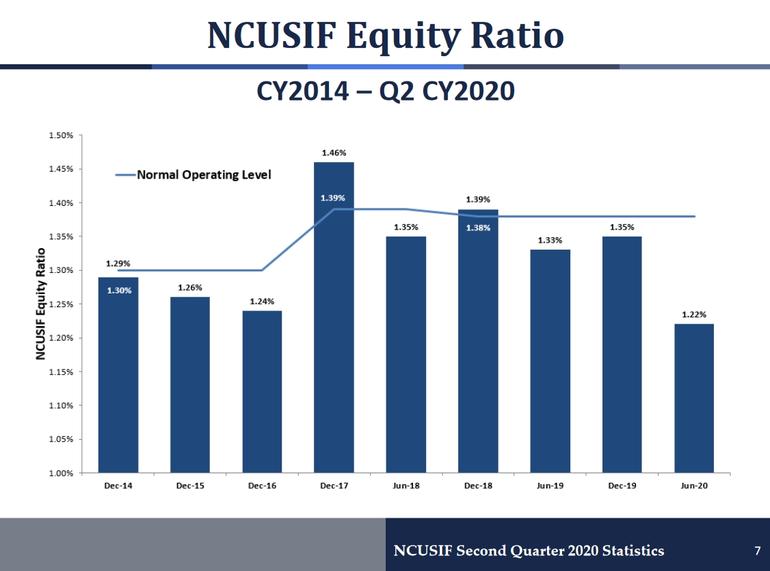
While a premium currently is not needed, the agency said during its open board meeting Thursday such a premium may need to be considered as the NCUSIF equity ratio has declined to 1.22%. Should the ratio fall below 1.2%, the Federal Credit Union Act dictates the agency must begin an equity fund restoration program and charge a premium to credit unions.
The equity ratio slipped 13 BPs from December 2019 (1.35%) to 1.22% in June. NCUA said previously the ratio has never declined more than 10 basis points.
The FDIC has already initiated a restoration plan for its insurance fund.
NCUA Board Member Todd Harper, who earlier this week suggested a premium may be needed during remarks as part of NAFCU's virtual Congressional Caucus, expressed strong concern during Thursday’s meeting that a premium will need to be assessed. He even suggested the agency consider a new way to manage the NCUSIF, including risk-based premiums.
What has driven the dramatic drop in the equity ratio won't come as a surprise to credit unions: the huge (13%) deposit growth during the pandemic, driven by stimulus money and a flight to safety, NCUA said.
Time To Be Proactive
While NCUA staff said the agency does not currently plan to charge a premium, Harper suggested the agency should be proactive.
“As a former Boy Scout I long ago learned the best time to repair the roof is when the sun is shining,” he said. “Why wait for storm clouds to roll in before we build reserves? Moving forward, the NCUA should seriously consider how we can allow for the accumulation of reserves during good times to cover losses in bad times without falling below the minimum statutory equity ratio. With more advanced funding of the Share Insurance Fund, we would be helping credit unions avoid paying premiums during economic downturns.”
If the equity ratio slips below 1.2%, if a premium were charged, NCUA said it would likely be five BPs.

Todd Harper
Agency staff said if a five-basis-point premium were charged on credit unions’ insured shares, the cost to credit unions would be $500 per $1 million in insured shares. That equates to $5,000 for a federally insured credit union with $10 million in insured shares, $25,000 for a credit union with $50 million in insured shares, and $5 million for a CU with $10 billion in insured shares.
Harper stressed in the short term, the NCUA board must be prepared to charge a Share Insurance Fund premium “should future events warrant it and credit unions need to be made aware of that reality. But in the long term I think it is important that we begin a discussion with Congress about modifying the way in which we manage the Share Insurance Fund.”
Harper noted the FDIC has higher reserve requirements, greater flexibility, and the ability to charge risk-based premiums.
“In my view those are sensible policies,” Harper said. “Therefore the agency should review its options and reach a conclusion about what statutory changes make the most sense for us to pursue…Charging premiums for share insurance during the midst of an economic downturn, however, is less than optimal.”
Prudent Decisions
In his remarks, NCUA Board Member J. Mark McWatters, in what is likely to be his last meeting as a member of the board, became the second member of the board in a week to suggest a NCUSIF premium may need to be assessed in the future, and that prudent decisions made in the past, including not listening to some credit unions, have helped to brace the insurance fund for the current challenges it faces.
McWatters noted he has previously indicated apprehension related to the downward trend in the equity ratio, and that it was his understanding the reduction referenced in the Sept. 17 board briefing was caused, in part, from an increase in the denominator of the equity ratio fraction triggered by COVID-related “flight to quality” share growth and, further, “that this downward pressure is projected to reverse, in part, at the end of the year as the new 1% capital deposits are funded by the credit union community.”

Mark McWatters
“My concern continues into 2021 and is driven by a repeat of the share growth 1% capital deposit timing mismatch, plus – more importantly – the potential decrease in the numerator of the equity ratio fraction caused by COVID-related credit union losses and failures and the continuation of the low interest rate environment,” said McWatters. “The latter two issues may not reverse by the end of 2021, as their resolution is dependent upon the underlying financial strength of the credit union system, the overall health of the economy, and monetary policy.”
Regrettably, continued McWatters, “it's not alarmist to foresee the equity ratio dipping below 1.20% in 2021, with far reaching statutory consequences, including the possibility of future credit union premium assessments. It’s also unlikely, based upon current analysis, that the adverse trend in the equity ratio will be offset by excess funds derived from the maturity of the final NCUA Guaranteed Notes, or NGNs, in 2021.”
McWatters called on NCUA to work with all constituencies within the credit union community to address the issues in a “transparent manner so as to mitigate the need for future premium assessments, particularly during the period in which credit unions are operating with the negative economic consequences of the Covid-19 pandemic.”
Monitor Liquidity
McWatters further called on NCUA to continue to thoughtfully and thoroughly monitor the liquidity and capital needs of credit unions throughout the system and further refine its contingency plans, as appropriate.
“As it’s unlikely that we will truly appreciate the adverse economic consequences of the COVID-19 pandemic until early 2021 or later, we should remain vigilant and prepared to modify our modeling methodologies and strategic and tactical responses as the facts and circumstances develop,” he said.
The outgoing NCUA board member said it is worth noting the Normal Operating Level and equity ratio both equaled 1.39% following the merger of the Temporary Corporate Credit Union Stabilization Fund into the National Credit Union Share Insurance Fund, and he reminded that at that time some had advocated for the NCUA to set the Normal Operating Level at or below 1.30% and to distribute funds so as to drive the equity ratio down to that level.
“Some even spoke of setting the Normal Operating Level and equity ratio at, or much closer to, 1.20%,” said McWatters. “If the board had voted to follow that approach, the equity ratio would surely have fallen to well below 1.20% by now with the heightened likelihood of material credit union premium assessments.”
McWatters stated that by increasing the Normal Operating Level and equity ratio to 1.39% when funds were readily available from the merger of the Stabilization Fund into the Share Insurance Fund, the NCUA board created, in effect, a “prudent safety net reserve that may serve to protect credit unions from future assessments at a time of economic stress when they are least prepared to fund additional premiums. If assessments are nonetheless required, the safety net reserve should lessen the blow. These reserves were designed and implemented to protect against adverse consequences arising from credit union losses and failures, economic downturns, unknown unknowns, and Black Swan events, such as the COVID-19 pandemic. It’s fortunate that the reserves have been available to the agency and the credit union system during the pandemic.”