

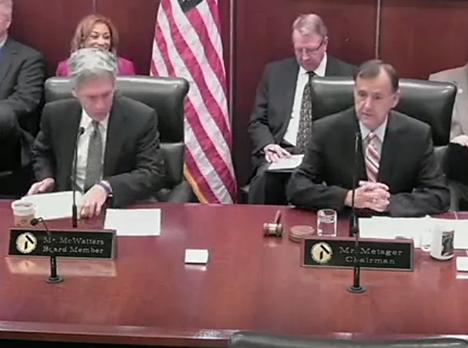
L-R: Mark McWatters, Rick Metsger
ALEXANDRIA, Va.—The NCUA board Thursday outlined some long- and short-term changes that may be coming to ease the burden on credit unions from annual examinations and quarterly call report filings.
There were no items on the agenda at the NCUA board meeting that required a vote. Instead, it was the first meeting to employ what new Chairman Rick Metsger had announced earlier in the week would be a “Board Briefing” in which Metsger and fellow board member Mark McWatters would discuss initiatives the agency is considering. The board meeting was the first since the departure of former chairman Debbie Matz.
Discussed by the two board members and staff was a plan to push the quarterly call report filing deadline closer to the end of the month in which it is due, more closely aligning with the FDIC’s filing deadline, as well as plans to possibly move the annual exam cycle to 18 months for well-run credit unions.
In addition, agency staff discussed with the board a process in which the agency might someday more closely monitor the portfolio and performance of credit unions remotely, reducing the need for onsite visits and examinations.
“Reimagining the data we collect via the Call Report is only the first concrete step in a much broader and longer-term retooling of how NCUA approaches its role in the credit union system,” said Director of Examination and Insurance Larry Fazio in remarks to Metsger and McWatters. “We have an opportunity to now to lay the foundation for a transformation of how we conduct business going forward. Efforts should lead to improvements in NCUA’s effectiveness, and efficiency gains at the agency as well as in credit unions—creating a better experience for credit unions in dealing with NCUA.”
More Effective With New Tools
Fazio said that changes could include providing credit unions with online access to all of the agency’s documents and artifacts for their credit union, submitting action requests electronically, and CUs being able to track the status of items relating to their shop in the NCUA workflow.
“NCUA should be more effective with new tools and techniques, spending less time onsite,” said Fazio. “So periodic exams, whether they be 12 months or 18 months, may be an antiquated concept in the future.”
Fazio said that longer term, NCUA is rethinking the entire exam structure and process.
“Instead of one big bang every 12 to 18 months, what if there was more virtual monitoring of the credit union’s portfolio composition and performance data, facilitated by the credit union securely providing the information periodically,” said Fazio. “Combine that with state of the art risk analysis techniques.
“What if NCUA had access to performance data that credit unions already provide to the credit bureaus, for example,” continued Fazio. “Why can’t policies and procedures be shared electronically and be reviewed offsite? Can’t conversations about specific risk and other observations that examiners make happen throughout the year happen through videoconferencing instead of waiting until the next onsite visit or exam? Then, onsite visits would only be needed for unusual developments, for when people want a face-to-face meeting, or to conduct occasional testing of data integrity control and governance—especially for credit unions that receive a clean opinion audit.”
Fazio suggested that complex technical matters could be better brought to bear across a broader set of institutions by dedicated teams of specialists with a corresponding less reliance on “generalist” examiners.
“This could happen if we were not tied to set timeframes for traditional onsite exams,” said Fazio. “Would this improve the consistency and the quality of exams? Would we be better informed about a credit union’s direction and its risks, and therefore generally more understanding of its results?”
Metsger said he has asked NCUA Region IV Director Keith Morton to head the planned working group on the review and modernization effort. Mark Vaughan, director of analytics and surveillance, outlined how the agency plans to draw credit union stakeholders into the Call Report and exam modernization effort.
In addition to a comment period, Vaughan said NCUA will hold “structured focus groups” among industry professionals.
Board member McWatters, who began the meeting by welcoming Metsger as the new chairman and by saying “let’s get to work and make progress,” asked Fazio and Vaughan how the effort to revise the Call Report differs from the effort of two years ago.
Fazio responded saying the current effort will be more transparent to stakeholders and will engage stakeholders more strongly within the focus groups.
“I find this approach refreshing, and the stakeholder part I have been advocating,” said McWatters. “But unfortunately I have heard from some of those involved in previous stakeholder groups that NCUA did not get them deeply involved. So we have a credibility problem and a reputation issue to overcome here.”
Fazio, who disagreed that all of the previous Call Report focus groups did not effectively draw in participants, assured McWatters that this round all CU stakeholders will be closely involved. “The goal will be to have full engagement,” he said.
"Transformational"
Metsger described what the agency is undertaking in modernizing the exam process as “transformational. As we move forward in all that we do it is important to look at the horizon. One of the great things about the (credit union) statute is that it does not define the timing of the exam cycle, which allows us to be transformational as we look as these new approaches. Why can’t we be a leader (among other agencies) in the exam process?”
Regarding the Call Repot filing deadline, Metsger noted that NCUA will be taking steps this year to possibly provide CUs with some relief.
“We will look at some things around the edges here for the next couple of call reports to maybe ease that burden,” said Metsger, suggesting that by the end of the year the agency may have a due date that is closer to what the FDIC requires from banks.
Recognizing that Call Report filing can be more challenging at times for smaller credit unions, Fazio suggested that the agency may look at removing some of data fields and forms for smaller institutions, having them only complete information that is relevant to their credit and the services they offer.