

ALEXANDRIA, Va.—With more than one in five NCUA employees having accepted buyout offers, Chairman Kyle Hauptman said Thursday the agency’s sweeping internal overhaul is not just a policy preference but an operational necessity, as the regulator used its first open board meeting since January to address its reorganization plans, advance its deregulatory push and formally roll out a new strategic plan that embraces AI, digital assets and a lighter-touch supervisory framework.
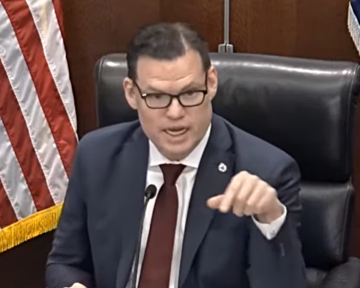
Kyle Hauptman
“It will take some time to transition from our present state, but we currently expect full implementation of the agency reorganization by Dec. 31, 2027,” Hauptman said, adding that the timeline is intended to give an implementation team time to finalize details, gather input, meet bargaining requirements and manage a smoother transition.
The meeting underscored how far Hauptman has moved to reshape the agency around a familiar theme: focusing on “material risks,” reducing what he sees as outdated or duplicative requirements, and modernizing the regulator itself even as its leadership future remains unsettled.
As Hauptman conducted Thursday’s meeting, that leadership picture remained cloudy. As CUToday.info has previously reported, Hauptman has been nominated to serve on the Public Company Accounting Oversight Board, but has also said he expects to remain at NCUA until a successor is confirmed, leaving the timing of any transition uncertain. That ambiguity comes as the agency continues operating under an unusual governance cloud, with a new chair potentially able to be named soon and with the lawsuit brought by former Board Members Todd Harper and Tanya Otsuka over their removals still hanging over the agency.
Still, Hauptman made clear he sees the reorganization as moving ahead. He said the agency had to rethink how it operates after “more than one out of five NCUA employees” took buyouts, but argued the changes also reflect a deeper view that some functions had become unnecessarily duplicative. The 2026 performance plan, staff said, sets a goal of refining NCUA’s organizational structure by consolidating major business units, grouping similar roles and responsibilities, and eliminating non-statutory functions, with project plans to be finalized by the end of this year.
On deregulation, staff said NCUA expects Phase One proposed rules to continue through July before shifting to Phase One final rules in the second half of 2026, with the phase expected to wrap in late 2026 or early 2027 depending on comment volume, internal resources and interagency review. Staff said the agency has received 239 comment letters on proposals that have already closed, while Hauptman defended the initiative by saying rules accumulate over time even when each one was originally adopted for a valid reason.
The board also used the meeting to release NCUA’s new 2026-2030 Strategic Plan, which largely codifies Hauptman’s agenda. The document centers on three top goals: safeguarding federally insured credit unions, enabling access to cooperative financial services and responsible innovation, and strengthening NCUA’s own capabilities and performance.
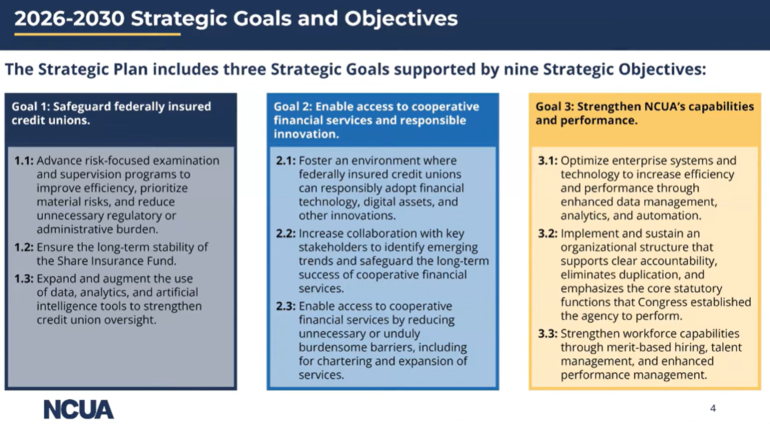
Hauptman said the plan was shaped by unusually broad outreach, including what he described as NCUA’s first-ever strategic-plan town hall and more than 250 responses through the agency’s Ask NCUA feedback tool from credit unions, CUSOs, leagues, trade groups, employees and members of the public. He framed that input as consistent with the movement’s “people helping people” ethos.
One area drawing particular attention was stablecoins. Hauptman said stablecoins remain “a priority” for the agency under the GENIUS Act, noting that an application-process proposal now out for comment includes credit union specific issues such as how subsidiaries would be defined, and that a second rulemaking on issuer standards is in the works. He also made a point of stressing that a CUSO or other entity issuing a stablecoin would not receive any NCUA insurance, a clarification he suggested was important given growing confusion around pass-through coverage and the broader debate over payment stablecoins.
Brokered and reciprocal deposits were also addressed. NCUA staff said the agency recently posted an FAQ to make clear that federally insured credit unions are permitted to participate in reciprocal deposit networks, emphasizing that the guidance was meant to remove uncertainty.