

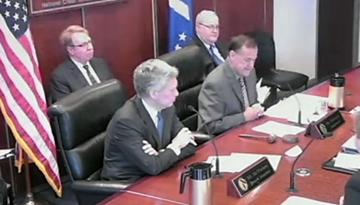
L-R: Mark McWatters, Rick Metsger
ALEXANDRIA, Va.—The NCUA board Thursday voted 2-0 in favor of issuing an advance notice of proposed rulemaking on alternative capital for federally insured credit unions.
The rule is out for a 90-day comment period.
Both Board Chairman Rick Metsger and Board Member Mark McWatters emphasized the importance of credit unions sharing their input in the shaping of a rule that the agency admits it is not an expert in creating.
Metsger emphasized that the ANPR (available in CUToday.info’s The gov) is a “thoughtful” 50-page outline of a complicated rule that would address several forms of capital and several ways for it to be structured.
“These are complex and difficult issues. That is why it is important to hear from the credit union community—and not just the trade associations. It is important to hear from all of you,” said Metsger, who noted that although more than 2,000 low income designated CUs now have access to secondary capital, only about 3% take advantage of it. “You have the background (ANPR) now to inform us so we can structure this rule in an appropriate way.”
McWatters emphasized a similar point.
“I am in agreement,” said McWatters. “There has for a long time been discussion about the forms of capital for credit unions—this has gone on for many years. This is the first full-bore attempt to address this issue. We have taken this slowly and thoughtfully under guidance of the Chair. We have hired outside counsel to address securities issues. We have taken a careful approach.”
McWatters urged credit unions to take ownership of a rule that could have a big impact on their future success.
“You will be the ones issuing the capital,” McWatters said. “If the rule does not work in the marketplace for you, or you cannot employ the capital in a way to earn more than you pay investors, this is all for naught. The last thing we want to do is spend your resources to come up with a rule that does not work for you.”
The notice seeks comment on a broad range of topics, including:
- Associated regulatory changes that would be necessary
- Potential tax implications related to issuing alternative capital, particularly for state-chartered credit unions
- Potential director and management liability issues from issuing alternative capital
- Investor protection issues and whether the sale of secondary capital, like supplemental capital, should be restricted to knowledgeable institutional investors
- The impact of alternative capital on the mutual ownership structure of credit unions
- The application of securities law to both supplemental and secondary capital
As CUToday.info reported, during the agency’s October board meeting, staff stressed that supplemental capital and secondary capital are two separate things and should not be confused, and that same point was emphasized Thursday. The agency has stressed that alternative forms of capital will mean new rules and potentially even other regulators for a credit union to deal with in the SEC and OCC—and that credit unions that turn to supplemental capital would need to deal with rules related to broker-dealers, investor advisory roles, state regulations and filing fees.
Trades Weigh In
NAFCU and CUNA thanked NCUA for addressing alternative capital.
“NAFCU applauds NCUA Board Chairman Rick Metsger and Board Member J. Mark McWatters for their efforts to address the critical issue of alternative forms of capital,” said Executive Vice President of Government Affairs and General Counsel Carrie Hunt. “NAFCU has long championed providing credit unions with more flexibility to meet capital requirements. We also continue to advocate for legislation that would create a fair capital system providing, among other things, access to additional capital for all credit unions, regardless of charter type.”
“We thank the NCUA for taking the next step toward allowing credit unions to use alternative forms of capital for purposes of complying with the risk-based capital rule,” said Jim Nussle, CUNA president/CEO. “We look forward to working with the leagues, credit unions and our examination and supervision subcommittee to make sure the agency gets the feedback it needs to continue to move forward. It is vital that credit union stakeholders carefully consider the questions put forth by NCUA, and to submit their comments on the matter during the comment period.”
Lucy Ito, CEO of NASCUs, said in response, “The state system is encouraged by this action, particularly since it holds the potential for synchronizing federal rules with existing authorities already on the books for credit unions in 15 states, which is a long-time goal of NASCUS. There is much to be considered in the 50-page proposal, particularly the challenges it outlines. The state system, however, believes that these challenges can be overcome -- and that credit unions will ultimately have access to the tools they need to maintain safe capital levels during good and bad economic times.”
Separately at the board meeting, NCUA also addressed statutory inflation adjustment of civil money penalties in a very short board briefing Thursday. The agency stated that the maximum penalty levels for 2017 are 1.6% higher than the maximum levels in 2016.