

ALEXANDRIA, Va.–It’s one thing for a credit union to make a commitment to pursuing diversity, equity and inclusion (DEI). But how does it then measure whether it’s really fulfilling that commitment?
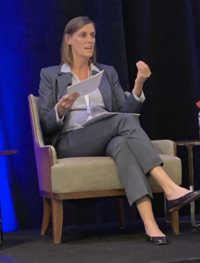
Cathie Mahon
That question was central to a discussion during NCUA’s DEI Summit here. Offering their perspective on the question of how to best collect diversity data were Victor Corro of Coopera; Cathie Mahon of Inclusiv; Taylor Nelms of the Filene Research Institute; Samira Salem of CUNA, and Larry Sewell of the African-American Credit Union Coalition.
The discussion was moderated by Monica Davy of NCUA.
Prior to the panel discussion, Nelms announced Filene will be introducing a Center for Diversity, Equity and Inclusion in 2020. It will be led by Dr. Quinetta Roberson of Villanova.
Here is a look at some of the questions posed and the answers provided:
Davy: What is the role for data in benchmark for measuring products?
Sewell: What’s more important is who the data represents. It represents people. It’s then about putting an identity behind the data and that’s what we at the AACUC want to do. It’s about who can be most impacted by the data and using it for their betterment, when it might have been used against them in the past.
Davy: What do you believe might be a barrier to providing this diversity data?
Mahon: When you look at results of previous years’ studies and self-assessments, there are a couple of things. I think many of our members feel like we’ve
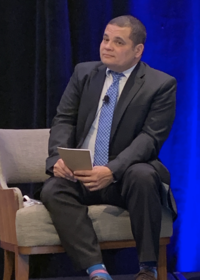
Victor Corro
been doing this and our institution speaks for itself. We started a campaign a few months ago called ‘Stand Up and Be Counted.’ It’s not so much messaging to our membership about, ‘Hey you need to be moving on this path;’ it’s, ‘You are the vanguard, stand up and be counted. Make sure your information and work is being considered as part of this industry-wide movement.’ A lot of the members we help can really be leaders.
The other thing is we have a wide variety of membership in terms of asset size and scale, so we have a lot of members over $1 billion in assets, but we also do have quite a few under $10 million. When you do look at the data, it’s pretty telling who is responding. There might be some more accessible starting points for the future for the smaller institutions who really do represent a lot of diversity in the movement to be more involved.
Davy: How would you advise CUs contemplating how to assess their diversity efforts?
Corro: I would say just do it. Our country is rapidly becoming more diverse. But when we compare the structure of power in CUs in the board and the C suite, it just reflects one worldview: white. That’s a huge disconnect. We have to ask ourselves if we as an industry reflect those who are around our branches and who access our digital channels, and even if we are reflective of those members now, where will we be in 10 or 20 years? By 2045 we will be a minority majority country.
Davy: From a research perspective, talk to us about the importance of getting this data so we can see where we are?
Nelms: The pitch has already been made about the importance of establishing a baseline to identify our gaps and measure our progress. We have a long way to go in increasing the accuracy of that baseline.
The research is also really important because there remains a lot we don’t know. It’s critical in helping us frame research questions going forward. We know the correlation between a more diverse population and the bottom line. But we don’t always know what the drivers of that are and what the benefits are that allow organizations to unlock the benefits. For me, the questions are always going to be what kinds of data, what are the buy-in incentives to get people to share
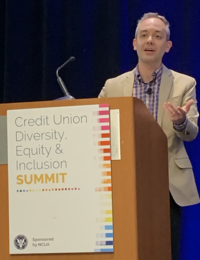
Taylor Nelms
data, and how are we going to protect it.
Corro: Sometimes, collecting the data is difficult because this conversation brings up the differences between us. Sometimes people shut down. I see it in my consulting work where we work with a lot of boards. We worry about how we’re being perceived when we say certain words. Let’s mind the language a little bit less and build goals around being more inclusive.
Davy: Does AACUC track African-American leadership within credit unions or even the MDI data about African-Americans, and if not, what would you do with that data if you did have it?
Sewell: Out of the 5,500 credit unions, there are approximately 165 African-American CEOs, and about 94 of those are women. Is there work to still be done? Most definitely, of course. If you look at the credit unions over $1 billion in assets there are six CEOs who are African-American. One of the things we like to do is share this information at our annual conference. At the AACUC our mantra is to bring strength to our organizations.
Davy: What are the challenges with CUs not collecting data? What recommendations do you have for making it easier for those CUs to respond?
Mahon: Interestingly enough, the data collection on the board, membership and staff is actually not that challenging. In fact, we do data collection process
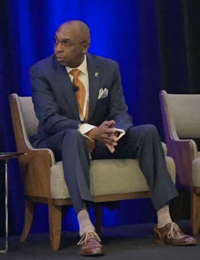
Larry Sewell
as we help (CUs) submit data to the CDFI fund. We see the transaction-level data on how well they are lending. In a lot of ways there is great capacity for tracking and measuring and reporting on that data.
I will say, though, there is a concern as always about the extent to which the regulator is truly going to value the business model. We do have to be clear that a lot of our diversity resides in credit unions that are being told every time they are examined that their business model is not sustainable. The examiner says, ‘I have a list of other credit unions you need to start thinking about merging into.’ There are a lot of institutions that may not transition to the future, but there are also a lot that represent sustainable business models.
Davy: Pretend NCUA is not in the room. Have a conversation about going forward. If it’s not NCUA doing the collecting, who should?
Salem: First and foremost, what’s important is to have an understanding of the value of DEI. It’s the rationale for why we are here, and then it becomes a priority for the system. Part of the challenge today is there are some credit unions that certainly understand DEI, but to get it at the level they need they need to redirect precious resources, and that is challenging. From our side we have to be very, very thoughtful about what kinds of data we are trying to collect knowing resources are precious.