

ALEXANDRIA, Va.–Diversity and inclusion initiatives are often thought of in terms of reaching a CU’s full membership, but it’s also critical to recruiting and retaining talent that reflects that membership, according to four people here.
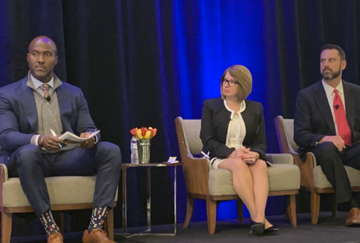
L-R: Kevin Martin, Lourdes Cortez, Tyler Valentine
Participating in NCUA’s Diversity, Equity and Inclusion (DEI) Summit here during a panel discussion at which they shared what their CUs and organizations are doing to recruit and retain diverse talent were Hannibal Brumskine of the National CU Foundation; Lourdes Cortez, president/CERO of North Jersey FCU; Tyler Valentine, president/CEO of Laramie Plains FCU, and Tonita Webb, COO of Seattle Credit Union.
The session was moderated by Kevin Martin, SVP-Organizational Performance and Strategic Planning SchoolsFirst FCU.
Here is a look at the questions asked and the responses provided:
Martin: Why is inclusion important to attracting, retaining and recruiting talent?
Valentine: I think the Millennial generation and younger are the most diverse generations we have had in this country. As we become more diverse, we have more access to education and information and we as organizations need to acknowledge that kind of diversity. If we keep doing the things we have always done, younger generations won’t take notice.
Cortez: Having a diverse workforce gives you more perspectives, helps with retaining talent, and if we look at our own industry there is so much diversity in who we serve. I feel having a diverse workforce helps your membership to relate and for your employees to better serve them, especially in areas that are underbanked or unserved.
Brumskine: There are a couple of reasons. When we think about inclusion, all we have to do is look around. The world we are in was designed to incorporate diversity. The reason the world can sustain itself is due to diversity. We are not unique as organizations. When I think about inclusion and diversity I think about innovation. In many ways, summing this up in one word does a disservice to the whole topic. When I think about diversity the first thing that comes to my mind is how can we as organizations think long term and recognize the environment we are in is constantly changing and the only way to adapt is to have a team that is diverse.
Webb: We want the best work out of people and when they can show up and be included and be themselves, we get the best work. That allows us to get to solutions.
Martin: Representation is extremely important. Seeing someone who looks like you in a position of influence tells you what your potential is. When did you realize you could be in a position of influence?
Webb: Like many people I was balancing to assimilate while also being myself and I hadn’t found my comfortable spot. I was talking to my CEO who is Latino. He had moved from L.A. to Seattle, which is a little different. Often, we go to our association meetings and we get looked at because we are a Latino and I’m an African-American and we’re different. In a conversation we discussed how as CEO and COO we could change that, and I think we have. It hasn’t been simple; it’s been a long journey. But it started with a decision to be ourselves. If we as leaders couldn’t be ourselves, how could we tell other people to be themselves.
Valentine: Becoming a CEO at 25 I’m not sure I had someone who looked like me from an age perspective, but I had worked for people who showed me what not to do. They modeled behavior I didn’t want and I was very intentional in my actions and my words. It’s been an evolution. I come from a ranching background and when people learn that it becomes a shock to them. You can be a multi-faceted person and people can find assimilation with different sides of who you are.
Cortez: Early on, my predecessor as well as a VP of operations when I started as a teller in 1983 who took me under their wing, and I remember the VP of operations—when I was debating whether to continue my education, as my father thought as a girl it was a waste of time to pay for my education—and they both encouraged me to continue my education. I had my mom’s support. I decided I’m not just going to be the teller, that one day I want that corner office. It wasn’t easy. I worked in every department, including collections, and I’m 4’11 and I was knocking on doors asking for payment. If I didn’t have these two individuals to encourage me and be role models I don’t know that I would be in that corner office today.
Martin: How have credit union recruitment practices changed?
Cortez: The landscape has totally changed. There were job boards and physical resumes. And now there is software that helps you recruit. What we see is the best talent is coming through networking and getting involved in the communities we serve.
Valentine: Obviously, the technology is a big piece of that. But what we have found most successful is we work a lot on our corporate culture and making sure we have a positive place to work and it’s inclusive and then build on that type of structure. We encourage our staff to recruit their friends and we have had the most success with hiring really like-minded people to our organization. When your friends love their jobs and they talk about that they encourage their friends to come to work for the credit union. That also helps with retention, as there is a little peer pressure to keep working with your friends.
Webb: It’s not just about placing an ad, it’s about your reputation. As we have gone out and told our story the number of people who started applying to work for our organization because of our story is just phenomenal. Who we partner with, who we impact has increased our recruitment efforts, too. It’s just not about our story and our difficulty. I admitted I also walk in privilege as a heterosexual. I didn’t have to fight to get married to have kids. That went through our community like wildfire. Our values and belief systems and getting them out there has been powerful.
Brumskine: The branding of your credit union is now critical. You are always recruiting just by your near presence. As credit unions we need to take a step back and see who are we and what values do we have. The values of employees have to align with your values. There is nothing wrong with being clear about what your values are. You cannot just play a passive role and give it to a recruiter.
Cortez: At one point the applicant would have to sell themselves to the employer. That’s not the case today; the employer has to sell themselves to the applicant. And they have no qualms talking about what they want.
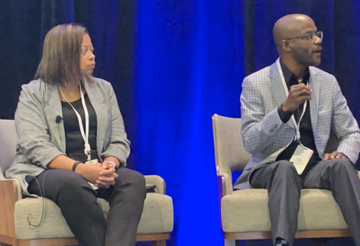
L-R: Tonita Webb, Hannibal Brumskine
Martin: What strategies or tactics have you used or changed as part of effort to create more diverse workforce?
Cortez: One thing we have done is start to work with universities and trade schools and talk to them about internships. Through the workforce development program there are grants out there that will pay for these internships at zero cost to the credit union. We have been able to hire full-time, qualified people with a skill set we were looking for.
Valentine: You have to review policies, procedures and practices. We have changed dress codes to be vendor neutral, rather than dress codes for men and women. We now allow tattoos. We have gone to open PTO policies. We do performance discussions that are not scripted on an annual basis and which look forward with action plans. We now try to propel every employee forward. With a younger workforce it’s really critical to have a robust coaching culture.
Martin: How do you monitor your progress with a more diverse talent pool, and beyond just the required reporting?
Cortez: We do track it. It’s a function done by HR. We track by departments and their goals come out of the strategic plan.
Webb: For us it starts with our board. We had 100% turnover on our board, and before we started tracking anything we thought we had to exhibit those communities from the top. So, we have someone from immigrant community, the LBGT community, Asian community, the African-American community and the Caucasian community. We don’t have all our seats filled, as we have been very intentional about it. Our board looks very different now. And now the board has set goals for us from that perspective, and those goals had to do with languages spoken, a plan for how we would change the organization internally, and a plan for how we were impacting the community, as well. This had to come from the board for this to stick. But this took us about five years to do; we had some really entrenched board members. And once you get all this diversity the next step is what are you going to do with it.
Martin: What would you recommend others consider in going forward and in working with their boards?
Valentine: If you’re wondering where to get started, there are so many resources available in credit unions. There’s the Global Women’s Leadership Network, for instance. This will be critical to credit unions going forward. Coming from a rural area without a lot of racial diversity, remember there is all kinds of racial diversity.
Cortez: I would encourage you to talk to your board about your compensation packages. It’s very competitive out there and the roles have changed. Take a look and make sure you have as part of your compensation things that would stand out. One of the things we offer is tuition reimbursement. Look at your healthcare and how you do your performance reviews. You have to think outside the box to be on top of your competition. There is software and resources out there to help you evaluate your employee compensation.
Webb: I would say if you are working on DEI efforts now and you’re not far along, ask your employees. Gather data from your employees. Get help. They have access to so much more data than you do to move things along. Most boards will also listen to your employees. In addition, dig down into your member complaints. You’ll find it there.