

WASHINGTON–On the opening day of NCUA’s DEI Summit here, Chairman Todd Harper urged attendees to remember the “roots of the credit union movement as a financial system meant to work for everyone, urged they share best practices, discussed the importance of “allyship,” and shared how CUs stack up in a “social index.”
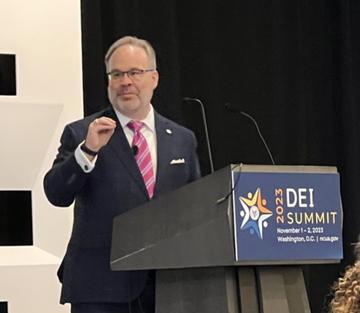
Todd Harper speaks during the Summit.
“Allyship” is the focus of the 2023 Summit, the NCUA chairman reminded, noting the meeting is themed “DEI: It Starts with Me.”
“It starts with our individual actions, our allyship,” Harper said. “But, it should come as no surprise that becoming an effective ally has its own demands and different interpretations. In my mind, allyship requires five essential elements: perspective, courage, action, reflection, and vision.”
Harper said that all come to their jobs with unique backgrounds, including his own growing up in Northwest Indiana and as the first openly gay man to lead a federal financial institutions regulatory agency.
“I strive to understand the importance of representation in an organization’s words and deeds,” Harper said. “Together, each of my own experiences have taught me that working for diversity, equity, and inclusion is more effective when I am the strongest ally that I can be. But, what does that really mean?”
Allyship Requires Courage
According to Harper, allyship requires courage, the ability to break a pattern and swim against the current.
“That’s because going against the popular sentiment can make an individual the subject of ridicule and an object of suspicion. I have certainly experienced each of those things as a gay man,” Harper shared. “And, I’m sure many of you here have also experienced hatred and derision, likely in even greater ways. But, what I take away from those experiences aren’t the bad things. It’s actually the good things. Namely, acting from the heart and practicing the ‘power of one’ can make any individual a change agent.”
Allyship Requires Action
Harper said allyship requires more than just perspective and courage, it also requires action, and that one example is NCUA’s Community Development Revolving Loan Fund, which in 2023 distributed $3.5 million in grants.
The agency has also modified its policies and started using new procedures to examine MDIs this year, he noted, as it has pivoted to using peer metrics to allow for apples-to-apples comparisons.
Another action by NCUA, according to Harper, is the establishment of its Small Credit Union and MDI Support Program for which it has budgeted 10,000 staff hours across its three regional offices for the initiative.
Allyship Requires Reflection
Finally, said Harper, in acting as an ally, “it’s also important to reflect on what you do well and where you can do better.”
To that end, he said NCUA has sought to lead by example in working to improve the diversity of its workforce, its leadership, and its supplier network.
He noted that in 2022, two out of every five new hires at the NCUA were people of color. And last year, nearly two out of three participants in the agency’s leadership development efforts were women, he added, saying the agency still has work to do in hiring and retaining Hispanic employees.
The Social Index
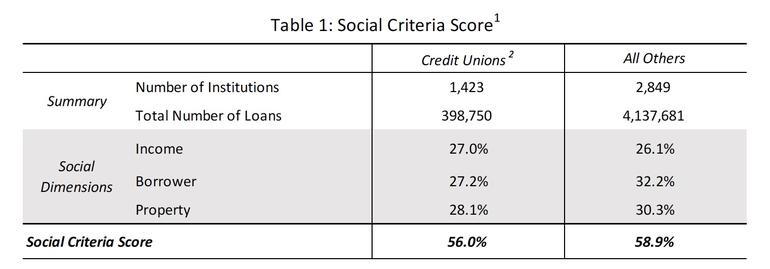
Harper explained NCUA’s Office of the Chief Economist used a “Social Index” framework — developed by the Federal Housing Finance Agency for Fannie Mae and Freddie Mac — to evaluate the extent to which credit unions are extending mortgages to historically under-represented groups and marketing to areas with limited access to credit.
According to Harper, theSocial Index framework scores a given pool of mortgages on eight criteria, including whether a loan was made to a low-income borrower, to a minority borrower, in a low-income area, or in a minority census tract, among other criteria.
Using these measures, a pool can be given a Social Criteria Score, the percentage of the mortgage pool’s underlying loans that meet any of the eight social criteria, he said.
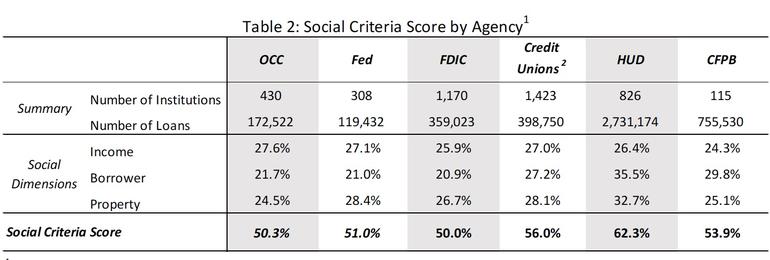
“When NCUA economists applied the Social Index framework to mortgages originated by HMDA-reporting credit unions in 2022, the analysis yielded mixed results,” Harper said. “First, the good news: Credit unions, overall, had higher Social Criteria Scores than many financial institutions regulated by other federal supervisors. Now, the bad news: Credit unions trailed entities regulated by the Department of Housing and Urban Development, including non-depository institutions. Those institutions scored 62.3% under the index criteria, compared to 56% for credit unions overall. Said another way, credit unions originated loans with a somewhat smaller Social Criteria Score than non-financial institutions.
Living Up to Mission
“To live up to their statutory mission of meeting the credit and savings needs of members, especially those of modest means, credit unions can do better in making mortgages to people of color, in underserved communities, and for low-income borrowers,” Harper added.
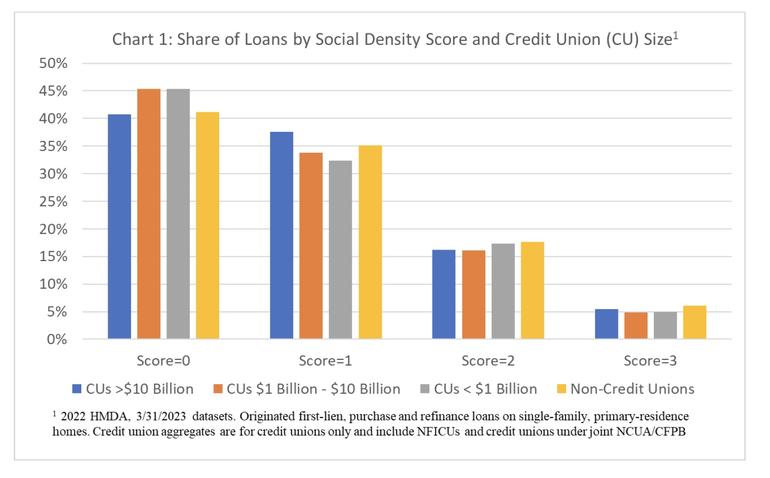
In addition, Harper said the analysis suggests that larger credit unions, as a group, had higher Social Criteria Scores than their smaller credit union counterparts. Credit unions with more than $10 billion in assets scored 59.2%, while credit unions with less than $1 billion in assets scored
54.6%. he acknowledges some of these differences in performance may result from field of membership limitations.
“Regardless, I encourage all credit unions to read the NCUA’s research note, available on the NCUA’s website, and to reflect on how they can become better allies to more of their members in mortgage lending,” he said.
A Special Obligation
In closing, Harper quoted Vice President Kamala Harris who once said, “If we are lucky enough to be in a position of power, if our voice and our actions can mobilize change, don’t we have a special obligation? Being an ally can’t just be about nodding when someone says something we agree with …It must also be about action. It’s our job to stand up for those who are not at the table when life-altering decisions are made. Not just those people who look like us. Not just those who need what we need. Not just those who have gained an audience with us. Our duty is to improve the human condition — in every way we can, for everyone who needs it.”