

ALEXANDRIA, Va.–NCUA Chairman Todd Harper kicked off the agency’s second DEI Summit by saying the objectives of the three-day event are to changehow people see diversity, equity, and inclusion; to understand how to implement programs and initiatives to support DEI, and to learn how the credit union industry can advance the principles each day.
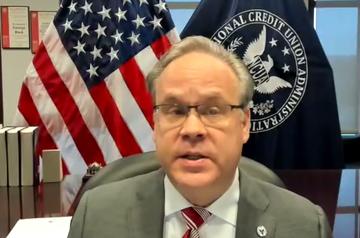
Todd Harper
The Summit, which is themed“DEI – From Intention to Action,” is about making clear that DEI is about more than just policies and principles, said Harper.
“They are foundational practices and behaviors that must be acted upon. After all, intentions are meaningless without concrete actions and behaviors to support these values,” he said.
Harper shared what he said are three examples of moving from inattention to action that he drew from his alma mater,Indiana University, including:
A Place at the Table
- George Taliaferro. Taliaferro was the first all-star, Black football player at IU, who also became the first Black player ever drafted by the NFL when the Chicago Bears selected him in the 13th round of the 1949 draft.
“While George Taliaferro is most known for his athletic achievements, his most significant contributions, in my view, came off the field. That’s because George was instrumental in helping to integrate Indiana University and Bloomington businesses,” Harper said. “One day, as a student, he took a chance and walked into the office of the IU President Herman B Wells. He explained to Dr. Wells that there was no place on campus for a Black man to eat, even though he had a dollar and a quarter in his pocket to pay for his lunch.
“George also explained that he had to walk several miles to and from campus in order to eat each day. Dr. Wells listened and then said, ‘Well, let’s see what we can do about it.’ What Dr. Wells did was to call up the owner of The Gables Restaurant, a popular gathering spot for students across the street from the campus.
“At the time, The Gables proudly displayed a very large picture of the 1945 championship IU football team, which included Taliaferro, but George could only see it through the outside window. After Dr. Wells suggested that he would prohibit all students from dining at The Gables if African-Americans weren’t permitted to eat there, the owner agreed to allow George and a friend of his choosing to eat at the restaurant for one week on a trial basis. George went every day, and the restaurant received no complaints.
“Not only did The Gables soon drop its segregationist practices, but soon other businesses around town did the same. And one evening, while at the local movie theater, George removed the ‘Colored’ sign that had directed African Americans to the balcony. In doing so, in his own quiet way, George tore down another barrier and opened the door to a better, more inclusive community.”
‘Apartheid Kills’
- Robert Johnson. Johnson, who attended IU at the same time as Harper and who ran on the same ticket for student government, championed the fight against apartheid.
“Robert was elected student body vice president, and I became a senator representing one of the dormitories on campus. As a student leader, Robert vocally stood up to the administration and pushed for divestment in South Africa. He called for the university to reevaluate its policies, which at the time invested more than $5 million in companies operating in that racist regime. Like Robert, I did not understand how a university that claimed to respect and welcome all people could support businesses gaining profit in a nation that deemed the color of a person’s skin to be against the law.
“That’s why when leading demonstrations, Robert would chant, ‘Apartheid kills; IU pays the bills.’ I supported Robert and his efforts to change an unjust system, voting for resolutions and other actions in favor of divestment. Robert also led student efforts to create a merit program for minority achievers and established a program to help first-generation people of color find mentors. I am proud to have supported Robert in all of these efforts to make Indiana University a more welcoming place for all.”
Increasing Student Representation
- Lindsey Batteast. “I met Lindsey, by chance, when I spoke before her career planning class as a guest lecturer. After that presentation, Lindsey and I struck up a conversation, during which I learned that Lindsey had benefited from a program called Women Rising, an initiative to give women the skills needed to negotiate better salaries and assignments early in their careers.
“As the head of a grant committee for the IU Well House Society, I had helped to fund some of the staff costs for the Women Rising, and Lindsey was selected as a student ambassador. With that common bond, it didn’t take much more for me to become her mentor. During her time at IU, Lindsey saw that people of color, like herself, were underrepresented in student government. Instead of accepting the situation, she took action to create change by building public awareness of the problem and creating a broad coalition of like-minded students. Ultimately, Lindsey’s efforts led to the adoption of an amendment to the student government constitution to increase the size of the student senate by roughly one-third and dedicating each of those new seats to underrepresented populations. The amendment unanimously passed the student senate and was fittingly ratified by a vote of the students on Martin Luther King Day.”
Getting Outside Your Swim Lanes
What unites those stories, Harper told the DEI Summit, is that each of those three people “in their own way and in their own time, got outside of their swim lanes. The changes led by George, Robert, and Lindsey did not occur by happenstance. It took concerted effort and a personal commitment. Each of them saw a problem, identified a solution, and acted to achieve change.”
Harper said that for those listening to the Summit to be successful would require more people willing to get outside their own swim lanes.
“We have made progress these last few years, but we have more work to do,” Harper said. “Diversity, equity, inclusion, and belonging are not just principles to be exclaimed during staff meetings or posted on a website. They go beyond just what is done internally. They are the very actions and initiatives an organization takes and commits to publicly.”
Steps Being Taken
Harper said those are the reasons he has made advancing economic equity and justice a priority for the NCUA, why the agency has funded underserved grants this year as part of the Community Development Revolving Loan Fund, and why NCUA is looking at the causes of appraisal bias.
“It’s also why I have urged credit unions to decrease their reliance on overdraft fees, which studies have shown are a tool of financial exclusion rather than inclusion,” Harper said.