

ALEXANDRIA, Va.–NCUA Chairman Rodney Hood said he may now lead a federal regulatory agency, but during his career on numerous occasions he has shown up to speak as part of a panel discussion and encountered people wondering why this African-American guy was in the room.
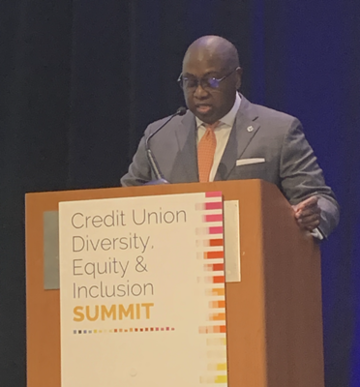
Rodney Hood discusses diversity and inclusion during NCUA Summit.
“For me, these discussions of diversity, inclusion, and equity are more than simply abstract ideals — they’re something I believe in deeply and personally, owing to my own background,” said Hood during remarks at the agency’s inaugural Diversity, Equity and Inclusion (DEI) Summit. “I’m proud to be the first African-American head of a federal financial regulatory agency. But getting here was not easy, and I’ve worked in the financial services industry long enough to know how challenging it can be for members of under-represented communities.”
Hood said many have also experienced that other side of that same type of bias, such as working for a manager who expects less of a person because of their skin color, ethnic background or gender.
Trying to Help, But…
“That doesn’t necessarily stem from a sense of hostility or trying to undermine you. In many cases, they may even think they’re trying to help you,” Hood said.” But they don’t realize they would be helping you more by challenging you to work up to your potential and to achieve more.”
Hood said while it may not be recognized, diversity is a foundational underpinning of credit unions themselves, founded by people who envisioned a system of locally owned and operated, member-driven cooperative credit institutions in order to fill a gap.
“So, when credit union people talk about diversity, inclusion, and equity, it is with an understanding that those values are, so to speak, part of this industry’s genetic code. And that is something you can all take pride in,” said Hood. “However, we should not look back on that proud history and see it as an invitation to rest on our laurels. Because the reality is that while the credit union industry has led the way on these issues, and more and more industries are following that lead, we still have a long way to go.”
Other Points
Other points made by Hood:
- While reaching out to traditionally underserved communities, Hood said a commitment to diversity and inclusion must consider the other dividing lines in society. “Age is one of those,” he said. “Accessibility is a dividing line. Increasingly, where you live is one of the dividing lines. Especially over the last decade, the withdrawal of financial services providers from rural America poses a serious threat to access for people who live there.”
- Credit unions, Hood said, can be a particularly powerful tool for meeting the needs of people who cannot get access to the financial system because they live on the wrong side of one of these lines. He urged the industry to think more about how to provide appropriate products and services to meet those needs.
- DEI makes “solid business sense,” said Hood, in addition to being a moral issue. Us that embrace these principles could out-perform the competition, he said, adding diverse organizations are better at attracting and keeping talent, enjoy better financial performances, and have higher levels of customer satisfaction.
Culture Council
Hood said the NCUA DEI Summit is just a starting point, and more is required than just giving a speech and going home. As part of that, Hood said he is establishing an NCUA Culture Council to focus on issues of inclusion within the agency.
“The NCUA Cultural Council will serve an important advisory and policy-making role within the agency to ensure that inclusion and equity are top priorities,” Hood said.
Like other NCUA representatives at the meeting, Hood also urged CUs to complete its Annual Voluntary Credit Union Diversity Self-Assessment.