

DULLES, Va.–Making DEI a sustainable effort within a credit union requires understanding why it matters, involves everyone and not just senior management, often leads to very difficult conversations, and can even mean letting some employees go, according to a panel discussion here.
The discussion and debate took place as part of NCUA’s DEI & ACCESS Summit at the Hilton Washington Dulles, which kicked off Tuesday as a multi-day, hybrid event that is also being broadcast virtually.
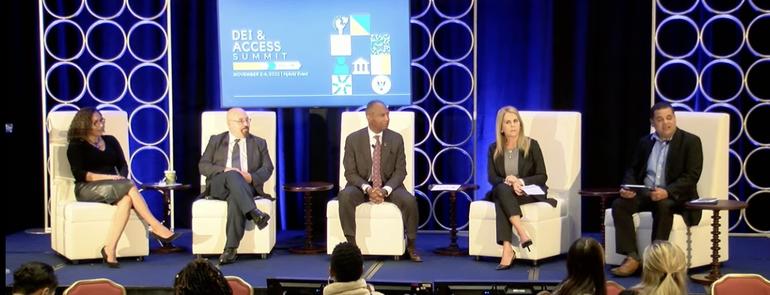
From left, Simira Salem, Pablo DeFilippi, Maurice Smith, and Lily Newfarmer, and Victor Miguel Corro.
Participating in the spirited discussion titled “Built to Last: How to Create a Sustainable DEI Effort in Your Credit Union,” were Samira Salem, VP-diversity, equity and inclusion with CUNA; Pablo DeFilippi, EVP at Inclusiv; Maurice Smith, the soon-to-retire president/CEO of Local Government FCU and Civic FCU; and Lily Newfarmer, president and CEO of Tarrant’s County Credit Union. The session was moderated by Victor Miguel Corro, CEO of Coopera.
Here’s a look at some of what was discussed:
Corro: Tell us why you are here.
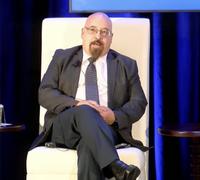
Pablo DeFilippi
DeFilippi: Why am I here? I believe in this. I came to this country as an immigrant. I have faced some of these barriers. When you think about New York City you think about Wall Street. What you don’t really know is New York City has a million people who are outside the financial mainstream. Serving minority communities is what we are here for. The realities are that many communities have lived in this condition for generations. So, when we talk about the impact of the downturn in the economy, for many communities that has been their constant, and they have a lack of access to financial services.
Smith: I have been in the movement for 43 years. I have enjoyed this movement and what it means to people. In those 43 years I have seen five recessions, rising rates, declining rates, high unemployment, low unemployment. I have seen everything an economy can throw at a community except for negative interest rates and a depression.
We know when there is an economic downturn which communities are hurt. They are the same communities that were hurt the last time. Nobody has the moral authority to serve communities like credit unions. If we don’t lift communities, no one else is going to do it. At the center of that is DEI as a moral imperative and a business case for what needs to be done.
Newfarmer: I run a smaller credit union. I really want to speak to that. This is such important work, and being a smaller credit union cannot be used as an excuse or a deterrent for not doing work in this space.
Corro: How do you keep motivated in doing this work when you see so many things coming at you, so much negativity and division?
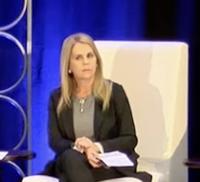
Lily Newfarmer
Newfarmer: It takes a concentrated effort and it has to be a part of your strategic initiatives. You may not know how to serve low-income and minority communities. We have a Community Development Advisory Committee. We realized our management team was four middle-aged white women. We are really focusing on changing that in practices of hiring and retention, and governance. too. This committee realized we don’t know how to best serve these communities.
The committee is comprised of folks who live and work in our communities and they have taught us. We took the time to learn and listen. We had good intention and strategy and focus, but we felt we were missing the mark. Once we reached out the light bulbs started to go on, and what has also been a windfall is our board had an a-ha moment that these committee members will be feeders for future board members.
Defilippi: I would flip the question. We can believe we can’t do this, but if we see resistance, that is the reality. We cannot use it as an excuse to say it’s too hard. When it’s hard it means it makes sense, it’s worth it. We are at a difficult time. Who are we? What is our purpose? If we don’t answer those questions then we are lost. We are competing not only with banks, but fintechs. Everyone in the community offers some sort of financial service.
So, what do we do? Do we give up? No. That’s where the opportunity is. The DEI conversation is just a stepping stone. It is to get us ready to embrace the community and do what we do, lending, help close the gap.
Smith: It also matters how we as institutions approach DEI. If you declare this is a project, you are declaring there is an end to it. The fact of the matter is the DEI conversation should be part of the DNA structure of the organization. If you think of it as a project, you often give it to one department or individual and pat yourself on the back that we have accomplished this.
It should be part of the curriculum for everyone in the organization. Everyone should have on their plate the consideration and responsibility of directing DEI. There is no end to it. Fatigue will occur if you think it is a project. You have to think of it as part of your organization like breathing and showing up for work on time.

Samira Salem
Salem: Some of the work we are doing now at CUNA is about embedding DEI throughout the organization, so that it’s not just my job or the DEI team’s job, but this is something for which we all share a responsibility. One of the things we have asked for and gotten is a recommitment from the top. The times have changed. We are having different kinds of conversations today than four years ago. The pressures are different. It’s economic. It’s been politicized, which we don’t like to say. But in this moment are we all in? I got a resounding yes (from CUNA leadership). We are now doing training on what does it look like to use this DEI lens in our work.
Corro: How do you make sure DEI is in the essence of an organization we are trying to change, to make more inclusive?
Newfarmer: It can be something as simple as adding a core value. We added inclusion. We also realized there are folks who are never going to get it, long-time employees. We created an exit strategy because we realized they are never going to serve the members the way we want them to. Those are hard decisions, but you have to do it. It’s what we are. I’m kind of embarrassed to say it, but four people were removed and we’re a small shop. It’s a commitment. You have to put your money where your mouth is.
DeFilippi: If we are really thinking about DEI as an opportunity to evolve and to become a reflection of the communities we serve, that is where the representation at the board level can be seen, but I wouldn’t stop at the board level. It needs to be seen in our employees, too, who (should) be bilingual. Language can be a connector. Because people speak another language it doesn’t mean they don’t want to speak English; it’s a connection in a community. It gets back to intentionality. Our employees are the best ambassadors in our communities. These employees need to be in positions where decisions are made. At the end of the day, money talks. We can talk DEI, but if we are not willing to make loans in these communities then we are missing the point.
Salem: The question of boards and the importance of boards to credit unions is something that has been on my mind. I joined the board of a credit union a couple of years ago. It was my first time on a credit union board. It has been a tremendous experience. I had previous experience on other nonprofit boards. They did a fantastic job with onboarding. But coming into this role it still took me a little bit of time to find my voice.
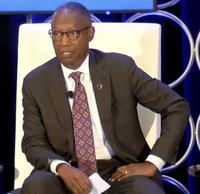
Maurice Smith
Corro: This is political and controversial. How do you go about this DEI discussion when we have so much division?
Smith: I believe the solution is to have a conversation. Simple as that. Case in point: we are not shy about our DEI journey at our credit union. We broadcast it loud and proud. We found we had a member on Facebook blasting us on our DEI journey and calling me all kinds of names. Our marketing team was trying to calm the person down. I didn’t know it was going on. When I found out, I reached out to the member directly. I think maybe it shocked him. He went into a tirade about critical race theory and reparations. At the end of several weeks of conversation I wouldn’t say we will be exchanging Christmas cards, but I understood better where he was coming from and he understood where we were as a credit union. At the end what we had was a healthy respect. The member said, ‘Thanks for engaging me. You took time to listen to me.’
When disagreements occur, just have a conversation. It’s the kinds of stuff we learned in kindergarten. Most of the time that gets you where you need to be.
Salem: (Salem recommended the book “See No Stranger: A Memoir and Manifesto of Revolutionary Love,” by Valarie Kaur, which she said everyone at CUNA has been asked to read.) It’s about moving toward love in difficult times. One of the practices is to wonder; to wonder about your opponent, to have the conversation and to really listen where they are coming from. You may not find resolution, and that’s OK. When you’re up against these moments where there is such divide, it’s easy to walk away.
Newfarmer: Or you can have them speak elsewhere. We had a lot of conversations around White privilege and those critical conversations and they were uncomfortable. There was lots of pushback. Sometimes, after the critical conversation has occurred and there still isn’t a solution and these are member-facing folks, sometimes you just have to help them pack their stuff and go.
DeFilippi: Transformational change doesn’t happen, you have to push it. And not everyone agrees. We know there are systemic barriers we have to address. It’s not for higher purposes, it’s about safety in our communities. When we talk about banking for instance, it’s not just about having a checking account or savings account, it’s about making communities safer. When you have crime in a community, who suffers? It's not just the victim. Property values go down. Then people feel the pain.
We have to bring the conversation to a point where everyone sees there is a common advantage to lifting everyone up. Inclusion is about providing havens for people to save their money so they are not victimized. It’s a basic principle. Communities that prosper tend to be safer for everyone in that community.