

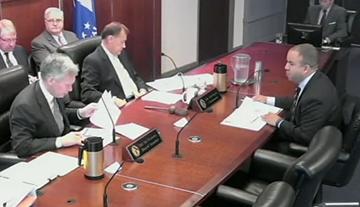
L-R: Mark McWatters, Rick Metsger, Rendell Jones
ALEXANDRIA, Va.–The NCUA board has approved a 2017 operating budget of $298.2 million and a 2018 budget of $312.1 million.
The final 2017 budget, which is down 1.7% from the previously approved budget, was OK’d by the board less than a month after it hosted a budget briefing with credit unions to share their feedback and suggestions.
“We made several modifications to the budget in response to public comments,” said NCUA CFO Rendell Jones.
Board member Mark McWatters, noting he has been an opponent of setting two-year budgets, said he was moved to vote in favor in part because of political changes. The board currently has a vacancy. McWatters, who is nominated for a board seat on the Export Import Bank, noted in the future it could even lack a quorum, so setting a board-approved two-year budget was a prudent move.
A key issue raised by credit unions at that hearing and by their trade groups in general has been why NCUA’s budget is not shrinking as the number of insured CUs continues to get smaller, and as the agency is preparing to roll out a regulatory flexibility initiative that will lead to fewer exams, especially on-site.
The 2017 budget calls for 17 fewer full-time equivalents and the 2018 budget assumes 25 fewer examiners across its five regions. Overall, NCUA plans 1,230 FTEs in 2017 and 1,208 FTEs the year after. Jones said Compensation and travel represent 83% of the budget.
Staff Numbers Down
While the number of staff may be down, however, the agency is spending more for its capital budget, including a significant investment in technology, cyber security, analytics and dashboards. The 2017 capital budget is $14.8 million in $15.4 million for 2018.
Jones said the operating fee adjustment for next year is estimated to increase by an average rate of 25.5%, based on estimated year-end assets. (State chartered credit unions are not assessed an operating fee.) Jones said to set the assessment scale for 2017 FCUs, CU growth is projected through the end of the year based on June 30 data, and is expected to be about 5.1%.
NCUA Board Chairman Rick Metsger called the 2017-18 budget “historic,” saying it is more transparent than any other budget, was developed earlier than any other NCUA budget, and allowed for more input than any other NCUA budget. No other federal agency, he said, has “come close” to the steps NCUA has taken with its budget.
“This is a bipartisan budget,” said Metsger, the Democratic appointee on the board. “I want to publicly thank my colleague (McWatters). It was a genuine partnership and an example of how government should work.”
“This budget will result in an extended exam cycle for most credit unions,” said Metsger.
But I want to reiterate it does not change our statutory obligation to protect the safety and soundness of the system and the share insurance fund…There’s no guarantee or right to an extended exam cycle; when an exam or supervisory contact is needed, it will be conducted.”
Two 'Regrets'
Metsger said he has two “regrets” about the just-completed budget process.
“Despite an unprecedented level of openness by the agency, so few people participated in the process,” lamented Metsger. “Beyond the seven participants in the budget briefing, only three individuals commented at all…Not one of the approximately 6,000 natural-person credit union CEOs commented outside the building to express any concerns or suggestions about the budget. In addition, very few people even took the time to look at the budget information our staff has compiled on our website.”
Metsger said that situation has confirmed his belief that the NCUA budget is really just a “punching bag” for the credit union trade groups to show they are fighting for credit unions. “Actual CEOs and directors understand they have more pressing issues that actually affect their work of serving their members,” said Metsger. “I think that is because they understand that over time the nominal amount of the budget has increased, just as everything else has over time.”
Metsger said his second regret remains that many people argue that the agency’s budget and staffing should be directly related to the number of credit unions being examined or the number of problem credit unions. “They don’t seem to understand complexity does matter and it is increasing,” he said.
But overall, Metsger said he believes the budget and budget process is something to be proud of.
“This is a demonstration that despite the predictions of naysayers in a town that is deeply divided, we can put our differences aside and develop and pass a budget that is good for the agency and good for stakeholders, and we do it in a transparent fashion,” he said.
McWatters said he agreed with Metsger, noting “our overarching duty” is to maintain the safety and soundness of NCUSIF.
“I dissented on the last two budgets, and I wrote somewhat strident descents,” said McWatters. “I laid out a number of factors, one of which was budgetary transparency. The budget briefing worked last month. It was not necessarily the turnout and the response I had hoped for, but it was a start. There were good comments. We learned things from the feedback and hopefully have incorporated those into the 2017-18 budget.”
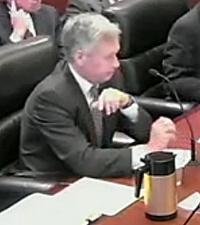
Mark McWatters
McWatters said a third reason he objected to the budget was the overhead transfer rate that funds its operations.
“It mystified me when I saw it and tried to decipher it,” he said. “It seemed like a good idea to put the OTR out for comment. There was some resistance to that for a while but there was a change of mind and it was put out for comment. This is very tedious, technical stuff. It would take longer than I would like to work through those, but hopefully we will have something ready to roll out within the next few months, the idea being not to justify what we are doing, but to present something a little different that is simpler and more elegant, and you do not have to spend three weeks trying to understand it.”
Collegial Board
Finally, said McWatters, he voted in favor of the 2017-18 budget for two other reasons.
“We have a much more collegial board than we had in the first two years I was here,” he said. “Working with Chairman Metsger has been a fairly fluid and harmonious process, and for that reason alone I am OK with the two-year budget. Second of all, we have some political uncertainty. You’ll notice there are only two of us up here, with one empty seat. A year from now we may not have a board quorum, so at least having a budget on the books approved by the board under a quorum seems to be a smart idea.”
During testimony before the board, Jones said feedback from credit unions and other has led to more information being provided to CUs, such as on the categories used to describe expenses, and it has also added material to the capital budget section to enhance transparency of each capital item for each of the 11 projects for 2018. He said NCUA will also be updating the FAQs to provide more explanatory information in response to comments that are made.