

ALEXANDRIA, Va.–The chairman of NCUA has offered his insights on what newly released credit union performance data reveal, including pulling back the curtain on what’s behind a rising industry average delinquency ratio, why he sees a “tale of two types of credit union members,” why NCUA is paying particular attention to several billion-dollar CUs, and more.
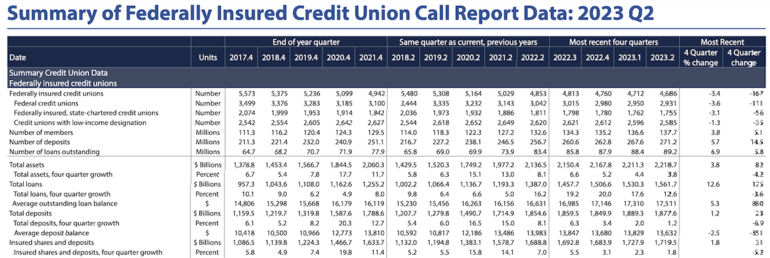
As CUToday.info reported here, NCUA has just released its Quarterly Credit Union Data Summary, which shows delinquencies, especially in credit cards, taking a jump during the second quarter of the year, with credit unions responding by significantly increasing their provisions for loan losses.

Todd Harper
As NCUA Chairman Todd Harper noted, however, delinquencies are highest among credit unions with assets of $50 million or below, with the delinquency rate at CUs of less than $10 million at 1.40 as of June 30, while the delinquency rate at credit unions between $10-$50 million was 0.84. It is 20 to 30 basis points lower in all other asset categories.
Overall, assets infederally insured CUs increased $82 billion, or 3.8%, over the year ending in the second quarter of 2023, to $2.22 trillion. Net income also decreased when compared with the first half of 2022, in part due to those loan provisions
Todd Harper noted the industry’s net worth ratio rose to 10.63% in Q2, an increase of more than 20 basis points from one year earlier, which he said will “provide a greater buffer in the event of an economic downturn.”
He further noted during a call with the media that while fee revenue has generally remained flat over the last year, credit union income has increased by nearly 30% during the same time period, driven by “sizable growth in interest income and investment earnings as a result we have seen a healthy increase in the net interest margin of 66 basis points over the last 12 months.
‘A Few Areas of Concern’
“Together, these trends give us reason for cautious optimism,” Harper continued. “I emphasize the word cautious because the second quarter data highlight a few areas of concern.”
Among the most primary of those concerns, Harper said, is one he also flagged earlier this year during a call following release of the first quarter data, and that was related to the possibility of an increase in delinquencies and charge offs in the months ahead.
At that time, reminded Harper, he had encouraged credit unions to prepare “for what the second quarter data now show (in that) we are seeing that pattern emerge. The delinquency rate among insured credit unions was 63 basis points in the second quarter of 2023, up 15 basis points compared with the second quarter of 2022. The credit card delinquency rate rose to 154 basis points from 107 basis points from one year earlier. The auto lending delinquency rate also increased to 67 basis points from 45 basis points a year ago.”
Rising Charge-Offs
Not surprisingly, Harper also pointed out that with the rising delinquencies have come rising charge-offs, which for all federally insured credit unions was 53 basis points in the second quarter of 2023, up 24 basis points compared to the second quarter of 2022.
“This new charge-off rate is more in line with historic norms,” Harper said. “But if delinquencies and charge-offs continue to rise it could depress credit union earnings in future quarters.”
In addition, Harper said that while the credit loan growth was “generally good” over the last year it fell below “what we would expect quarterly loan growth to be. Additionally, there was a small quarter over quarter decline in insured shares of 0.5%. The decline would have been larger, but credit unions have increased their payouts for time deposits.”
The Biggest Takeaway
Overall, Harper said his biggest takeaway from the second quarter data is it’s a “tale of two types of credit union members, both of which represent risks that credit union must manage. On one side of the spectrum we have a group of members within the credit union system who have shifted deposits from regular shares and money market accounts into better paying share certificates. In all, total balances of share certificates in the credit union system have risen sizably over the last year, growing 69% during the last 12 months.
“While that's good news for credit union members with discretionary funds it creates interest rate and liquidity risk that credit unions must carefully manage going forward,” Harper continued. “On the other side of the spectrum we are seeing credit union members with growing financial stress. Delinquency rates are rising on most types of loan products, including credit cards and auto loans, and with tighter household budgets we also saw regular shares in savings accounts fall by 11% during the last year as these members drew down their savings built up from pandemic relief programs.”
Lower Balances, Higher Balances
Harper said the data show the average credit union member deposit balance in the second quarter was $13,632, $351 less than one year earlier, and that before adjusting for the inflation.
“During the last year credit card balances (have) also elevated (up 14%) and are higher than what we should expect in the typical second quarter,” Harper said. “During the last year the number and amount of short-term, small dollar loans offered by federal credit unions through the NCAA Payday Alternative Loans (PALs) product is up 23% year over year.”
Harper reminded that higher balances on credit cards and PALs are signs of “household stress,” and that moreover balances on home equity lines of credit and other second liens have also increased 34% during the last four quarters.
“In some cases those balance increases are indicative of households having financial difficulties,” the chairman stated. “With rising household financial stress, credit unions need to carefully manage their credit risks going forward. Early intervention at the onset of a delinquency can prevent that delinquency from growing into a charge-off.”
Harper said examiners will not “criticize” any credit union's efforts to provide “prudent relief to borrowers when such efforts are conducted in a reasonable manner with proper controls and management oversight.”
Other Issues Addressed
Other points made by Harper during his call with the media following release of the Q2 data:
- The number of federally insured credit unions declined by 26 during the second quarter, which is the smallest quarterly decline since the fourth quarter of 2005.
- Harper reminded that payments on federally guaranteed student loans will resume in October after a long hiatus, and that “households operating at the margins…could face tough budgeting decisions, including deciding whether to pay their government student loan, their auto loan, their credit card, their mortgage or their private student loan. “Credit unions should carefully monitor any changes in loan performance that may be related to this reinstitution of payments and work with members experiencing problems,” the chairman said.
- Harper reminded that during the pandemic overall credit scores rose as a result of the government stimulus payments. But those programs also served to “mask” problems that may be starting to be reveal themselves, meaning some members’ credit scores may not be as good as initially thought to be.
- Harper said there as been a “recovery from the first quarter” among credit unions when it comes to liquidity pressures. But there are some concerns. “We do have individual credit unions with quality issues, including the number of credit unions with more than a billion dollars in assets, and we are working with them to help them to manage their liquidity risks and to take earlier actions so that those potential liquidity risks don't grow into actual problems,” Harper said.