

NEW YORK–Given the ongoing uncertainty around interest rates, how credit unions can best manage all the associated risks was the subject of discussion by three people.
The insights were shared during the NCUA Capital Markets Symposium hosted by the agency and Board Member Rodney Hood at the New York Stock Exchange during a session on “Interest Rate Risk Management.”
Participating as panelists were Leah Viault, managing director with Piper Sandler; Emily Hollis, CEO of ALM First, and April Clobes, president and CEO of Michigan State University FCU. The panel was moderated by Tom Fay, supervisory financial analyst with NCUA.
Here is some of the Q&A:
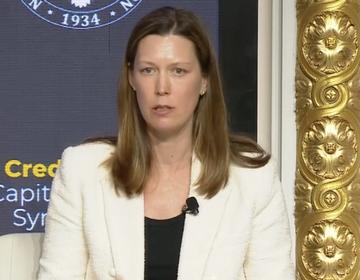
Leah Viault
Fay: For smaller institutions, how can credit unions use natural hedges to keep interest rate in check?
Viault: Depending on the tolerances of the management team, derivatives may not be appropriate. Historically, credit unions have used purchased assets and wholesale funding to position their interest rate risk and their balance sheet into a good position. I think that in the past few years we've learned that investment portfolio construction is extremely important, so we’re making sure that we're doing a lot of modeling around the cash flows that we're organically creating in our loan book. We’re having a good understanding for our members’ share accounts and making sure that we have a robust investment policy with a range of permissible investment securities that we can call upon to move our interest rate risk as needed.
A lot of our clients who came in the past few years with a lot of strong mortgage pipelines and a lot of fixed rate loans on the balance sheet had to move quickly to put the duration back into balance as rates started to move.
Certainly, taking out some wholesale funding was a great way to do that in a time when some of the traditional tools, like selling loans or selling securities to raise liquidity, was more challenging.
One Advantage for Smaller CUs
Hollis: The smaller credit unions are usually very well capitalized. We work with about 300 clients and the average size is about $4 billion, so we generally don't see a lot of the smaller credit unions, but I did have the fortune to talk to one smaller CU during the GAC and we discussed really focusing on the franchise value of their liabilities. Because they are smaller--they might have one SEG--they might be able to touch their membership a lot more. Remember, we talked about this effective duration mismatch. But the more sticky their deposits are, the more that they service a membership that is very loyal to them, that extends this effective duration. It actually allows us to model them as if you have a much greater unrealized gain. When rates rise they have the capabilities of doing that a lot more than maybe a very large credit union that has numerous SEGs.
I think that's very important, because that's the whole vision of the credit union industry is to take care of the members.
Staying Balanced
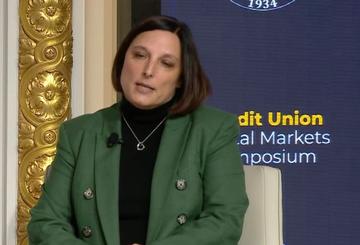
April Clobes
Clobes: I meet with our CFO every week. We're not over 100% lent out, but we're always in the 95%-98% range. We serve young people and we time things. In Michigan, people don't seem to shop for homes and cars when it’s cold, so we know how to time our investment maturities to match when we know we will have high loan demand.
We also work to make sure we don't have a concentration of specific loan types. We do a lot of mortgage lending, but we also then may set a target amount for what we're going to sell each month based upon volume so that we then have the liquidity to do auto loans and signature loans and other loans with different terms.
We really work to make sure that our total portfolio is in balance. I think that's what's important in having the liquidity.
One Last Thing
The last thing I would say is we communicate with the board on a regular basis on what the portfolio looks like and what targets we’re achieving, so if we have a month where we maybe sell a significant amount of mortgages, maybe our loan growth numbers are not 15-20% year over year because we've made a decision to purposely sell for liquidity. I think that's important because a lot of people make judgements based on how well they're doing by year over year growth, and I think sometimes we don't want to measure ourselves in that way.
That outlook for your organization may not be just how well did I do in my lending, because now there are all these other problems because they didn't manage pricing and don't have liquidity and so forth. I think it's really important for us to educate the board on how all the tools work together to create the best balance sheet for our organization.
Fay: Recently, all of our knowledge has been refreshed on how securities are accounted for and why that made a big difference in the Silicon Valley Bank situation. What advice do you give for accounting treatment for investments vs. risk management for investments?
Viault: We now know with 20/20 hindsight a lot was invested in longer-duration securities and our betas that the industry was modeling on that stimulus money was too low. The money started to flow out as a fiscal tightening took hold and the industry for the most part was left with a very large duration mismatch. Some institutions tried to solve that duration mismatch within an accounting solution, so they moved to value of those securities as HTM.
Credit unions that had the derivatives capability already in place or moved quickly to get one were able to directly offset the impact of that long duration on their investment securities portfolio with pay-fixed swaps and hedges either tied directly to the available-for-sale book or pointed towards pools of loans, which had a very similar impact of reducing asset duration. Some put hedges on the liability side to extend liability duration to again check down the balance sheet’s overall position.

Emily Hollis
I think when you use an interest rate hedge you're better aligning the true economics of your balance sheet with the investment securities and there's an accounting symmetry there, as well, in addition to moving the interest rate risk position to a more neutral stance.
We've seen credit unions use all of the different strategies that I've highlighted.
‘You’ve Got to be Disciplined’
Hollis: Without the use of derivatives, if asset duration extends the portfolio, the investment profile is the rudder that needs to be realigned. In order to realign it, if rates are rising there might have to be some accounting losses to take in order to shorten the portfolio and realign the duration.
You have got to be disciplined. I think that's the whole ALM issue: be disciplined about realignment. Sometimes, when the portfolio is realigned, whether it's to shorten duration or extend or to rebalance the portfolio because spreads have changed, you know take an accounting loss in order to go into a product that has wider spreads so it’s economically advantageous to the institution.
It's a little bit difficult to get across those concepts, but I encourage everybody to look at those concepts. Another thing is we suggest to most all of our clients is to put every investment in available for sale.
The Real Purpose of Balance Sheet
Clobes: Our organization is set up to make sure our balance sheet has the liquidity needed to serve members. We aren’t always chasing yield. We don’t look at how much further do I need to go to get a return, we look at how much do we need to do lending. That works for our organization.
We have a constant revolving door of loan demand. We know that every day if we put it out in loans it’s going to make more money than anything else I can invest in. Our goal is to utilize our balance to make loans. That is our number-one driver for the balance sheet. We keep money in investments and we have liquidity because it’s great way to manage and it’s necessary. But we have a different mindset. It has helped us during this time.