

NEW YORK–Credit unions should bifurcate their investment portfolios, think about liquidity every day and consider selling some of their offices under sales/lease-back arrangements, according to one panel here.
That advice for responding to liquidity shortages and other stresses in the current operating in the current landscape were shared during NCUA’s first-ever Capital Markets Symposium here as part of a discussion on liquidity risk management.

Wade Barnett
Sharing their insights during the panel were Wade Barnett, managing director and head of credit union financial services at Jeffries; Mary Beth Spuck, CEO at Resource One CU; Tim Bruculere, SVP at Alloya Corporate FCU, and Patrick Dwyer, VP at the Federal Reserve Bank of New York.
Here’s what each of the four had to say about addressing liquidity today and in the coming years:
Think About Purpose
Barnett: We advise credit unions to think about the purpose of that (investment) portfolio. What is the intended purpose? We have really advocated to our clients to bifurcate, so they have two distinct investment portfolios. Let's call them two buckets. They have a strategic liquidity bucket and they have a total return bucket.
The strategic liquidity bucket applies to any credit unit of any size. It's driven by your full balance sheet cash flows. How much you put in that bucket is largely going to be determined by your liabilities, by your balance sheet cash flows. You have to do a lot of analytics to look at those bonds, but you want bonds that are not going to have principal interrupted. So, you're not looking at a lot of step-ups, callables, or products like that. You're looking for products that pay monthly principal and interest, because you're managing to an outcome. The outcome you want is surplus liquidity, that you can either lend out or withdraw to reinvest right back into the same discipline.
Stop the Comparisons
Stop comparing yourself to your peer group based on yield. It is a huge trap, time and time again. Stop saying, ‘We’ll, this credit union is doing this.’ There's no data in a 5300 Report that tells you whether there's duration mismatches. So, get rid of that measurement. I think there are plenty of other ways to compare yourself to your peers without just looking at yield.
The one thing I would say from a liquidity risk management standpoint, is you look at your own portfolio and begin with the end in mind—how much excess liquidity do you want to supplement your balance sheet. Do I want $5 million a month, $10 million a month, $20 million a month?

Tim Bruculere
Survived Before & Will Survive Again
Bruculere: Credit unions survived the 21% interest rate period. They survived Y2K, 9/11… Credit unions at this point in time have more tools than they have ever had during all those other times. So, credit unions are going to survive and they're going to thrive during this period. But those 5% rates can sneak up on you when it's been zero for so long.
With 1,400 (Alloya) members we started getting line of credit increase requests. Where we would get four to five a month in the past, we were getting four to five a day. Credit unions started looking and seeing all that money go.
Our balance sheet went from about $6 billion to $16 billion during the initial rounds of stimulus and we decided it may go out as fast as it's coming in. We said, ‘Let's not invest in those Treasuries,’ even though that might give up a little income, because we are a liquidity provider our credit unions and they might need that money. We just kept it in cash and I think it benefited us because of those numbers I just gave you. Credit unions really needed funding.
Our advice remains simple to our members. Think about (liquidity) every day. Think about it when there's not a need for liquidity. Think about it when there is a need for liquidity. But maximize your sources of funding.
A Tool to be Used
Dwyer: The discount window is a tool that you should be familiar with and hopefully be ready to use if it makes sense. Many credit unions have already established access to the discount window with their local Reserve Bank and many credit unions use the discount window periodically. And it really should be seen as a complementary tool.

Patrick Dwyer
“We're available all the time to answer your questions and make you familiar with our programs and help you get set up, if you aren't already. The Federal Reserve really sees the discount window as a critically important tool to support the implementation of monetary policy to support financial stability—but also to support the banking system.
Perception of Weakness, But…
I know sometimes there's a concern, particularly with larger banks, that coming to the Fed and using the discount window can be seen as a sign of weakness. Maybe there are scenarios where that makes sense. But from the Fed’s perspective, our facilities are there to be used when needed. We grant loans on-demand, no questions asked for healthy institutions. I know there's also concern about public disclosures of use of the discount window. Since the global financial crisis and the passage of the Dodd-Frank Act, we are now required to disclose borrowing from the Fed. But, it's with a two-year lag. That information doesn't come out until two years after the borrowing.
We have set up a new program quickly in response to recent events called the Bank Term Funding Program. It is very similar to the discount window in many ways. Operationally, it's very similar. You just call up your Reserve Bank to utilize that facility in the same way, but it's got some important features that are targeted at recent events. The most important feature is that the set of collateral that it accepts is limited to treasuries and agency securities, including agency MBS. But more notably than that is how we treat that collateral. We will value the collateral at par and we don't apply any margins. So, we'll lend up to the full par value of those types of securities.
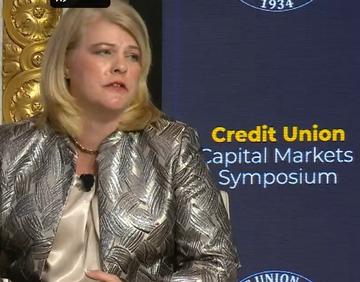
Mary Beth Spuck
Opportunity for a Capital Infusion
Spuck: There is about $60 to $90 billion out there that could be freed up by selling (some credit union) buildings and leasing them back. It's called a sales/leaseback opportunity. Because of accounting changes in 2022, credit unions are able to do this and be able to write that down to their capital—the difference between their depreciated value and what they sell it for. Think about if even 10% of the credit unions that are eligible to do this did this, that could release up to $6 billion to $9 billion back into the credit union environment to be able to loan back out to members. Or, they could also use it to purchase participation loans from other credit unions.
We could actually infuse the credit union movement with a tremendous amount of money. I'll give you an example of a credit union on the West Coast that did this last year. They sold their building for $59 million and they're depreciated value was just under $10 million. So, they were able to capitalize on a $50 million gain that they were able to take to their capital, which increased their capital by 75 basis points. That also gave them liquidity. It gave them money to be able to put back out into the community to member loans to be able to build up that that credit union. That's a tremendous amount of opportunity that you should take a look at.