

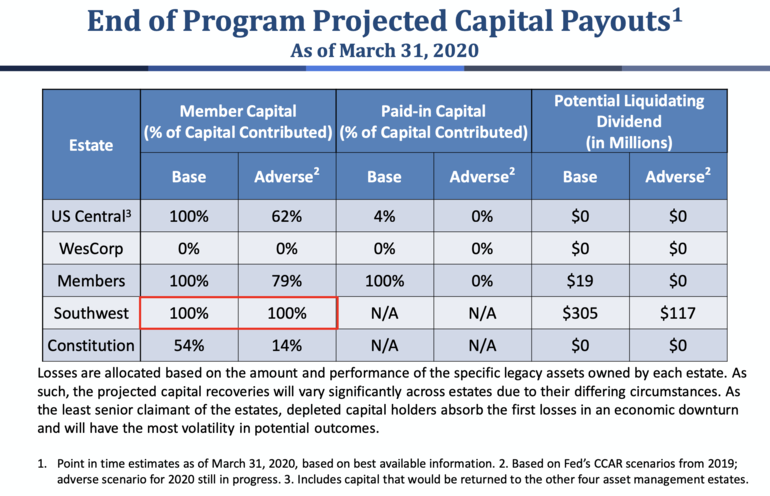
ALEXANDRIA, Va.–Credit unions that were members of the former Southwest Corporate FCU will receive a letter from NCUA within the next week notifying them of the amount they will receive from the distribution of the asset estate created after the defunct corporate was conserved following the financial crisis of a decade ago.
The update came during the NCUA board meeting at which a presentation on the NCUA Guaranteed Notes program and Asset Management Estates was shared.
Credit unions that were members of three of the four other corporates that were also conserved by NCUA—U.S. Central, Members United, and Constitution Corporate—will also likely be receiving distributions, but not until 2021. Credit unions that were members of the former Western Corporate FCU (Wescorp), the California-based corporate that was the largest of all corporates at the time it was shuttered, will not receive any distribution, as the assets underlying its estate have not sufficiently recovered.
Distributions to the approximately 1,000 former CU capital-holders in Southwest Corporate should see their respective funds via EFT sometime in July, according to agency staff.
As CUToday.info reported here, the mid-2020 and potential 2021 payouts are a long way from the formation of the corporate resolution program of a dozen years ago, and during the NCUA board meeting all three board members thanked numerous people, including their predecessors, for their work in getting credit unions to this point and helping to resolve one of the most challenging periods in credit union history.
All three board members have various relationships with the resolution of the failed corporates and the housing crash. NCUA Chairman Rodney Hood previously served on the NCUA board from 2005-09, seeing both the peak and the crash of the housing crisis. NCUA Board Member Mark McWatters has served on the board since 2014, including two years as chair, during which he joined with former board member Rick Metsger to wrap up the Temporary Corporate CU Stabilization fund, which paid our $735 million to credit unions. And NCUA Board Member Todd Harper worked on Capitol Hill during the financial crisis, including when former NCUA Chairman Michael Fryzel testified on the agency’s plans for the corporates.
The Long Decade
It’s been a long decade leading up to the payout to four of the five failed corporates. Early on, when credit unions were paying assessments to stabilize the system, there were projections the underlying assets—primarily mortgage-backed securities—would never recover, and credit unions would pay even heftier total assessments than the $5 billion they ultimately were forced to pay.
Indeed, NCUA Regional Director Keith Morton, who is also president of NCUA’s AMAC, which handles the asset management estates of the five failed corporates, noted that at the height of losses in 2009, there were projections losses could have exceeded $30 billion, and that was at a time when the entire NCUSIF stood at about $11 billion.
But those underlying legacy assets have recovered more quickly than many expected, as housing bounced back and was strong, at least up until the pandemic began. NCUA staff noted the “vast majority of losses have now been realized.”
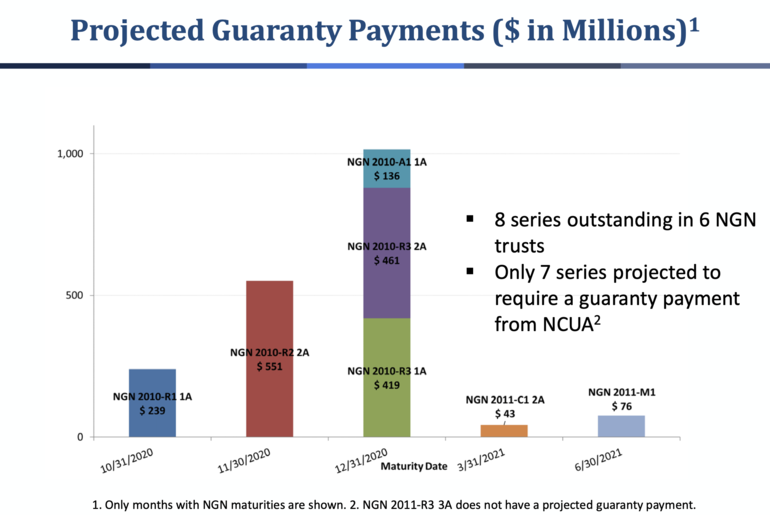
The remaining eight NCUA Guaranteed Notes series mature in the final quarter of this year and the first two quarters of 2021, with the last NGN deal maturing on June 12, 2021.
Nearly 3-Dozen Auctions
To date, NCUA said it has held 34 auctions of NGNs and 23 different broker/dealers have purchased legacy assets at fair value. Those auction represented 428 total bonds sold for approximately $2.8 billion in sales proceeds, at an average of about 7% above book price, NCUA said.
“The multifaceted corporate resolution program has been extremely effective at protecting the NCUSIF, reducing costs and allowing the agency to pursue legal settlements,” said Morton.
NCUA has recovered $3.8-billion following lawsuits against big Wall Street Banks (that figure is after paying out more than $1 billion in legal fees, as CUToday.info reported here.
The distributions being made to the depleted capital holders will only be paid after all senior priority claims have been fully paid or provided for and after some fiduciary cash is kept on hand.
Currently, only the Southwest Corporate estate now has sufficient fiduciary cash to conservatively provide for all future guaranty obligations and pay a meaningful amount of funds. Those 900 CUs that remain and that were membership capital holders will receive partial recovery –42% of $403.5 million of membership capital–or approximately $171 million.
In the report provided to the board, the projected value of assets and distributions that will be paid to capital-holders of the other three corporates is detailed and can be found here.
A ‘Success Story’
NCUA’s Hood said during the virtual board meeting the ultimate fate of the NGN and AME programs is a “success story,” and he praised former NCUA Chairman Debbie Matz among others.
“The credit union movement can be proud of its resilience,” said Hood. “And NCUA staff can take pride in efficiently managing these assets to maximize recovery.”
NCUA Board Member Todd Harper also praised all of the NCUA chairs who have been involved during the NGN program and corporate resolution, as well as the agency’s Larry Fazio and MarkTreichel, among others.
He noted that many had criticized NCUA for suing Wall Street over the quality of the MBS corporates had been sold.
“Initially, many said it would be fruitless to pursue the Wall Street firms, as they had never lost. NCUA became the first to sue and first to recover,” Harper said.
In all, the agency filed more than two-dozen complaints against more than 30 defendants.
‘Prescient Actions’
Similarly, NCUA Board Member McWatters praised all those who had contributed to the corporate resolution, saying “prescient” actions had been taken.
“During the financial crisis of 2008/2009, NCUA Chair Mike Fryzel worked to design and develop the policies and infrastructure of the NCUA Guaranteed Notes program and the mortgage-backed securities lawsuits that laid the cornerstone for these potential distributions,” said McWatters. “Without the NGN program and the MBS lawsuits it is unlikely that any of the recent past or projected distributions would occur. NCUA Chair Debbie Matz then worked diligently to further design, develop, and implement these policies, programs, and lawsuits.”
McWatters noted that during his own chairmanship, as well as under Chairman Rick Metsger (who was board member while McWatters was chair), he reminded the agency merged the Temporary Corporate Credit Union Stabilization Fund (TCCUSF) into the National Credit Union Share Insurance Fund (NCUSIF) thereby permitting, without premium assessment to any credit union, as well as the payment of nearly $900 million in distributions to credit unions, the funding of over $700 million in reserves for credit union losses, and the “dramatic improvement in the safety and soundness of the NCUSIF.”
“I wish to express my sincere thanks to my former Board colleagues and the NCUA staff (particularly Sarah Vega, Mike Radway, Steve Bosack, Mark Treichel, John Kutchey, Larry Fazio, Rendell Jones, and Keith Morton among many others) for their vision and wisdom in staying the course when others were calling for the agency to fire-sell the corporate assets and refrain from wasting time and resources on “frivolous” lawsuits. These so-called pundits were way off the mark,” said McWatters. “I am pleased that my tenure on the NCUA board has lasted long enough to witness the fruits of the labor of those who have come before me.”
NASCUS Response
In response, NASCUS President and CEO Lucy Ito said, “We commend NCUA for the transparent and prudent manner in which it is distributing funds to Southwest capital holders. The agency was also very clear in describing the process it will undertake to determine additional future interim distributions.”