ALEXANDRIA, Va.–Following an update on the state of the National Credit Union Share Insurance Fund, one NCUA board member said CUs need to brace themselves for a future premium assessment, while another board member said if some people had had their way any such premium would have been even larger.
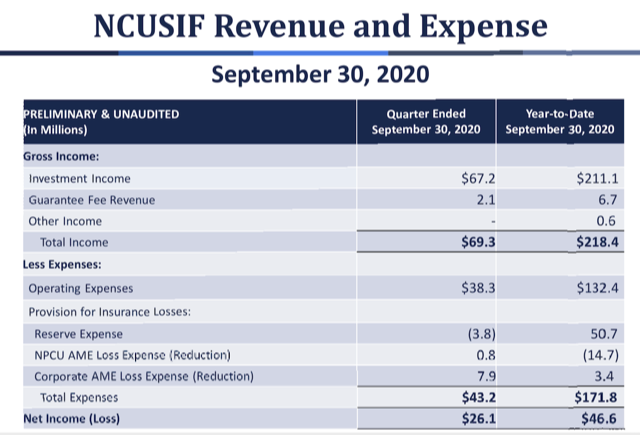
The update on the state of the insurance fund was provided by NCUA CFO Eugene Schied, who reported the fund closed the third quarter with net income of $26.1 million, bringing net income year to date to $46.6 million.
Overall performance can be seen in the chart, below.
As of Sept. 30, total assets in the NCUSIF stood at $19.2 billion, up from $17.6 billion as of mid-year.
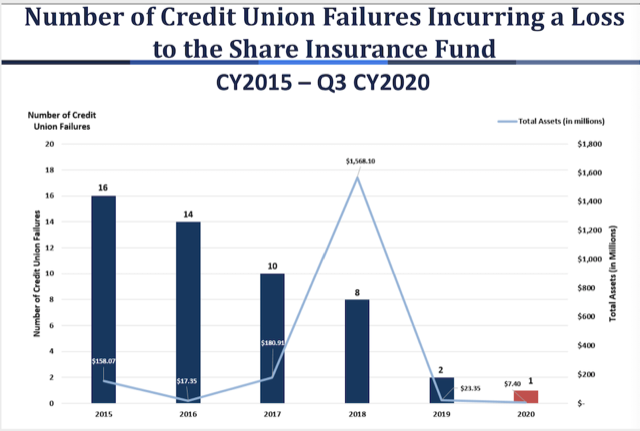
Through the third quarter of 2020 there has been just one credit union failure that caused a loss to the fund, an involuntary liquidation due to fraud, a cost of $1.2 million.
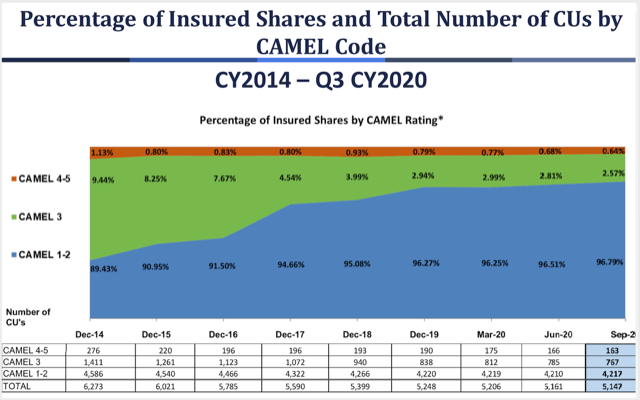
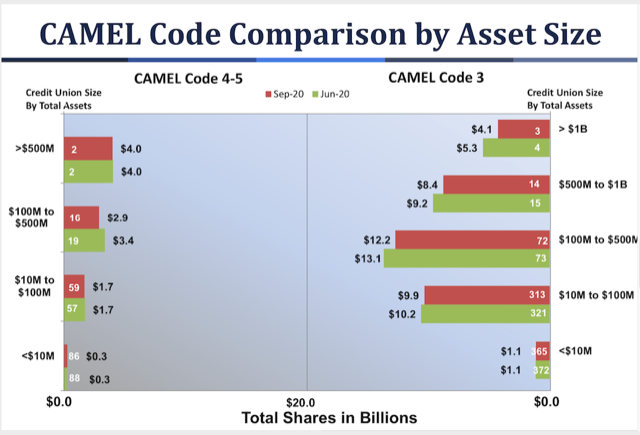
As of June 30 the NCUSIF equity ratio is at 1.22%. The equity ratio will next be updated at yearend. NCUA also updated the percentage of insured shares and total number of CUs by CAMEL code, as shown below.
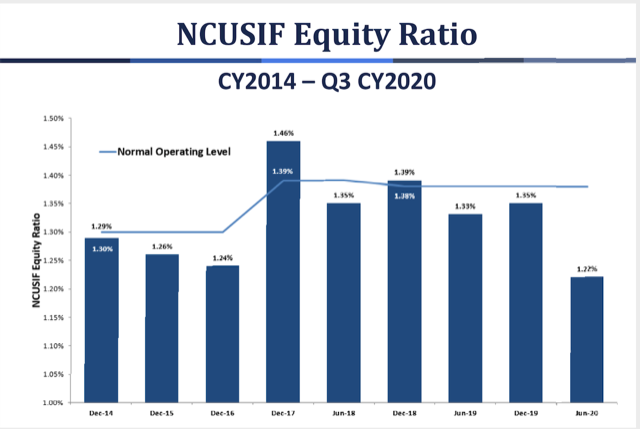
Asked by NCUA Chairman Rodney Hood about the 1.22% equity ratio, Schied said the updates are only reported twice each year, and a formal update on the equity ratio will not be provided until end of year.
Premium is Coming
NCUA Board Member Todd Harper said the continued economic uncertainty due to the pandemic means credit unions must prepare for increased delinquencies, loan defaults, business and personal bankruptcies and even failed CUs.
“It seems likely we will see higher than average failures over the next two years,” said Harper. “We also know growth in credit union assets will continue to exceed the ability of the NCUSIF to earn interest for the next few years, so it appears the equity ratio will continue to decline. It’s not a question of whether we will charge a premium, but a matter of when. Credit unions need to brace themselves for that eventual reality.”
Harper asked NCUA’s CFO how much less, as a result of declining interest rates, he anticipates the fund will earn in interest assuming the fund remains at $19.2 billion.
Schied said in looking at different scenarios, should rates remain low through 2023, quarterly income could fall between $25 million-$35 million per quarter in a 1% averaged weighted return.
“We should expect to earn much less than we have in the past. Is that the case?” Harper asked.
Yes, responded Schied.
When must the NCUA charge a share insurance premium? asked Harper. Scheid said it would have to be considered if the equity ratio falls below 1.2% or is projected in the near term to fall below 1.2%.
Harper expressed concern about charging for a premium during a pandemic, and said he’d like to see greater reserves set aside during good times to prevent scenarios such as that CUs are likely to face in the next few years.
McWatters' Comment
NCUA Board Member J. Mark McWatters said he remains focused on the equity ratio, including the potential decrease in the numerator of the equity ratio fraction caused by COVID-19 related and other credit union losses and failures, and the continuation of the low interest rate environment.
Noting the two issues may not reverse by the end of 2021, McWatters called for a modification of NCUA’s policy so as to “present to the credit union community and other members of the public a transparent calculation of the equity ratio each month with a detailed analysis of both the numerator and denominator of the fraction. The public dissemination of this information is of particular relevance as the COVID-19 pandemic rages and the resulting stresses on the credit union community and the NCUSIF continue.”
McWatters further called on NCUA to work with all constituencies of the credit union community to address the related issues in a transparent manner “so as to mitigate the need for future premium assessments, particularly during the period in which credit unions are operating with the negative economic consequences of the COVID-19 pandemic,” the consequences of which may not be fully realized until early 2021 or later.
A Mistake Avoided
McWatters said current conditions make clear that earlier calls by some to lower the equity ratio, which were rejected by the board when he was serving as chairman, would have been a mistake.
“It is worth noting, again, that the Normal Operating Level and equity ratio both equaled 1.39% following the merger of the Temporary Corporate Credit Union Stabilization Fund into the National Credit Union Share Insurance Fund,” said McWatters. “At that time, some advocated for the NCUA to set the Normal Operating Level at or below 1.30% and distribute funds so as to drive the equity ratio down to that level. Some even spoke of setting the Normal Operating Level and equity ratio at, or much closer to, 1.20%. If the board had voted to follow that approach, the equity ratio would surely have fallen to well below 1.20% by now with the heightened likelihood of material credit union premium assessments.”
‘Prudent’ Move
McWatters said the creation of a “prudent safety net reserve” has worked to protect credit unions.
“If assessments are nonetheless required, the safety net reserve should lessen the blow,” said McWatters. “These reserves were designed and implemented to protect against adverse consequences arising from credit union losses and failures, economic downturns, unknown unknowns, and Black Swan events such as the COVID-19 pandemic. It’s fortunate that the reserves have been available to the agency and the credit union system during the pandemic.”