

ALEXANDRIA, Va.– Differences in how credit unions performed by state can be seen in the latest Quarterly U.S. Map Review from NCUA, with Oregon and Nevada leading the way in asset growth, while assets grew least in Washington, D.C. and Arkansas.
Overall, federally insured credit unions experienced double-digit asset and share-and-deposit growth over the year ending in the fourth quarter of 2020.
But as has been the case with other data on overall CU performance, the numbers are significantly influenced by the stronger performance of larger credit unions.
Nationally, median asset growth over the four quarters of 2020 was 14.2%, compared to 2.8% during 2019. Median growth in shares and deposits during 2020 was 15.9%, compared to 2.6% during 2019. The median total delinquency rate among federally insured credit unions at the end of 2020 was 51 basis points, compared to 66 basis points at the end of 2019. Additionally, 83% of federally insured credit unions had positive net income in 2020, compared to 88% in 2019, NCUA said.
The NCUA’s Quarterly U.S. Map Review tracks performance indicators for federally insured credit unions in all 50 states and the District of Columbia and includes information on two important state-level economic indicators: the unemployment rate and home prices.
The NCUA Quarterly U.S. Map Review is based on year-over-year data analysis.
Here’s a look at how credit unions performed by category and state:
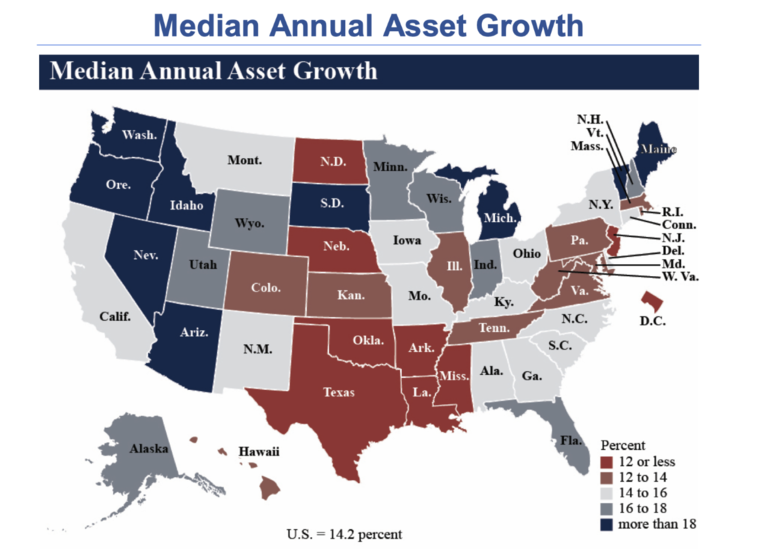
Median Annual Asset Growth
- Nationally, median asset growth over the year ending in the fourth quarter of 2020 was 14.2%. In other words, half of all federally insured credit unions had asset growth at or above 14.2% and half had asset growth of 14.2% or less, NCUA reminded. In the year ending in the fourth quarter of 2019, the median growth rate in assets was 2.8%.
- Over the year ending in the fourth quarter of 2020, median asset growth was highest in Oregon (21.4%) and Nevada (20.3%).
- At the median, assets grew the least in Washington, D.C. (7.5%) and Arkansas (8.8%).
Median Annual Share & Deposit Growth
- Nationally, median growth in shares and deposits over the year ending in the fourth quarter of 2020 was 15.9%. In the year ending in the fourth quarter of 2019, the median growth rate in shares and deposits was 2.6%.
- Over the year ending in the fourth quarter of 2020, median growth in shares and deposits was highest in Oregon (23.1%) and Vermont (22.3%).
- At the median, shares and deposits grew the least in Washington, D.C. (8.6%) and Arkansas (10.5%).
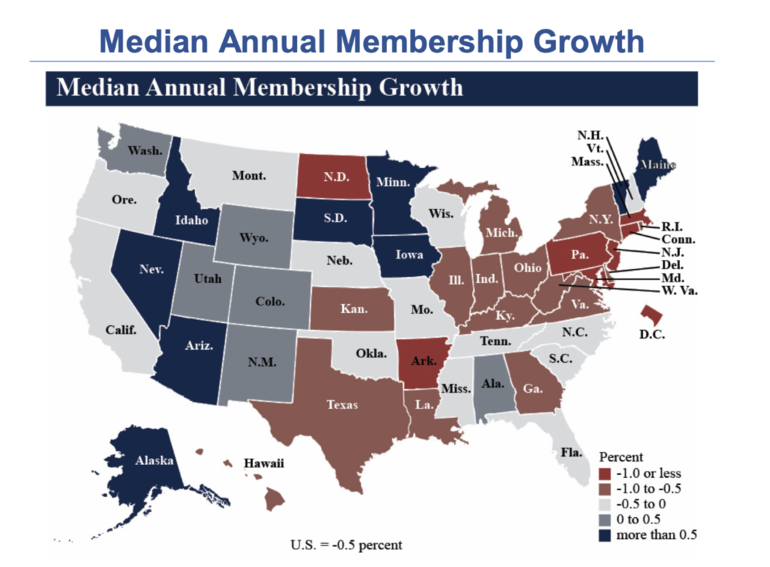
Median Annual Membership Growth
- While overall membership in federally insured credit unions continued to grow during the year ending in the fourth quarter of 2020, at the median, membership declined 0.5%. Membership was unchanged at the median over the year ending in the fourth quarter of 2019. Overall, 56% of federally insured credit unions had fewer members at the end of the fourth quarter of 2020 than a year earlier. Credit unions with falling membership tend to be small, NCUA noted, pointing out 65% had less than $50 million in assets.
- Over the year ending in the fourth quarter of 2020, credit unions headquartered in Alaska (3.7%) and Idaho (2.3%) posted the highest median membership growth rates.
- In 31 states and Washington, D.C., the median membership growth rate for federally insured credit unions was negative. At the median, membership declined the most in New Jersey (-2.4%) and Massachusetts (-1.4%).
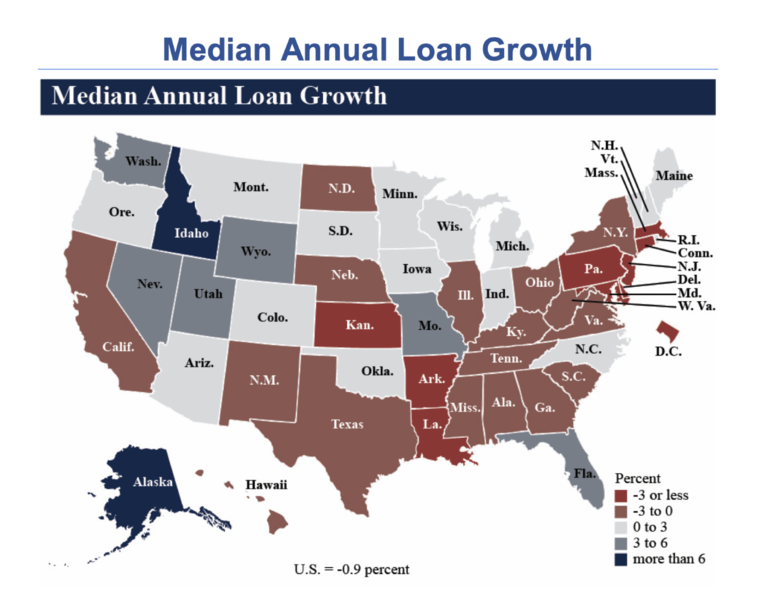
Median Annual Loan Growth
- Nationally, loans outstanding declined 0.9% at the median over the year ending in the fourth quarter of 2020. During the previous year, loans grew by 3.1% at the median.
- Over the year ending in the fourth quarter of 2020, median loan growth was strongest in Alaska (7.2%) and Idaho (7.0%).
- In 25 states and Washington, D.C., the median loan growth rate for federally insured credit unions was negative. At the median, loans outstanding declined the most in New Jersey (-8.1%) and Delaware (-6.2%).
Median Total Delinquency Rate
- At the end of the fourth quarter of 2020, the median total delinquency rate among federally insured credit unions was 51 basis points, compared to 66 basis points in the fourth quarter of 2019.
- At the end of the fourth quarter of 2020, the median delinquency rate was highest in New Jersey (121 basis points) and Vermont (85 basis points).
- The median delinquency rate was lowest in Rhode Island (21 basis points) and Oregon (22 basis points).
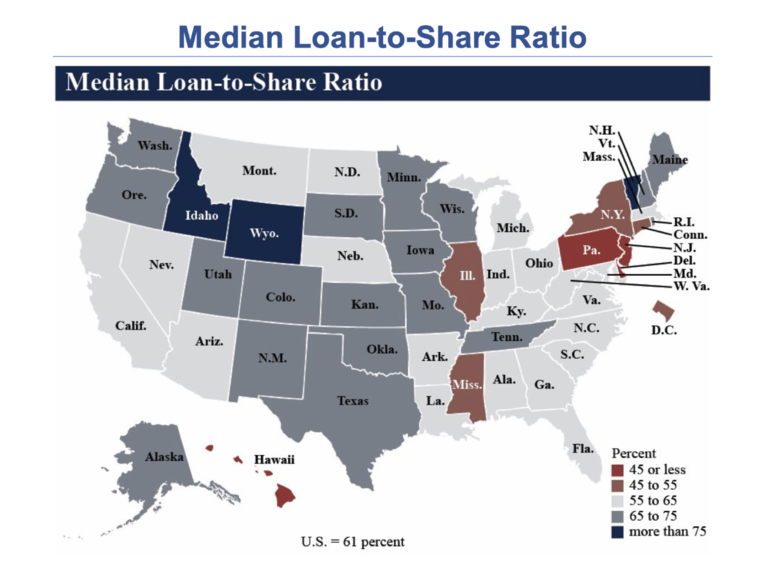
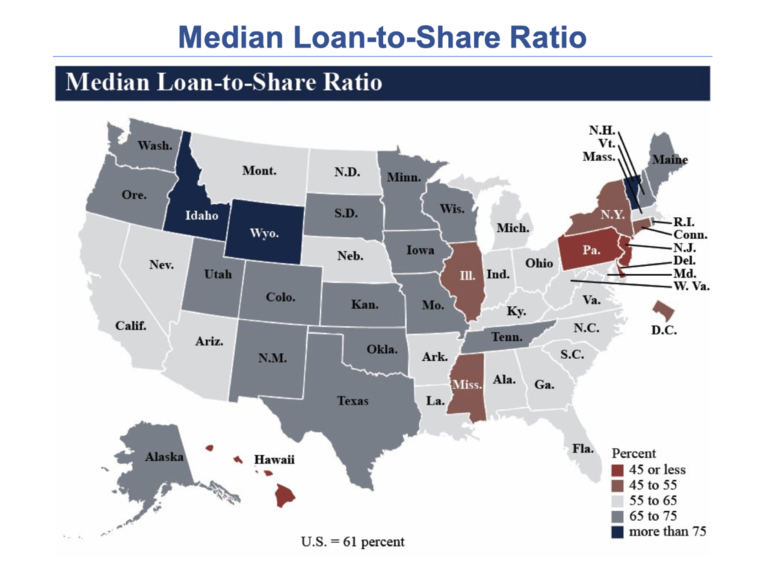
Median Loan-to-Share Ratio
- Nationally, the median ratio of total loans outstanding to total shares and deposits (the loan-to-share ratio) was 61% at the end of the fourth quarter of 2020. At the end of the fourth quarter of 2019, the median loan-to-share ratio was 71%.
- The median loan-to-share ratio was highest in Idaho (78%), followed by Vermont and Wyoming (both 77%).
- The median loan-to-share ratio was lowest in Delaware and New Jersey (both 43%), followed by Hawaii and Pennsylvania (both 45%).
Median Return on Average Assets
- Nationally, the median return on average assets at federally insured credit unions was 40 basis points in 2020, compared to 60 basis points during 2019.
- Idaho (86 basis points) and Utah (71 basis points) had the highest median returns on average assets during 2020.
- Washington, D.C. (17 basis points) and New Jersey (18 basis points) had the lowest median returns on average assets during that time.
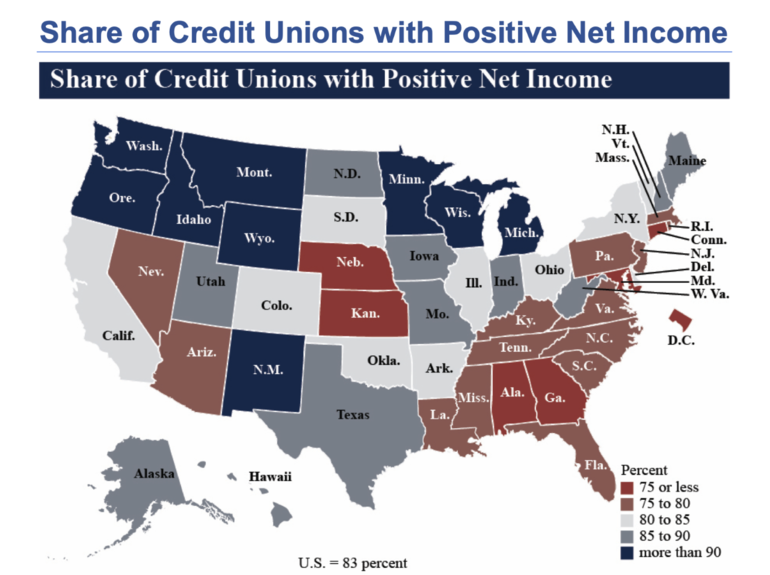
Share of Credit Unions With Positive Net Income
- Nationally, 83% of federally insured credit unions had positive net income in 2020, compared to 88% during 2019.
- At least 65% of credit unions in every state and Washington, D.C. had positive net income during 2020.
- The share of federally insured credit unions with positive net income was highest in New Mexico and Washington (both 98%), followed by Montana and Oregon (both 96%).
- The share was lowest in Kansas (69%), followed by Connecticut and Maryland (both 70%).