

ALEXANDRIA, Va.–NCUA staff provided greater detail around what the agency is proposing with its 2023-2024 budgets, and then responded to questions from all three NCUA board members during the agency’s budget briefing here.
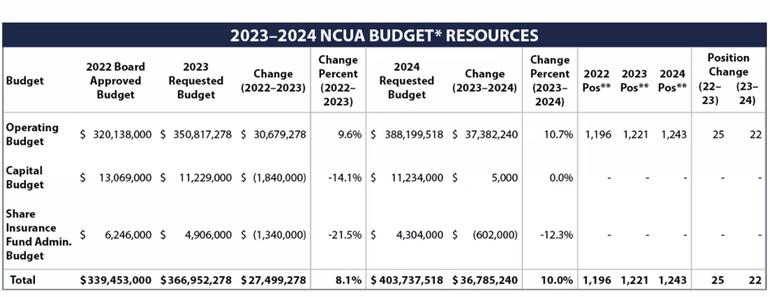
As CUToday.info has been reporting, NCUA earlier announced a proposed combined 2023 staff draft budget of $367.0 million, an 8.1% increase from the 2022 staff budget. NCUA’s proposed operating budget is $350.8 million, which is 9.6% higher than in 2022.
The proposed 2023 capital budget is $11.2 million, or 14.1% lower than in 2022. The proposed Share Insurance Fund administrative budget is $4.9 million, or 21.5% lower than in 2022, NCUA said.
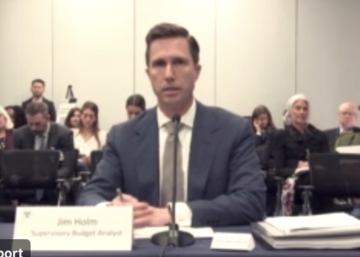
Jim Holm
Providing the staff presentation was Jim Holm, director of budget and performance in the Office of the Chief Financial Officer.
The key themes in the proposed budget, according to Holm:
- Specialized examination and analytics staff both in the field and at headquarters dedicated to areas of emerging complexity and risk
- Expanded and ongoing efforts to ensure robust cybersecurity
- Resources for NCUA’s Advancing Communities through Credit, Education, Stability and Support (ACCESS) initiative
- Additional staff for continued enhancements to NCUA’s fair lending program
- Critical investments in new information technology systems and infrastructures to its data reporting services and Model Examination and Risk Identification Tool (MERIT)
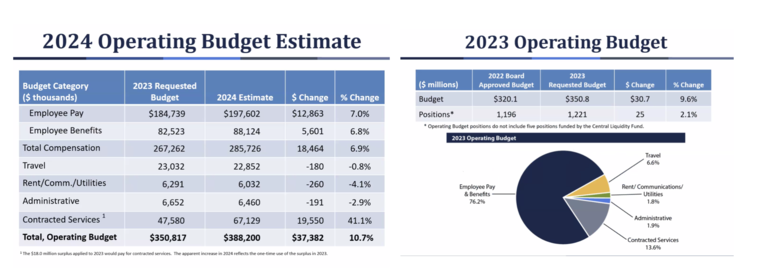
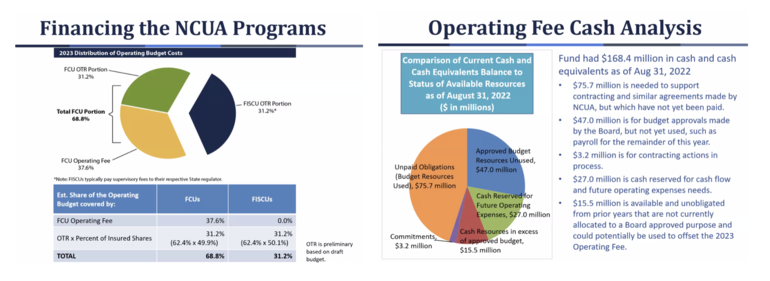
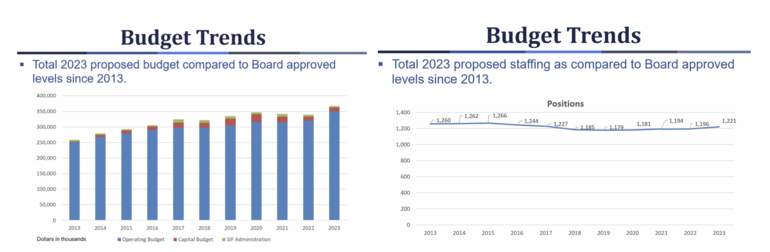
Holm outlined the 2023 Operating Budget broken out as shown in the slide. Three quarters of that budget is for employee pay and benefits, and the agency is proposing an increase of $12.9 million in compensation, a 5.1% increase.
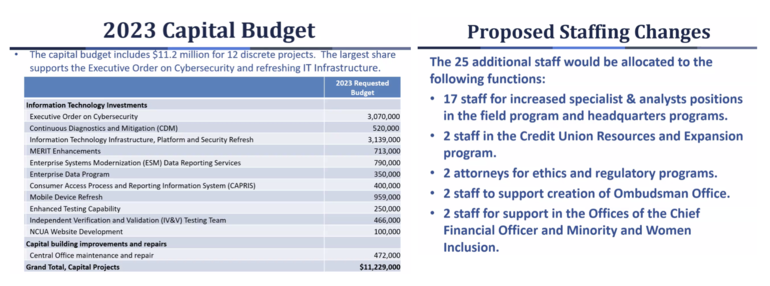
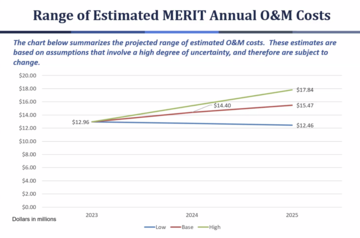
Calling it a “backbone for NCUA operations,” Holm outlined the range of increased costs for MERIT, as seen in the slide below. He added some of the increase in costs comes with the “specialized expertise” the agency needs related to the system.
Holm further outlined the proposed 2024 budget, as seen in the charts below.
Holm then participated in a Q&A with members of the board members. Here is a look at some of what was discussed:
NCUA Board Chairman Todd Harper: We have gotten a lot of questions about contracted services; how will that benefit credit unions and their members?
Holm: Like all organizations, the economic pressures in the economy right now are impacting our budget across the board. We see that in contracted services most directly. Our budgetary growth from 2018 through the draft 2023 budget is actually lower than the rate of inflation over the past five years. We are seeing that inflation in contracted services in prices for the products we purchase, for increased costs of labor, increased costs for shipping and supplies. There are three contracts that contribute a significant share to the 2023 budget growth: the maintenance of the MERIT system, the budget for cybersecurity and the highly skilled labor that delivers that kind of cybersecurity support, and for our national conference in 2023 in lodging and event space costs.
What is the benefit to credit unions? Contracts allow NCUA to purchase goods and services from the private sector that we shouldn’t be producing ourselves so that we can focus on our mission.
Harper: With at least a $3 million increase, I’d like to focus on cybersecurity. We received a letter from a credit union wanting more details on how that aligns with the executive order on cybersecurity. What is required by the executive order?
Holm: It is a significant part of our budget. The executive order will be implemented in phases over the next few years. It’s a pretty big lift. The goal is to prevent, protect, assess and remediate any cyber-event that might happen. The Goal is to strengthen our cyberdefenses at the agency. It’s defensive, but also in anticipation of a bad day and limiting the impact.
Harper: What about extending the exam schedule? Currently, we have set that threshold at $1 billion, but some have asked us to raise it to $3 billion. Could you talk about this exam threshold and the tradeoffs we should consider?
Larry Fazio: The $3 billion level comes from the level set by Congress for the FDIC. When you think about it in the context of the relative risk, the relative size of their fund versus the size of our fund. The FDIC fund is about six times larger than our deposit insurance fund. The retained earnings in their fund are about 26 times larger than the retained earnings in our fund. Their fund is funded almost entirely by banks paying premiums. Ours is largely funded by the 1% deposit by credit unions. When you think about six to 26 times larger, if you did the math, what would the equivalent be for us? And that’s just one way of looking at it. You’d be looking at a range of $118 million to $517 million. So, we are already considerably higher. That’s just one context.
Yes, it is relatively more risky, but what is cost/benefit tradeoff to the share insurance fund, which is more complicated? If we extended exams to the $1-$3 billion cadre, you’d be looking at a net decrease of needed examiner positions of roughly 24, which translates into roughly $4 million in annual budget impact. The potential cost to the share insurance fund is really a function of the probabilities…Just for context, if a $1-$3 billion CU fails, you’re looking at an expected cost of $400 million to $1 billion to the SIF.
NCUA Vice Chairman Kyle Hauptman: Of the proposed examination hires, how many are core functions?
Holm: In the 25, we have 17 who we think are critical analytics staff. Two more positions are proposed for CURE that are related to our objectives, and there are six mission support positions in the budget, all in headquarters. Ten of those positions would be in the regions.
Hood: We should be asking ourselves, when credit unions move to ONES supervision, what staffing changes should be made to reflect this reality other than just adding new staff?
Holm: The 2023 budget puts on-budget one staff position in ONES that the board previously approved. When we develop the examiner workload budget, we account for credit unions that grow to a size that they fall under ONES supervision by reducing field examination hours and increasing workload hours in ONES. Effectively we are not adding new staff when ONES takes over supervision and examination of a large credit union.
However, when credit unions reach the threshold for supervision by ONES, the NCUA’s supervision and examination activity for those large credit unions’ operations increases because of this complexity of those credit unions’ operations and the systemic risk that they present. Thus, credit unions falling under ONES supervision marginally increases the total agency workload, and results in a marginal increase in the overall staff levels required for supervision and examination.
NCUA Board Member Rodney Hood: A couple of the positions proposed result from building out an independent ombudsman office. Do credit unions take advantage of the ombudsman office now?
Holm: Yes, credit unions do currently take advantage of the Office of the Ombudsman, primarily as a resource to obtain information about agency resources, programs, or policies. Since the beginning of 2022, the Office of the Ombudsman has corresponded with over 250 credit unions through phone call and email inquiries, information requests, and responses to the post-exam survey. Credit unions often contact the office to request information about chartering, field of membership, MERIT, FOIA processes, consumer complaints, and other published guidance. Some credit unions also contact the office for its other functions – such as confidential feedback about agency processes, exam problem resolution, and post-exam surveys.
Hood: Of the 25 new positions called for in this budget, how would management plan to fill 25 new positions when there are numerous vacancies already throughout the field program that are impacting the completion of the exam and supervision program? How many vacancies exist now? If we added 25 new positions, what is the plan to get those filled next year?
Holm: You are correct, there are currently numerous vacancies at the agency, in part because of the tight market for skilled and qualified knowledge workers that the NCUA recruits. As of Sept. 24, there were 53 vacant positions within NCUA.
To fill current vacancies and new positions in 2023, we plan to prioritize recruiting for field and analytical positions, which are more than half of the 25 new positions proposed in the 2023 budget. We have a two-year implementation plan for many of the specialist positions, and will continue building out our hiring efforts for these important new positions through 2024.
This year, the Office of Human Resources has instituted process reforms and engaged more directly with hiring offices to reduce the time to hire new employees, particularly credit union examiners. We are also increasing our marketing and recruiting outreach, and the 2023 budget supports a coordinated recruiting effort between OHR and OMWI to reach a wider audience of potential employees. These efforts have begun to show results this year, and our rate of on-boarding of new staff has increased since the start of 2022. We plan to continue these efforts next year, which we expect will enable the agency to reduce the vacancy rate substantially.
Hood: A large driver of expenses next year are the operations and maintenance of the MERIT platform. When MERIT was conceived, was the board, before our time, informed that the expenses would be this high for Operations and Maintenance on a yearly basis?
Holm: We have been looking at MERIT over a few years. We are happy with the initial performance of the program. Our Initial estimates for MERIT operations and maintenance were based on a preliminary project scope, and have proved to be higher than originally anticipated.
The functionality for the MERIT system is broader since first developed. The system now includes an integrated business intelligence tool, an ingest tool for loan and share data, an application for state supervisory authorities and credit unions to manage their users, and increased cybersecurity features to protect data and meet executive order requirements.
Those are some of the drivers of why the budget is higher than the original estimates.
(Holm said the agency is projecting the annual operating and maintenance costs of MERIT to range between approximately $12.5 million to $17.8 million over the next three years.)
Hood: Last year, we budgeted examiners hours for the regions to work with small credit unions. I viewed this as a trial program. When will we know if this effort had its intended effect?
Holm: We did program in additional hours for the small credit union program. Those projects are underway and can take a longer time to show a particular return on investment. The regions are closely monitoring how examiners are using the hours budgeted to support and advise small credit unions and are seeing the regions step up the hours on a monthly basis. I don’t have specific answers yet, and we can set up a briefing with you about the specific findings and success stories.