

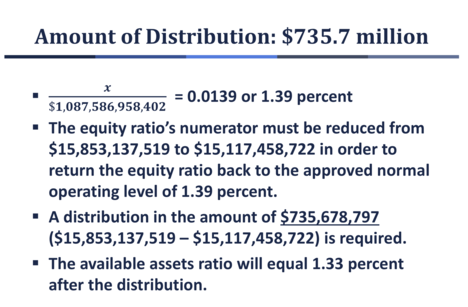
ALEXANDRIA, Va.–In what was referred to as a “historic day” that “no one thought would ever come,” the NCUA board has voted in favor of making an equity distribution to credit unions from the NCUSIF of $735.7 million to be paid in the third quarter of this year.
The payout reflects excess funds in the National Credit Union Share Insurance Fund following the 2017 merger with the Temporary Corporate Credit Union Stabilization Fund, created nearly a decade ago to hold special assessments on credit unions following the failure of five corporate credit unions during the financial crisis. The payout is not a “rebate” of those assessments, which have been spent, both NCUA board members emphasized during their remarks.
Credit unions will be able to determine how much they will individually receive on a pro rata basis using an online calculator NCUA will be unveiling later this year.
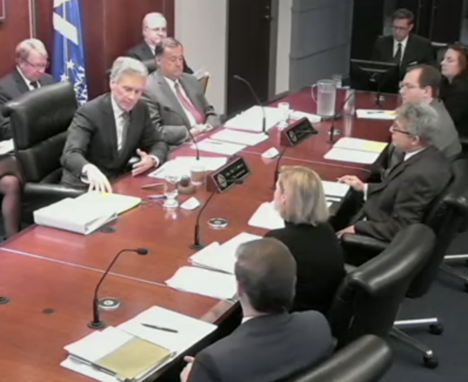
NCUA staff speak to board at meeting.
All of this is taking place following decade of anger by some over having to pay for corporate failures, uncertainty over what might lie ahead, and more recently, divided positions by the credit union trade groups on whether such a payment should occur, with additional arguments by some analysts that credit unions are settling for a fraction of what they could receive.
In a statement following the vote, CUNA CEO Jim Nussle said ““We are closely reviewing the details of NCUA’s plan for share insurance fund equity refunds for credit unions in 2018.”
Meanwhile, Dan Berger, CEO of NAFCU, which opposed the payment plan, said, "While we are grateful credit unions will get some money back soon, NAFCU will continue to aggressively fight for credit unions to get all their money back, not just the small portion they're due to receive."
For additional coverage on the trade group response, see separate story on CUToday.info.
Officially, the board approved the final rule to amend part 741 to clarify the calculation methodology for NCUSIF equity distributions and to create a temporary provision to govern NCUSIF equity distributions related to the Corporate System Resolution Program. The agency said the additional purpose of the final rule is to give stakeholders greater clarity around the distribution.
Who's Eligible
According to NCUA, the credit unions eligible for payouts include:
- Active federally insured credit unions as of Dec. 31, 2017
- Newly chartered federally insured credit unions that filed at least one call report for a reporting period in 2017
- Financial institutions that converted to federal share insurance during 2017, provided they filed at least one call report as a federally insured credit union for a reporting period in 2017
- Credit unions that converted to private insurance, provided they filed at least one call report as a federally insured credit union for a reporting period in 2017
- Liquidation estates, provided the liquidated credit unions filed at least one call report as federally insured credit unions for a reporting period in 2017
When NCUA Chairman J. Mark McWatters announced in 2017 that funds could be returned to credit unions as early as 2018, it came as a surprise to many in the credit union community, after the agency had long maintained that no payout would occur until at least 2021, at the earliest. But legal recoveries against banks and brokerages that sold failed investments to corporate CUs ($5 billion to date minus $1 billion paid to attorneys) plus increasing values of underlying securities held by NCUA accelerated the timeline of such a payout once the two funds were merged.
But NCUA discovered that while the Federal Credit Union Act includes language about making equity distributions from the NCUSIF, as it has done on several previous occasions, the Act is largely silent on the methodology to be used in making such a distribution, leaving the board with a great deal of leeway.
The lack of language on the methodology shouldn’t surprise anyone, said McWatters.
“I suspect that at the time no one realistically thought this day would be here, that there would be $4 billion in recoveries or that underlying securities would recover,” said McWatters.
Following a proposal put out for comment in 2017, NCUA said it received 50 comments, most of which were strongly supportive of greater transparency and which overwhelmingly favored a quarterly average approach in the methodology when it comes to determining the pro rata amounts, according to NCUA staff.
The only minor point of disagreement between McWatters and board member Rick Metsger had to do with payout to formerly federally insured credit unions that converted to private share insurance. McWatters called it a matter of “inherent unfairness” that any privately insured credit union that did not file a call report with NCUA during 2017 would not qualify for a payment even though it paid into the corporate resolution fund. But Metsger, calling it “rough justice,” noted there is only one such CU affected. Another CU that converted to private share insurance in 2017 did file one call report and will be eligible for a payment.
Maybe Not Fair to All, But Still the Best
Other aspects of the rule may not be fair, as well, said Metsger, but they are the best that can be expected.
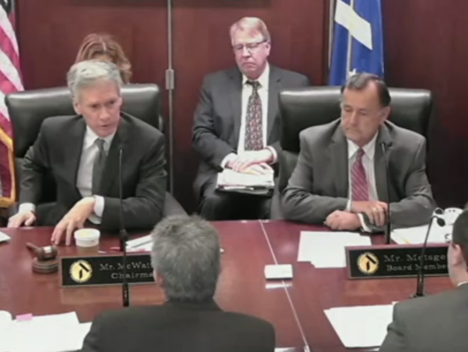
J. Mark McWatters, left, and Rick Metsger at board meeting.
“Winston Churchill said democracy isn’t perfect, and the same can be said for this rule. It isn’t perfect, but it is better than others,” said Metsger. “While this final distribution will make a number of changes, it provides for a special temporary rule for distributions in 2018 for the proportion of insured funds (a credit union) held for a look-back period. There will be a 36 quarter, or nine-year, look-back, and that will occur each year. It is longer than the four-quarter average for any distributions in 2022 and subsequent years. So this is rough justice, takes into account insured shares after the merger, not before. Under the law that is the only look-back we can do.”
Overall, summed up Metsger, “I will not allow the perfect to be the enemy of the good.”
Responding to some of the questions he has received since the equity distribution was announced last year, McWatters congratulated the agency for what it has been able to do, which he said includes writing out a $700-million check to credit unions with an NCUSIF premium charge of “zero,” all the while also adding to reserves for potential losses and maintaining the equity ratio of the NCUSIF.
“I’ve heard credit unions say, “Instead of paying out the $735 million, why don’t you pay out everything above 1.30, or even set the NCUSIF Normal Operating Level below 1.30 and pay out even more, and if we get into trouble we’ll write checks later?” shared McWatters. “Speaking for myself, the problem with that is we are stewards for the share insurance fund and the taxpayers. We cannot just come up with arbitrary numbers. The NOL is established through objective analysis. That netted an awkward NOL of 1.39, so it made no sense to have a NOL any lower than that. Is there anything in the FCU Act that mandates those extra funds in the NCUSIF be returned to those credit unions? No, there is not.”
An Historic Day
For his part, Metsger added, “This is a historic day and a historic distribution and also a day we never thought would come. And some, as recently as last fall, didn’t want to come. This distribution is historic because at nearly three quarters of a billion dollars it is nearly 15 times larger than the last distribution of $52 million in 2007. It is larger than the cumulative amount of all previous distributions to credit unions since the capitalization of the NCUSIF. To best of my knowledge it is the only fund to make a payment to insured institutions. When you add the $736 million credit unions will receive to the more than $1.3 billion in premiums they will avoid, the total is more than $2 billion. This is a huge benefit to credit unions and a lot of money for provident and productive purposes.
“The check may not be in the mail yet, but it’s on its way,” Metsger added.
In response to a comment also made by Metsger, McWatters said, “You said bipartisan and then you said non-partisan. That is so true. You and I talk together, we work together. No one is wearing an R hat or a D hat here. We are trying to get the best result for the credit union community.”